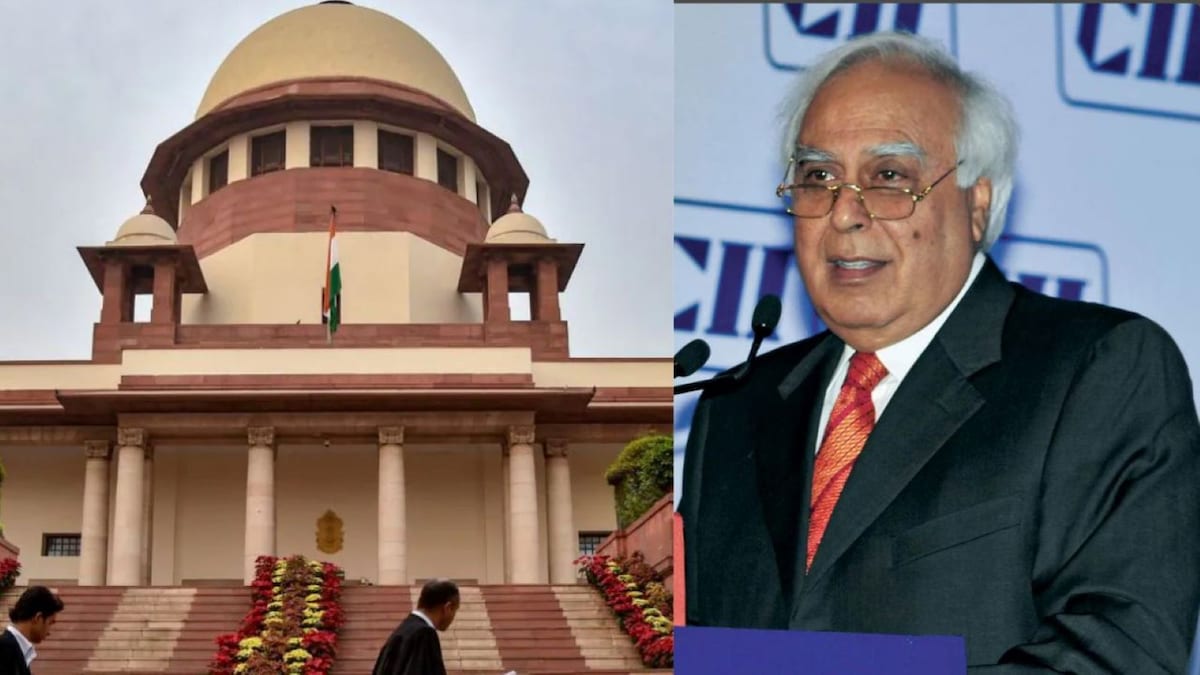
The petition arises amid ongoing political realignments, with legislators from the Aam Aadmi Party (AAP), Trinamool Congress (TMC), and Shiv Sena (UBT) joining other parties. Sibal has cited pending cases, including the Shiv Sena (Uddhav Balasaheb Thackeray)’s challenge regarding the approval of the merger of some of its MPs with the Shinde-led Shiv Sena.
Why has Kapil Sibal approached the Supreme Court?
In his petition, Sibal argues that the current interpretation of the Tenth Schedule enables splinter groups to escape disqualification via political party mergers. The matter was brought up before a Bench of Chief Justice of India (CJI) Surya Kant and Justices Joymalya Bagchi and V Mohana on Wednesday morning.
In seeking urgent listing, Sibal pointed out that the petition raises the question of whether the composition of Parliament can evolve in the “manner currently witnessed in this country and the interpretation of the tenth schedule paragraph 4 in this context.”
“What is happening in this country? If this continues, the 10th Schedule (of the Constitution of India) will become essentially moot… There is another plea listed (UBT Sena),” Sibal was quoted as saying by Bar and Bench. The Supreme Court has agreed to list Sibal’s petition.
What is the Tenth Schedule?
The Tenth Schedule, known as the anti-defection law, was introduced into the Constitution via the 52nd Constitutional Amendment Act in 1985. It outlines provisions for the disqualification of legislators on the grounds of defection.
This law applies to members of Parliament and state legislatures as per Articles 102(2) and 191(2) of the Constitution.
When can a legislator be disqualified?
The Tenth Schedule states that a legislator may be disqualified if they, as a member of a political party, voluntarily resign from that party or vote, or abstain from voting, against the party’s direction without prior approval. If the party condones such voting or abstention within 15 days, disqualification does not occur.
For legal purposes, an elected member is regarded as belonging to the political party that nominated them for the election. A nominated member is considered part of the party they were affiliated with at the time of nomination or, if unaffiliated, the first party they join within six months of taking the oath.
The law also stipulates that a member elected without the backing of any political party will be disqualified if they join a political party post-election. Likewise, a nominated member will face disqualification if they join a political party beyond six months after taking the oath.
Under the Tenth Schedule, questions regarding whether a member has incurred disqualification are decided by the Chairman or the Speaker of the relevant House.
What is the merger exception?
According to the Tenth Schedule, a member is not disqualified if their original political party merges with another political party. This exemption holds if the member either joins the newly formed party post-merger or opts not to accept the merger and continues functioning as a separate group.
For anti-defection law purposes, the new political party or the separate group is considered as the member’s political party after the merger. The Tenth Schedule further specifies that such a merger is acknowledged only if at least two-thirds of the members of the legislature party consent to it.