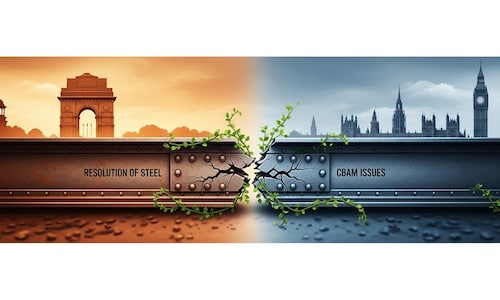
These topics will be at the forefront during UK Secretary of State for Business and Trade Peter Kyle’s visit to India on June 2.
He is scheduled to have a bilateral discussion with Commerce and Industry Minister Piyush Goyal.
These matters have become a significant hurdle in the implementation of the Comprehensive Economic and Trade Agreement (CETA).
Both matters are expected to be explored during Kyle’s visit, with indications that progress on the pact will be challenging until they are resolved.
Starting July 1, 2026, the UK will impose limits on tariff-free steel imports, slashing overall quota volumes by 60% compared to the current steel safeguard measure. Imports exceeding these limits will incur a 50% tariff.
This measure pertains to steel products that can also be produced within the UK.
Previously, Britain enforced safeguard measures that included import quotas, which have now been reduced.
In December 2023, the UK government announced its intention to implement the Carbon Border Adjustment Mechanism (CBAM) beginning in 2027.
According to the economic think tank GTRI, India’s exports valued at USD 775 million to the UK may be affected due to Britain’s plan to impose a carbon tax on items such as iron and steel, aluminium, fertilisers, and cement from 2027.
Following the European Union (EU), the UK will become the second economy to adopt CBAM. The UK refers to it as an import carbon pricing mechanism, focusing initially on sectors like iron, steel, aluminium, fertilisers, hydrogen, ceramics, glass, and cement.
This tax could range between 14-24% of the import value once free allowances under the Emission Trading System (ETS) are entirely phased out.
During his visit to London in 2025, Commerce and Industry Minister Piyush Goyal expressed concerns about this tax and indicated that India may consider retaliatory measures if the UK proceeds with its plans.
In the fiscal year 2025-26, India’s exports of iron, steel, and related products to the UK amounted to USD 893.4 million, representing a notable portion of USD 13.4 billion in total merchandise exports to the UK.
Sources have also hinted that India could look at balancing the UK’s steel concerns with concessions on British scotch, as offered by India in the CETA.
Under the agreement, India has committed to lowering duties on UK whisky and gin from 150% to 75%, and further to 40% in the 10th year of the arrangement.
In India, popular Scotch whisky brands include Johnnie Walker, Chivas Regal, and The Glenlivet, with Johnnie Walker being particularly well-loved.