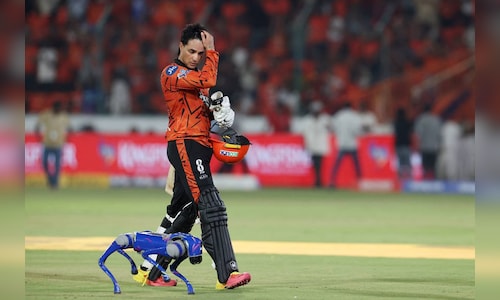
Abhishek led the innings with remarkable steadiness, scoring an unbeaten 135 off 68 balls, which helped Hyderabad secure a commanding 47-run victory on Tuesday. The opener displayed an impressive array of strokes in a dominating performance that propelled SRH to their fourth win out of seven matches this season.
The left-hander faced difficulties initially during the T20 World Cup, co-hosted by India and Sri Lanka, but regained his form at a pivotal moment, playing a vital role in India’s title win. He has successfully carried that momentum into the IPL.
“I believe he’s always possessed that maturity, which has been evident over the past couple of years. You can’t be the number one T20 batsman in the world without having maturity. Certainly, he evaluates the opposition, assesses the pitch, and decides on his approach,” said Aaron in the post-match press conference.
Aaron noted that Abhishek demonstrated a sharp cricketing intellect, batting cautiously in the early stages before accelerating and attacking the bowling.
“Today (Tuesday), the surface wasn’t one where you could go all out every single ball. You have to respect the opponent and the pitch, and he (Abhishek) accomplished that perfectly.
“He has shown signs of this in the past, but when you play a high-risk, high-reward style, it doesn’t always pay off, so it’s important to allow players like Abhishek some leeway,” Aaron added.
Young pacer Sakib Hussain kept the Delhi Capitals batters at bay and claimed a wicket, but it was Sri Lankan right-arm quick Eshan Malinga who devastated the chase, finishing with figures of 4 for 32 after SRH set a target of 243.
Aaron praised the variations and sharpness displayed by both bowlers as outstanding.
“They possess skills that differentiate them from other bowlers. Speaking about Malinga, he can make the ball reverse. We witnessed reverse swing from the 11th or 12th over today, which complicates things for the opponent because, with a white ball, it’s hard to determine the shiny side.
“He executes his yorkers effectively, has an excellent slow ball, and bowls at speeds of 140 plus, almost 145. As for Sakib, his slow ball is exceptional. He generates almost as much turn as an off-spinner on his slow ball using the same arm speed, executes yorkers, and can also bowl over 140,” Aaron elaborated.
He added that prior to the IPL season, SRH prioritized bowlers who would perform regardless of pitch conditions.
“Considering the current direction of the game and the IPL, having pace variability is crucial; you need to range from 140-145 down to almost 107, as Sakib’s slow ball registers around 107.
“Heading into this year, one of our strategies was to recruit bowlers who could deliver regardless of the surface. With Sakib and Malinga, their skills nearly eliminate the pitch factor for the captain. This distinction was evident to me and to everyone,” remarked Aaron.
Praising the 21-year-old Sakib, Aaron highlighted his variations, pointing out that a bowler with a pace of 140 kmph can easily be taken apart in the IPL, but Sakib’s variety has proven effective.
“Again, it’s about that variance. I’ve watched Shakib for nearly two years. He’s always had the speed, with a quick arm action that can be quite awkward. As a batsman, especially at the Rajeev Gandhi Stadium on our pitch, if you bowl 140 plus with a beautiful action, you’ll likely get hammered.
“You need some variation, and that slow ball is exceptional. He possesses the skills, and while he may not have had long-term coaching access, he has worked hard in the past few months. We’ve held camps specifically for him, and he traveled to Bombay for five days, then came to Chennai.” Aaron noted that Sakib has responded exceptionally well to the training regimen since being acquired at the IPL 2026 auction.
“A lot of effort has gone into preparing him right after the auction, and his response has been positive—he has the determination and the hunger.
“That’s the key; you can have the best skills in the world, but without the will and desire, it won’t come together,” concluded Aaron.
(With PTI input)