In a discussion with CNBC-TV18, Joshi noted that the company’s power operations have stabilized following planned maintenance shutdowns earlier this year, which are not expected to affect steel production in the future.
“The power plant shutdown concluded in early January, and now both turbines are operating normally,” Joshi mentioned. “We do not foresee any impact on steel production for the entire year.”
Although the company has not set quarterly earnings expectations, Joshi highlighted that the April-June quarter typically proves to be the strongest due to increased power demand and favorable exchange realizations.
“Given the nature of our business, Q1 is generally robust because of energy demand, and we expect that trend to continue,” he added.
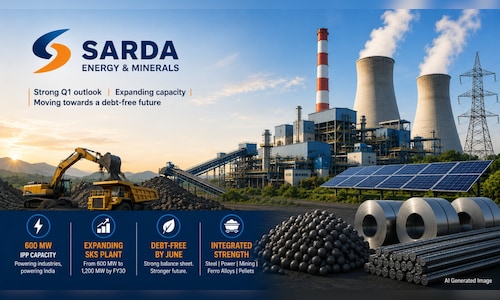
Sarda Energy currently boasts an independent power producer (IPP) capacity totaling 600 megawatts, with 300 megawatts allocated under medium- and long-term power purchase agreements (PPAs), while supply is active for 200 megawatts. The remaining capacity is being marketed through short-term PPAs or on the power exchange.
Joshi indicated that exchange realizations tend to peak in the first quarter. The company also anticipates its additional 30-megawatt captive power unit to become operational by June.
On the financial front, Joshi reported a significant reduction in debt, expecting to achieve a consolidated debt-free status soon.
“We are already debt-free on a standalone basis,” he remarked. “Net debt has decreased by 85% at the consolidated level, from ₹1,500 crore to approximately ₹200 crore as of March, and we aim to operate debt-free by June.”
The firm noted that most ongoing capital expenditures, including mining projects, are being financed through internal accruals, with any temporary debt increase likely only related to the planned expansion of the SKS power plant.
Sarda Energy intends to double the SKS power plant’s capacity from 600 megawatts to 1,200 megawatts by FY30 as part of its broader expansion strategy. Joshi explained that this is a brownfield expansion, enabling quicker execution due to existing infrastructure like land, railway links, coal handling systems, and water evacuation facilities.
The company has already submitted an application for environmental clearance for the expansion and is actively preparing the detailed project report.
Sarda Energy also plans to invest roughly ₹500 crore to increase its pellet manufacturing capacity to 2 million tonnes annually, up from approximately 0.9 million tonnes currently.
This update follows Sarda Energy & Minerals’ announcement of a strong fourth-quarter earnings report for FY26 on May 23, showcasing a consolidated net profit of ₹158 crore for the quarter, marking a 46% increase from ₹108.3 crore a year ago.
Revenue from operations rose by 1.2% year-on-year to ₹1,253.6 crore, while EBITDA surged 28.4% to reach ₹347.4 crore. The EBITDA margin saw a notable increase, expanding to 27.7% from 21.8% during the same quarter the previous year.
Sarda Energy & Minerals operates across sectors including steel, ferro alloys, power, mining, and integrated energy, with a significant footprint in central India.

Also Read | Sarda Energy Q4 Results: Profit jumps 46% despite muted revenue growthThis is an edited transcript of the interview.Q: While obviously Q3 and Q4 saw that impact coming in from some of the shutdowns that you all had in terms of plant maintenance. What is the outlook now for Q1 FY27? Has that normalised now, or could that come into Q1 FY27 as well?
Nilay Joshi: See, the power plant shutdown got over in early January, so both the turbines are functioning normally now. That was a planned shutdown, and the other 30-megawatt captive unit will become operational from June, but for the full year it will not impact production. So, as of now, the power plant is functioning normally, and the other 30 megawatt will come on board by June.
Q: So, maybe some bit of an impact will come in, right, in Q1?
Nilay Joshi: For steel, we don’t expect any impact for the full year.
Q: Okay. What about EBITDA, right? Q1 FY27 — is it going to be the best in terms of EBITDA? Will you reach ₹600 crore again?
Nilay Joshi: While I’ll not give a number, see, the nature of the business is such that normally Q1, because of energy demand, is a strong quarter, and we expect it to remain a strong quarter.
Q: So, last time you did ₹600 crore, so we can expect around that level, right?
Nilay Joshi: Again, I mean, we don’t give quarterly guidance, but yes, Q1 is a strong quarter because realizations are stronger in power.
Q: Just talking about that, how much of your power is in fact sold on a merchant basis? And can you just give us a sense of exactly how rates might have changed?
Nilay Joshi: So see, as of now we have three — the total power IPP capacity is 600 megawatts. We have medium- and long-term PPAs to the tune of 300 megawatts, around ₹5.5 per unit. As on date, we are supplying power out of the 300-megawatt PPA. We are supplying power for 200 megawatts. For the balance 100 megawatts, we have entered into a PPA, but the power supply will start from April 1, 2027. So, compared to last year, where we had only 100 megawatts under PPA, as of now we have 200 megawatts under PPA, and the balance we are selling either through short-term PPAs or on the exchange. Exchange realizations are, of course, the strongest in Q1.
Q: Okay, just circling back to FY27, we spoke about EBITDA, but just tell us about the balance sheet. What are you estimating or guiding for in FY27? For example, is the company going to generate enough cash to be debt-free?
Nilay Joshi: So, on a standalone basis, we are already debt-free. Even on a consolidated basis, you must have seen that we have very, very strong liquidity, almost ₹2,400 crore of liquidity on the balance sheet, and effectively we are about net debt-free. Net debt has gone down by 85% at the consolidated level also, from ₹1,500 crore levels to hardly ₹200 crore as of March, and by June, hopefully, it will be a debt-free operation.
Q: You are talking about EBITDA doubling, right? You all have spoken about that. So, what does that indicate in terms of peak debt going forward? FY27 Q1 may go in strongly, but are there any concerns going forward?
Nilay Joshi: No, so see, most of the capex that is happening as of date, like the mining capex and all that we have guided, is all happening out of internal accruals. The only capex where we see debt coming onto the balance sheet is the doubling of the SKS power plant. But at the same time, we have very, very strong internal accruals, so I don’t see any deterioration in the capital structure. While debt will, at a gross level, definitely come on board, but then cash generation is also there. And for the mining project, we are not taking any debt.
Q: On this SKS expansion, which you just mentioned, of doubling it from 600 megawatts to 1,200 — are there any issues with regard to turbines?
Nilay Joshi: No. As you must have seen domestically there are two power equipment suppliers, right — L&T and BHEL. Their order books are tight, so we are trying to see what best is possible.
Q: Okay, so no issues on that front, right? And you can look at doubling it as well in terms of your capacity. You’ve spoken about doing that in five years, so that’s on track?
Nilay Joshi: Yes, yes. So, the guidance that we have given for FY30 is that we are looking to double things by that time. That is the aspiration. If you see, this is a brownfield expansion, so we have a large part of the balance of plant and land, etc., already in place. The land, coal infrastructure, railway infrastructure, water evacuation, and related activity are already there. So, compared to a greenfield project, that is why we expect a shorter timeline.
Right now, we have applied for EC. As we speak, the DPR is going on, we have applied for EC, and we are hopeful of a positive outcome.
Q: Okay, just one quick one. Pellet expansion — you’ve also said there is an approximate investment of around ₹500 crore that you’re looking to make there. Could you talk to us about the revenue expected here, as well as EBITDA contribution going forward?
Nilay Joshi: So, it will hopefully be in line with what we are doing. We already have about a million — I mean, nine lakh tonnes of annual capacity — and basically we are doubling it. We are going to 2 million tonnes, so you can simply double all the numbers on the pellet side.