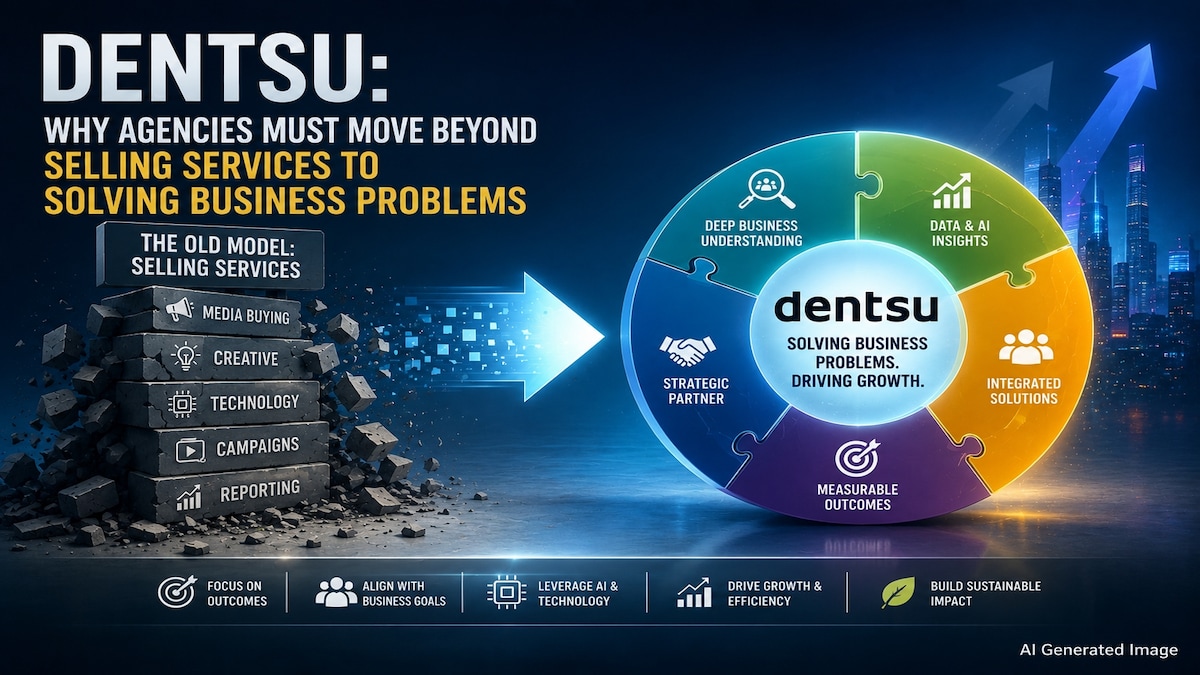
This transformation is affecting how agencies are structured, the skills they seek, the technology they invest in, and even their metrics for success.
According to Harsha Razdan, CEO of South Asia at Dentsu, simply providing a menu of services is no longer a competitive edge for agencies. They must start with the client’s business challenges and assemble the right blend of capabilities to address them.
In an interview with CNBC-TV18, Razdan mentioned that the industry’s focus has shifted significantly from service delivery to achieving business outcomes.
From outputs to outcomes
For many years, agencies primarily measured success by what they produced—advertising campaigns, media strategies, creative assets, or technology initiatives. Now, however, companies are increasingly interested in how these activities impact their business.
Marketing budgets are now expected to generate measurable returns, whether it’s through enhanced sales, better customer engagement, or increased profitability. Consequently, agencies face heightened pressure to show commercial impact rather than merely completing tasks.
“The time for companies like ours and agencies to discuss outputs is over. It’s entirely about outcomes now, and agencies must adapt as clients evolve,” Razdan stated.
He believes agencies need to adopt the mindset of their clients. Today’s marketing leaders are expected to merge brand-building with data, technology, and commercial decision-making. Agencies, he argues, must cultivate a similar approach to stay relevant.
“Looking at an agency, unless we reflect that same mindset and comprehend what the CMO is conveying, I don’t believe we are fulfilling our role,” he explained.
Why selling services is no longer enough
A key transformation reshaping the industry is the method by which clients select their agency partners.
Rather than purchasing individual services from various specialist teams, many companies now expect agencies to grasp their broader business goals before proposing a solution.
Razdan suggested that agencies should initiate client dialogues by inquiring about the business challenges that need addressing, rather than starting with a specific service.
“Go ask them what needs to be solved instead of leading with a service,” he advised.
He noted that conversations with multiple CEOs revealed a shared frustration: many organizations were dealing with several agency teams working independently, with no single partner accountable for the overall business objective.
In response, Dentsu has restructured its India operations around integrated client teams that unite expertise in creative, media, technology, entertainment, and sports. Instead of functioning in separate business units, the firm now manages its largest clients through a cohesive structure designed to provide more comprehensive business solutions.
Clients increasingly want strategic partners
This shift also mirrors changing expectations within boardrooms.
Business leaders are progressively expecting agencies to contribute to commercial strategy rather than merely executing marketing. They want to comprehend how an agency’s capabilities can help accomplish business objectives rather than just hearing about those capabilities.
As Razdan recounted one recent interaction with a senior executive: “We don’t want our partners to stop acting like partners. Don’t come in and tell me what you can do. Tell me how you can assist me and simplify my work.”
This evolution is driving agencies beyond their traditional role as service providers and toward becoming long-term strategic advisors.
Economic uncertainty is raising the stakes
A more challenging business environment is accelerating this evolution.
Geopolitical tensions, pressures on corporate profitability, and cautious consumer spending are prompting companies to scrutinize every marketing investment more closely. Budgets that once focused primarily on brand awareness are now increasingly expected to yield measurable business returns.
Razdan believes these pressures will persist through the latter half of the year.
“If clients struggle, the pressure will increase on agencies like ours,” he stated, noting that uncertainty has escalated compared to a year ago.
In such conditions, agencies capable of clearly demonstrating commercial value are likely to gain an edge over those that merely execute campaigns.
AI is reshaping agency work
Artificial intelligence is adding another dimension to this shift.
Instead of displacing agencies, AI is redefining the skills they need and how work is accomplished. Routine tasks are becoming more automated, allowing professionals to concentrate on strategy, creativity, and problem-solving.
Razdan suggested that embracing AI is crucial for career advancement.
“Your job won’t be safeguarded by ignoring it. Others will use it, and that could cost you your position,” he warned.
Dentsu has implemented AI training throughout its India operations via Dentsu University and is leveraging the technology to enhance internal productivity as well as develop client solutions.
He also believes that agencies should collaborate with specialized technology firms instead of attempting to build every AI capability in-house, enabling them to adopt new innovations more swiftly.
New skills are becoming more valuable
As agencies assume broader business roles, the skill sets they require are evolving.
Although traditional advertising expertise remains vital, agencies are increasingly in search of professionals with backgrounds in consulting, data, technology, cloud computing, and digital commerce. The aim is to incorporate a wider range of perspectives into client discussions and address more complex business issues.
Razdan emphasizes that continuous learning will become increasingly vital as AI transforms the workplace, with employees needing to acquire expertise across various disciplines instead of limiting themselves to a single specialization.
A fragmented media landscape is creating new opportunities
Consumers today split their attention across streaming platforms, social media, influencers, retail marketplaces, gaming, live events, and quick commerce. As audiences fragment, brands require more integrated marketing strategies to effectively reach them.
Razdan believes this creates opportunities for agencies with expertise across multiple channels.
He identified sports, e-sports, live experiences, retail media, quick commerce, e-commerce, influencer marketing, B2B marketing, and sustainability consulting as some of the fastest-growing sectors for the business.
The challenge, he argues, is no longer about selecting a single marketing channel but rather about integrating them to meet a client’s commercial objectives.
The bigger picture
Razdan’s insights reflect a broader transformation occurring within the global advertising industry.
As marketing becomes increasingly driven by data, technology, and accountability for business performance, agencies are more frequently evaluated based on the commercial outcomes they deliver rather than the individual services they offer.
This shift is altering how agencies are structured, the talent they attract, and their collaboration with clients. Success increasingly hinges on grasping a company’s business objectives, integrating various capabilities, and delivering measurable results.
In essence, the future of advertising agencies may depend less on the services they provide and more on how effectively they address business challenges.
Watch the accompanying video for the full discussion.