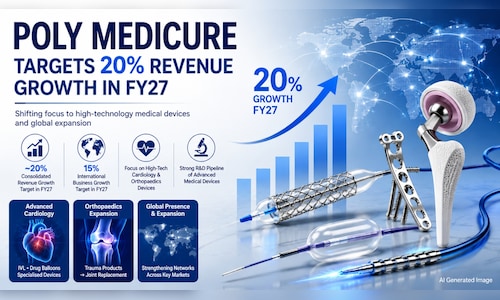
In an interview with CNBC-TV18, Himanshu Baid, Managing Director of Poly Medicure, shared that the company is pivoting away from low-tech products to develop a portfolio centered on advanced medical devices, especially in cardiology and orthopaedics.
“It’s a pivotal transition for the company, evolving from low-tech to medium- and high-tech products,” Baid noted. “In the next four to five years, we will shift from a low- and medium-tech platform to a high-tech one—this is our trajectory.”
The firm anticipates a 15% growth in its international business for FY27, with consolidated revenue potentially nearing 20%, aided by recovery in Europe and contributions from acquisitions.
Poly Medicure is working on a variety of advanced cardiology products, including intravascular lithotripsy (IVL) devices, drug-coated balloons, and other specialized items, many expected to launch in the upcoming months.
Baid remarked that some products will be launched soon, while others might be available by year-end, depending on regulatory approvals and market entry timelines.
“We are currently developing products such as drug-coated balloons, IVLs, and several high-end devices,” he said, emphasizing that in-house research and development are at the heart of the company’s strategy.
The company is also growing its orthopaedics division. Baid indicated that Poly Medicure is presently concentrating on trauma products and completing the product line from its acquired European firm before delving into joint replacement devices in the coming years.
This approach aims to diminish India’s reliance on imported medical devices while leveraging larger global markets for advanced products. Baid suggested that generating around ₹150 crore in revenue from these new high-end products within three years is feasible.
While its infusion therapy segment has traditionally made up a significant share of Poly Medicure’s portfolio, its contribution is projected to stabilize around 50% in FY27 as the company focuses on newer categories.
The firm also expects a resurgence in its international business after previous supply chain challenges hampered exports, notably in Europe. Baid explained that disruptions related to changing shipping routes around the Red Sea resulted in inventory mismatches with clients and affected revenue growth.
“I believe we were somewhat unprepared for that,” he said. “However, we’ve seen improvements over the last few months.”
Poly Medicure has acquired additional distributors in Europe and anticipates a rebound in the region after growth slowed in FY26.
Nonetheless, external challenges persist. Baid cautioned that rising crude-related raw material costs could impact margins starting in the second quarter, though currency depreciation and cost-saving measures may help mitigate this effect. He mentioned that the company might consider implementing another round of price hikes toward the end of the second quarter or the beginning of the third.
The West Asia segment also continues to face challenges from high freight costs and shipment delays. Poly Medicure generates approximately 6–8% of its revenue from this region, where orders worth ₹20–30 crore were postponed in March, with similar issues ongoing in the first quarter.
Poly Medicure recently reported a 27.8% year-on-year drop in fourth-quarter net profit to ₹66.3 crore, compared with ₹91.8 crore the previous year. Revenue for the January–March quarter increased by 21.3% to ₹534.5 crore, while EBITDA fell by 7.8% to ₹110.3 crore. The EBITDA margin decreased to 20.6%, down from 27.1% during the same period last year.
Despite the quarterly downturn, Baid said the operational performance improved sequentially.
“The fourth quarter was significantly better for us compared to earlier quarters,” he stated, noting that standalone EBITDA margins reached their highest level of around 27%.
Also Read | Poly Medicure shares down 15% in three sessions after Q4 results; Here’s what the management saidThis is an edited transcript of the interview.Q: It seems like you are facing challenging times in the near future. Given your guidance, you mentioned a revenue target of around ₹2,300 crore. Could you share how infusion therapy, which has dropped to around 50% of the total mix from about 65-70%, will contribute in FY27? Additionally, the receivable day cycle has lengthened due to export weaknesses. What measures are you implementing to enhance working capital efficiency?
Himanshu Baid: The fourth quarter was indeed much better for us than the previous ones. If you recall, we had anticipated a positive shift starting from the fourth quarter, and that is manifesting in revenue and margins. In fact, the EBITDA margins, standalone, were the highest in the fourth quarter, around 27%. Although the consolidated numbers dipped due to one-time expenses in subsidiaries, overall, the trajectory is looking good.
Regarding the infusion business, I expect it to remain around 50% for FY27 as we are emphasizing other areas. This is a transitional phase for the company—shifting toward medium- and high-technology products is driving this change over the next four to five years.
As for working capital, we experienced some strain last year due to extended credit to our domestic and international customers. However, we are currently at a point where we should see no further degradation in cash flow cycles. In fact, we may start to recover more from where we stand today.
Q: Can you provide a figure for the receivable days?
Himanshu Baid: Currently, receivables are around 95 to 98 days. We hope to bring that down to approximately 90 days or thereabouts.
Q: You’ve mentioned several high-end products in development, such as IVL and advanced cardiology devices. What commercialization timeline are you looking at, and what revenue potential do you foresee from these products over the next two to three years?
Himanshu Baid: The cardiology segment is a high-TAM business. India heavily relies on imports for most advanced products, except for stents and some basic items. Our current focus is on drug balloons, IVLs, and various high-end devices. Some products will launch soon, while others are slated for release by the end of this year, subject to regulatory clearances and access to international markets.
The key is to develop these devices in-house and concentrate on R&D, which has been our focal point.
Additionally, we are currently focusing on orthopaedics, particularly trauma, and completing the product range from the European company we acquired. We plan to shift focus to joint products in the next few years. The movement towards high-tech offerings is crucial, especially for products where India has import reliance, tapping into global markets with expanded opportunities.
Q: Is a ₹150 crore revenue achievable in three years?
Himanshu Baid: Yes, absolutely.
Q: In terms of the India business, FY26 growth compared to FY25 is stable at around 18-19%. The export sector, particularly in Europe, is where you’ve seen substantial declines. To what extent is this due to lower-cost Chinese imports or dumping into Europe?
Himanshu Baid: Chinese dumping is a prevalent issue globally, not just in India. For us, the primary concern was a supply chain mismatch. A significant portion of our goods was being transported through the Red Sea, which faced closures, forcing us to adapt to alternate routes. The reopening of the Red Sea subsequently resulted in inventory mismatches with numerous customers, causing revenue dips.
We were somewhat caught off guard, but recent months have shown a positive shift. We’ve expanded our distributor network in Europe, and things look promising. We have guided for 15% growth in international revenue, excluding India. Thus, we are optimistic about our current standing. The business is seeing improvement.
Q: So, international revenues are expected to grow by 15%, while consolidated revenues will reach 20%?
Himanshu Baid: Yes, that’s correct.
Q: Will Europe see a rebound since FY25 growth was around 25%, while FY26 was only about 7-8%? Is that due to current conditions?
Himanshu Baid: For Europe overall—including our acquisitions and operations outside India—it should improve because our subsidiaries will also contribute growth, including those acquired previously. We anticipate close to 20% consolidated growth.
Q: Regarding commodity inflation, you noted that crude-linked raw material prices have risen by about 20%. What assumptions have you made regarding crude prices in your guidance? If prices remain high, how do you foresee that affecting you? Additionally, will you implement further price increases?
Himanshu Baid: I can’t predict future conditions as each day brings new challenges. Fortunately, in the first quarter, we had a significant inventory, so impacts from raw material price hikes were minimal.
However, we may experience slight effects starting in the second quarter. The key point is that we export around 70% of our products, so currency depreciation should provide some relief. The 7-8% decline in currency since February will benefit us in conjunction with some price increases.
Currently, we project a modest margin erosion of 200-250 bps at the gross margin level if prices stabilize. Still, we are pursuing cost-saving measures to recover margins, and another price increase may occur by late second quarter or early third quarter.
Q: And concerning the West Asia situation, you mentioned that 6-8% of revenues come from there. Although demand remains strong, shipping and pricing issues persist. Could you quantify the deferred revenue you mentioned in the conference call?
Himanshu Baid: Approximately ₹20-30 crore of revenue was postponed in March, with similar deferrals occurring in the first quarter. The biggest challenges stem from skyrocketing shipping costs, which have surged to 5x, 6x, or 7x, resulting in delays due to alternate routing and delivery uncertainty.
We hope for gradual improvements, but the current conditions regarding exports to West Asia remain quite fluid.
Q: What about renal care? I think it saw around ₹190 crore in FY26. What growth do you expect this year? Additionally, how many dialysis machines are you targeting to sell—last year it was around 450. What projections do you have?
Himanshu Baid: This year, we anticipate around 20% growth in the renal segment. The cautious outlook results from challenges posed by Chinese dumping, where various companies leverage the FTA route to introduce products into India at zero duty. We have urged government action to curb this.
If those measures are not taken, we foresee modest growth around 20%. Last year, we achieved 20-22% growth from FY25 to FY26, and we estimate selling between 550 and 600 dialysis machines.
Q: Regarding the price of your dialysis machines compared to Chinese or European options, could you provide a comparison? What closing comments do you have regarding those price ranges?
Himanshu Baid: Chinese machines generally cost about 10% less than our offerings due to their extensive manufacturing capabilities. In contrast, European machines tend to be around 20-25% pricier than our products made in India.