Both nations also targeted shipping routes, with the US claiming it was enforcing a naval blockade while Iran asserted it was acting against vessels that breached its navigation rules in the Strait of Hormuz, a crucial waterway for one-fifth of global oil supply.
Oil prices surged over 4% on Friday, reaching their highest levels in more than a month, adding political pressure on US President Donald Trump as his Republican Party attempts to maintain power in the upcoming congressional elections in November.
Washington and Tehran have been pushing the boundaries of confrontation since their ceasefire agreement unraveled last week, raising fears of a return to full-scale war.
The US military’s Central Command reported that it concluded its recent wave of strikes by targeting surveillance facilities, military logistics infrastructure, underground weapons depots, and maritime capabilities.
“US forces utilized fighter jets, drones, and warships among other resources,” Central Command stated. “Over 50,000 American service members are active in the Middle East and remain alert, effective, and prepared.”
Iranian media claimed on Saturday that several missiles struck power facilities and desalination stations in the southern Iranian city of Jask, according to a local official. The official stated that drinking water was cut off in villages in Jask due to the assault.
The US declared that its forces redirected four commercial vessels, disabled one, and boarded another as part of its enforcement of the naval blockade against Iran.
In response, Iran’s Revolutionary Guards announced that four vessels violating its shipping regulations were halted from passing through the strait through a coordinated missile and drone operation.
Additionally, Iranian media, citing the Revolutionary Guards, reported that two oil tankers exploded and caught fire after traversing a mined route south of the strait, a claim that the US military dismissed as false.
Meanwhile, armed individuals seized another vessel off Yemen, raising alarms over security in another critical chokepoint for oil transport at the entrance of the Red Sea.
Iran’s state television cited the Revolutionary Guards as stating that until US “aggression” ceases, the export of chemical fertilizers or even “a single drop of oil and gas” from the region will not be possible.
Mohsen Rezaei, an adviser to Iran’s supreme leader, cautioned on Friday against further US escalation or any efforts to capture Iranian territory.
CONCERN OVER INFRASTRUCTURE
UN Secretary-General Antonio Guterres expressed concerns about escalating violence, especially regarding “attacks on civilian infrastructure in Iran and the broader region,” as stated by his spokesperson.
The US military’s Central Command indicated that its targets included “military logistics infrastructure,” marking the first time it mentioned infrastructure in over a week.
Iranian media reported enemy strikes early on Saturday in coastal Hormozgan Province on the Iranian side of the Strait of Hormuz. State TV reported three fatalities and eight injuries, with damage to two bridges and a road tunnel.
Reports of explosions or strikes were also confirmed in Sirik, Ahvaz, Yazd, Jask, and Khorramabad late Friday or early Saturday.
On Friday, Iranian state media stated that at least five bridges were targeted in US airstrikes, resulting in seven deaths during attacks on bridges in the southern port of Bandar Khamir, where a train station was also hit. An airport further east in Iranshahr, near the Pakistan border, was also reported to be targeted.
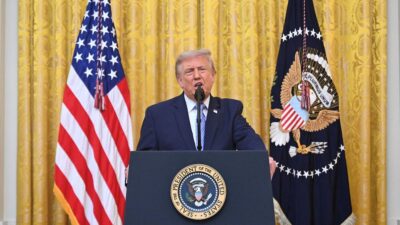
Trump has threatened to initiate comprehensive airstrikes on Iranian infrastructure and has not ruled out a ground assault on Iranian coastal areas or islands. US officials have indicated that strikes in southern Iran are partly intended to provide Trump with options.
Such actions risk provoking Iran to target the vital infrastructure of vulnerable Gulf states or could embolden its allies in Yemen to further disrupt global energy supplies by attacking shipping in the Red Sea.
Iran has declared attacks on Gulf nations that host US airbases, including Bahrain, Qatar, Kuwait, and Jordan, in addition to a US vessel in the northern Indian Ocean. Saudi Arabia’s civil defense issued early warnings in at least two locations, the first in months, though no damage has been reported thus far. Earlier in the conflict, Iran had targeted several of the oil-rich kingdom’s energy facilities.
Kuwait’s authorities reported that one of their power generation and water desalination facilities had been struck in an Iranian attack, resulting in damage, a fire, and the disruption of numerous electricity generation units.
The Kuwaiti military later stated it was responding to Iranian drone strikes.
Iran’s Revolutionary Guards reported that they had attacked a depot of US drones in Bahrain and destroyed Bahrain’s main artificial intelligence center using ballistic missiles and drones.
State news agency IRNA reported that the Iranian navy launched a shore-to-sea cruise missile at what it termed a hostile US vessel in the northern Indian Ocean. The Iranian army claimed that the missile launch instilled “fear and panic” and forced the vessel to retreat out of reach of Iran’s navy.