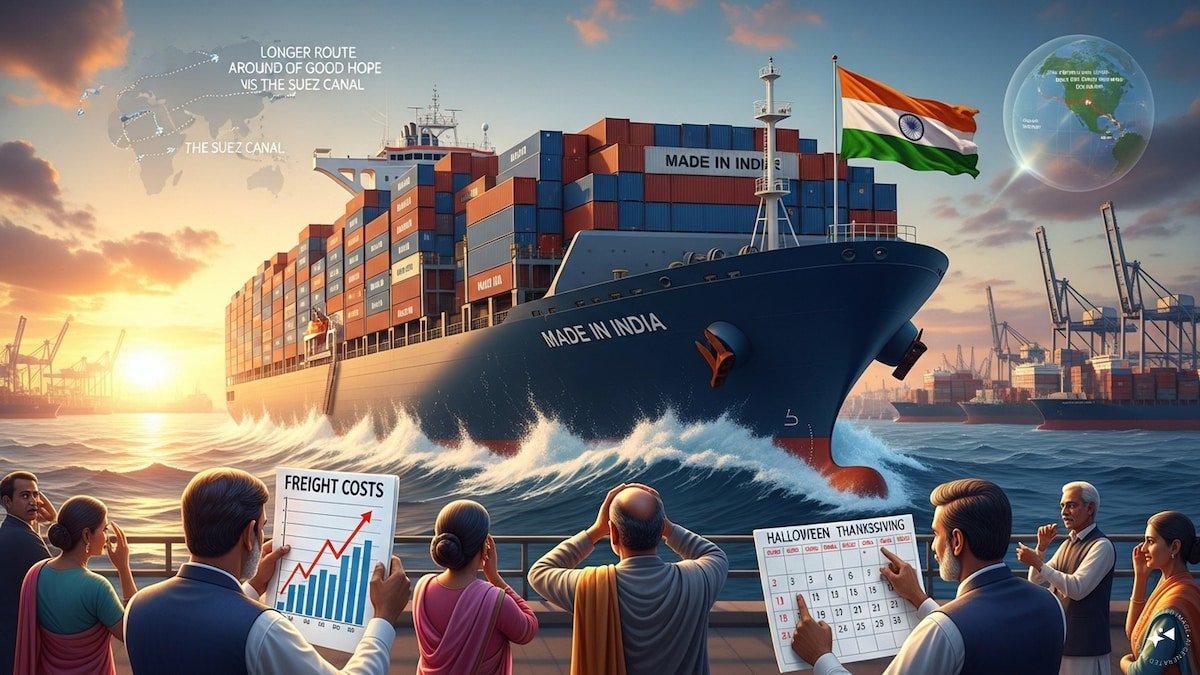
Shipping expenses to the US, Europe, and other Western areas have soared by 3-4 times over the past few months. Currently, exporters are paying over $9,000 per container, a significant increase from around $3,000 a few months ago.
This sharp rise in freight rates is particularly challenging for Indian exporters, coinciding with the upcoming festive and agricultural seasons in key Western markets.
Industry insiders indicate multiple factors are causing the disruption, with the most significant being the timely availability of vessels rather than a true shortage of vessels or containers.
Also Read: Rising oil prices and freight rates impact India in the wake of the West Asia conflict
Congestion at ports has upended vessel schedules, impacting timely vessel availability for bookings. Experts note there isn’t a shortage of vessels; however, the schedule disruptions hinder exporters from securing vessels promptly.
Numerous blank sailings across various routes are exacerbating vessel schedule issues.
Additionally, two out of five weekly shipping services to the US, including routes to the East Coast, have been suspended, which further limits India’s export capacities.
The ongoing use of the longer Cape of Good Hope route is also affecting vessel schedules. Indian exporters opted for this route over the Suez Canal last year due to the Red Sea crisis and Houthi attacks. The Cape route adds 10-15 days to the travel time, further delaying vessel returns.
As the festive season demand in the US and Europe intensifies, exporters find the situation even more challenging. Typically, supply for the festive season begins in July-August every year. Exporters report that while freight charges usually increase during this period, this year’s hike is exceptionally steep, with shipping companies charging 3-4 times the usual rates. Added expenses from war risk charges, additional transportation to ensure containers reach optimal ports, and various other fees have ballooned the overall costs. Indian exporters are absorbing these costs to capitalize on peak festive demand.
Also Read: Exporters encounter cost pressures as India reduces RoDTEP benefits, experts note
With demand staying robust and uncertainty over vessel schedules persisting, shipping lines are imposing exorbitant rates.
Sunil Vaswani, Executive Director of the Container Shipping Lines Association, mentioned to CNBC-TV18, “The current scenario isn’t due to an actual shortage of vessels or containers but a disruption in vessel schedules. This is not an issue of vessel/container shortage. There is ample shipping capacity; it’s the disrupted vessel schedules caused by several factors, including the Red Sea and Strait of Hormuz crises and key, well-equipped ports like Jebel Ali not operating at full capacity. Consequently, the voyage schedule is entirely disrupted. Vessels are opting for longer routes, experiencing port delays, and taking longer to return, which has fundamentally disturbed the accuracy of the vessel schedule and bookings.”
He added that congestion at major transshipment and shipping hubs, including Colombo, Singapore, and Malaysia, is aggravating the situation.
CNBC-TV18 sources indicate that China is also frontloading its exports to the US in anticipation of the festive season, contributing to the further unavailability of vessels on time.
All these challenges arise during a particularly critical time for Indian exporters.
The July-August period marks the onset of the peak export season for Indian exporters targeting festive demand in the US and Europe. This includes Diwali demand among the Indian community and significant Western festivities such as Halloween, Thanksgiving, Christmas, and New Year.
This period is also vital for agricultural exports to these markets.
Indian exporters typically begin dispatching supplies from late July to guarantee that products reach international markets ahead of the festive season. However, the unavailability of vessels on time, coupled with unpredictable shipping schedules, forces exporters to incur exorbitant freight costs to avoid missing peak festive opportunities.
Also Read: India and the US remain engaged in trade as most exports face a 10% forced-labor tariff alongside normal duties
With vessel schedules remaining disrupted, exporters now face a dual challenge of significantly higher freight costs and uncertainty around the timely availability of vessels.
For Indian exporters, the concern extends beyond merely securing shipping capacity; it encompasses whether that capacity will be available at the appropriate time to meet peak-season demand.