His correspondence, directed to the EU’s leading officials, arrives as the 27-member bloc considers initiating its own talks with Russian President Vladimir Putin, amid US-mediated discussions that have stalled as the US shifts its focus to issues surrounding the Iran war.
Under Merz’s framework, Ukraine would engage in EU discussions but would not possess voting rights. Additionally, Ukraine would be included as non-voting “associate members” within the influential bodies of the European Commission and the European Parliament.
He emphasized that this arrangement would not constitute a “light membership” and would “far exceed” the existing Association Agreement governing EU-Ukraine relations. Merz proposed a “snap-back mechanism” to address any potential regression in Ukraine’s democratic principles.
European Council President Antonio Costa and European Commission President Ursula von der Leyen previously reiterated the need to commence official membership discussions with Ukraine “without delay,” with Merz supporting the initiation of this process.
Delays and roadblocks
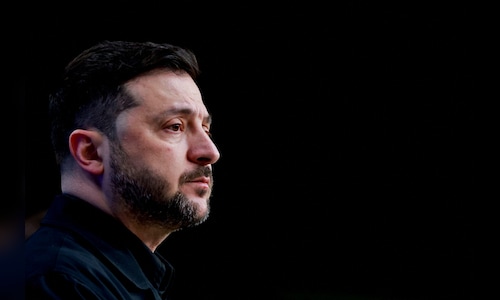
On Wednesday, Ukrainian President Volodymyr Zelenskyy expressed his approval of recent indications of progress in the accession talks, stating in his remarks that this is “very important for us. Ukraine has met all necessary conditions for this advancement.” Candidate nations are required to align their regulations across 35 policy areas, or “chapters,” covering aspects from judicial standards to agriculture and fishing regulations. All 27 EU member states must reach a consensus before any chapter can open, and again to close it.
Notably, Hungary has hindered the commencement of negotiations; however, this might change with the new government now in office in Budapest this month.
Nonetheless, Merz’s plan may not sit well with certain European officials who contend that EU membership should be a merits-based process that concludes only when all required benchmarks have been satisfied.
However, the German leader indicated that his approach could also be applied to other nations awaiting accession, particularly those in the Western Balkans, where EU leaders are scheduled to convene for a summit next month.
A European negotiating track
Regarding the ongoing war, Merz stated that his proposal “will aid in facilitating the current peace discussions as a part of a negotiated resolution. This is vital not only for Ukraine’s but for the entire continent’s security.” Ukraine views EU membership as one “security guarantee” for a stable future post-conflict. Its strongest assurance would be NATO membership, although the Trump administration has asserted that this cannot occur, and other countries are hesitant to allow it while hostilities persist.
As US-led mediation efforts have faltered, EU nations have begun deliberating whether to initiate a parallel negotiation path and who might represent their interests should the unlikely scenario arise that Putin consents to converse with them.
Earlier this month, Costa remarked that “we need, at the appropriate time, to engage in discussions with Russia to address our mutual security concerns.” He clarified that this should not “interfere” with US-led talks but emphasized the importance for Europe to address its own security issues.
Since then, European media has speculated about potential EU negotiators, including former German Chancellor Angela Merkel, who speaks Russian and is well acquainted with Putin, as well as former European Central Bank President Mario Draghi.
Also Read | Ukraine drones kill four in Russia, Moscow faces biggest attack in over a year
Putin has indicated he might communicate with Gerhard Schröder, another former German chancellor. However, officials have dismissively responded to this notion even within Germany, where Schröder’s connections to the Russian energy sector and friendly rapport with Putin have diminished his political standing following Russia’s full-scale invasion of Ukraine in 2022.
EU foreign policy chief Kaja Kallas remarked that it would be “unwise” to permit Putin to select a negotiator, especially a “high-level lobbyist for Russian state-owned enterprises.” Zelenskyy has welcomed an enhanced European role, stating on Sunday that “Europe must be involved in the negotiations. It is crucial for Europe to have a strong voice and presence in this process, and it is necessary to determine who will represent Europe specifically.”