Set for launch on July 18, Skyroot Aerospace will deliver Vikram-1, the country’s inaugural privately developed orbital launch vehicle, from the Satish Dhawan Space Centre located in Sriharikota. A successful launch would signify a monumental accomplishment for India’s private space sector.
However, the true challenge for Skyroot extends beyond the success of a single rocket reaching orbit.
The company is confronted with a more intricate query: Can a private Indian entity convert a successful orbital launch into a dependable, repeatable, and commercially sustainable venture?
This encapsulates the potential of Vikram-1.
Skyroot aims to fill a specific niche in the global launch market — catering to clients eager to deploy smaller satellites into designated orbits without the need to wait for a larger rocket’s availability or to compromise on their desired launch timeline.
The firm refers to this as a “cab to space” model.
It firmly believes that this sector will remain under-supplied for several years.
Significance of Vikram-1
Vikram-1 is not Skyroot’s debut rocket.
Last year, it successfully launched Vikram-S, a suborbital rocket that ascended to an altitude of 88 km. Yet, Vikram-1 signifies a considerably larger technological and commercial advancement.
This rocket reaches the height of about seven storeys and is engineered to transport satellites into low Earth orbit, approximately 450 km above the planet’s surface. It is four times the size of Vikram-S and needs to reach speeds of around 8 km per second to achieve orbital status.
This transition from suborbital to orbital flight is substantial.
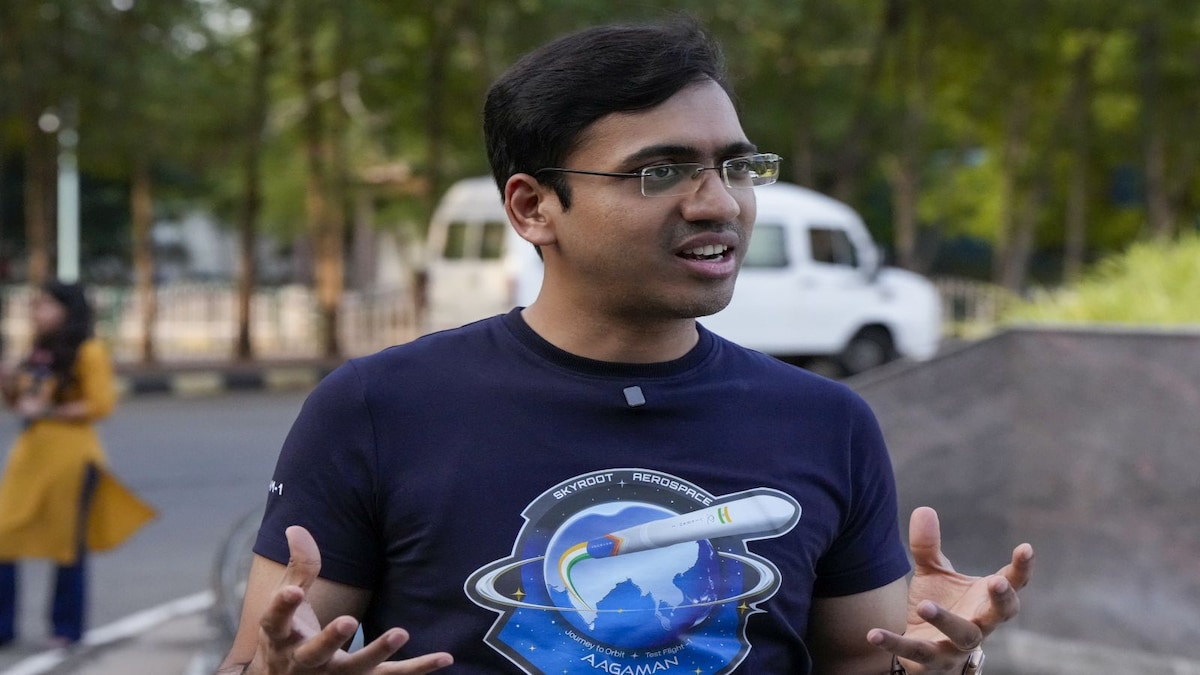
“It’s likely an order of magnitude more challenging due to the rocket’s size and multiple stages,” said Pawan Kumar Chandana, Co-founder and CEO of Skyroot Aerospace, in an interview with CNBC-TV18.
The mission, named Aagaman — which translates to arrival — is the inaugural launch out of three planned operations designed to validate Vikram-1 before initiating regular commercial missions.
Chandana noted that the rocket is completely designed and manufactured in India, with over 90% of its components sourced nationally.
The mission will carry four satellites, comprising payloads from Skyroot, Indian startups Grahaa and Cosmoserve, as well as German space tech firm Dcubed.
This international payload underscores the broader market that Skyroot aims to capture. Their clientele isn’t limited to India; a launch service provider could cater to satellite firms worldwide.
A deeper look at the ‘cab to space’ concept
To comprehend Skyroot’s business model, it’s beneficial to analyze standard satellite launch arrangements.
Typically, a large rocket operates like a train, accommodating multiple customers and adhering to a launch timetable centered around a primary mission or a compatible group of payloads.
While such an approach can be cost-effective, it obligates satellite operators to wait for an appropriate rideshare chance.
Additionally, they may need to accept an orbit, launch date, or mission plan that isn’t their top preference.
In contrast, a smaller dedicated launch vehicle functions more like a taxi.
The clientele essentially reserves the entire vehicle, affording them more control over the launch specifics.
“It’s essentially a cab service to space. It’s a niche market. It’s a unique market, and it’s significantly underserved in the space industry,” Chandana elaborated.
The trade-off, however, is in cost.
A rideshare customer shares the expenses of a larger rocket among various payloads, whereas a dedicated launch customer bears the full cost of the vehicle.
For certain satellite operators, the value lies in the added flexibility.
A firm may prefer to launch at a particular moment, reach a specific orbit, or avoid lengthy waits for a compatible rideshare mission.
This represents the market Skyroot is aiming for.
For a Vikram-1-class launch, the company estimates a long-term revenue per launch of around $10 million.
Why does Skyroot believe in the size of this market?
The global number of satellites being launched is rising as space-based applications expand.
These encompass communications, Earth observation, navigation, scientific research, and a widening array of commercial services.
Yet, satellites are only effective if they successfully reach orbit.
This remains the industry’s most significant bottleneck.
Chandana asserts that the demand for launch services significantly surpasses the supply. Skyroot anticipates this disparity will persist for the following five to ten years.
“This is one sector where demand outstrips supply by a substantial margin,” he stated.
For Skyroot, this presents a compelling opportunity. Yet, demand alone does not guarantee the success of a launch company.
They must first prove their rocket’s reliability in reaching orbit and then produce sufficient rockets while conducting enough launches to establish a repeatable business model.
Skyroot has three factories in Hyderabad, collectively capable of producing more than one rocket per month, according to Chandana.
They’re working towards boosting that capacity to two rockets monthly, albeit this will necessitate further infrastructure investment.
The company is already in the process of manufacturing its second test-flight vehicle, expecting to launch it within the year.
The essence of the business model is reliability
A rocket operates differently from conventional products.
If a consumer product fails, it can typically be replaced without severe repercussions. However, a failed launch can obliterate a customer’s satellite, disrupt an entire mission, and tarnish the launch provider’s reputation.
This makes reliability one of the most coveted assets in the launch sector.
Thus, the foremost question for Skyroot isn’t how quickly it can produce more rockets.
It’s whether Vikram-1 can consistently achieve orbital success.
“Globally, there are very few reliable options,” Chandana remarked. “Only a handful of companies are conducting regular launches worldwide.”
This scarcity can afford pricing power to launch providers with established track records.
This dynamic is also the reason the economics of the launching industry can seem counterintuitive.
Why enhanced technology may not directly lead to cheaper launches
It is easy to presume that advancements in technology will inherently lower launch costs.
However, the price a customer pays hinges on more than just the manufacturing expense of a rocket.
It also incorporates the value of dependable and limited access to orbit.
A launch provider might curtail production costs via improved technology, refined production methods, or reusable systems. However, if the number of dependable launch providers remains constrained and demand continues to surpass supply, the price levied on customers may not decrease proportionately.
This is the scenario Chandana outlined when he said:
“While costs decrease, prices continue to rise.”
Meaning, production costs can drop while customer prices stay elevated if access to orbit remains restricted.
This situation may evolve as more entities enter the market and reusable rockets become more prevalent.
For the time being, though, reliability remains a substantial entry barrier.
Why small rockets may be just the beginning
Skyroot’s immediate goal is to focus on the dedicated-launch segment for smaller vehicles.
Nevertheless, the company is also venturing into reusable launch technology, though Chandana indicated that this development is still a few years away.
The broader ambition is to grasp a more significant share of the launch market.
This strategy is exemplified through the cab-and-train analogy.
Smaller rockets can cater to clients desiring dedicated access to a specific orbit, while larger and potentially reusable vehicles could target the substantially broader market for high-volume launches.
The two markets differ significantly.
For now, Skyroot is honing in on proving the cab model.
The long-term vision is to build the infrastructure necessary to operate at a considerably larger scale.
The advantage of India: a pre-existing ecosystem
One of the most significant benefits for private space enterprises in India is that they are not starting from scratch regarding the entire space infrastructure.
Vikram-1 is set for launch from ISRO’s Satish Dhawan Space Centre.
Skyroot has also utilized existing testing facilities at Sriharikota for its rocket engines.
Orchestrating an orbital launch requires a sophisticated ecosystem, including launchpads, tracking radars, antennas, ground stations, and facilities for integrating and assembling the rocket.
Establishing all of this independently would call for substantial capital and extensive development time.
Reforms in India’s space sector have opened some of this vital infrastructure for private firms.
This allows companies like Skyroot to allocate more capital toward rocket design, manufacturing, and technology instead of replicating already existing infrastructure.
For emerging launch companies, this can make a considerable difference.
The $600 billion opportunity encompasses more than just rockets
The market Skyroot is aiming for is a segment of a much larger global space economy.
When Chandana references a space industry valued at roughly $600 billion, it does not solely denote the launch vehicle market.
The expansive space economy encompasses satellite manufacturing, communications, Earth observation, navigation, data services, and various downstream sectors.
Launch is merely one component of that ecosystem.
Nonetheless, it is a vital one.
Without dependable access to orbit, the rest of the space economy cannot flourish.
This also elucidates why entering the launch business is incredibly challenging. The technology is sophisticated, financial demands are high, and the consequences of failure can be severe.
These hurdles limit the number of firms capable of providing reliable orbital launch services.
Skyroot estimates that 70-80% of its potential market is global and primarily commercial. This perspective is noteworthy, as the company’s addressable market isn’t confined to India’s developing domestic satellite sector.
Its clientele could emerge from various international sources.
The ultimate pursuit is not merely to seize a significant slice of the entire $600 billion space economy.
Rather, it is to secure a foothold in one of the most challenging and strategically vital sections of that ecosystem — launching satellites into orbit.
What comes after Vikram-1?
The imminent challenge is Mission Aagaman.
Vikram-1 must successfully navigate an intricate orbital mission involving multiple phases, high velocities, and precise navigation.
This launch also serves as the first among three planned test flights aimed at validating the vehicle.
If Skyroot can establish reliability, the subsequent hurdle will be scaling operations.
This entails producing more rockets, increasing launch frequency, and maintaining reliability as launch cadence escalates.
The company aspires to transition from a production capacity of over one rocket monthly to two rockets per month while bolstering its infrastructure.
This phase represents a shift for the launch industry into a manufacturing and operational conundrum.
A rocket enterprise cannot rely on a single successful launch for sustainable commercial viability.
It must develop a replicable system where rockets are built, tested, launched, and, where feasible, recovered or replaced at a commercially manageable cost.
The larger question for India’s private space sector
Vikram-1 transcends being just a showcase of technology.
It serves as a test of whether India’s private space sector can transition from creating prototypes to running operational businesses.
Skyroot has already confirmed that a private Indian company can design and construct a rocket capable of reaching the edge of space.
The next challenge is significantly more complex: achieving reliable orbital launches, consistently performing this feat, and securing sufficient customers to render the economics viable.
This embodies the true importance of Mission Aagaman.
The launch could signify the pivotal moment when India’s narrative in space evolves from the question, “Can a private company construct a rocket?” to a far more profound inquiry:
Can an Indian private firm become a dependable global launch service provider?
Skyroot’s journey starts with Vikram-1.
Should the company triumph, the next chapter in India’s space saga may not only be written by the government’s missions.
It could increasingly be defined by rockets produced, launched, and operated by India’s private sector.
Refer to the accompanying video for the full conversation.