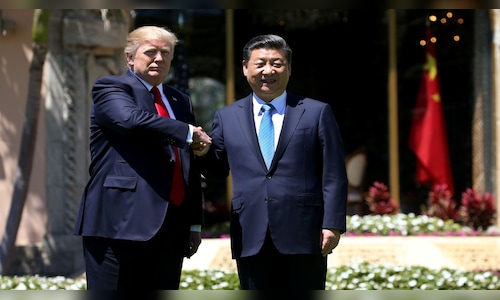
Adam Dixon, Adam Smith Chair and Director at Panmure House, along with Satoru Nagao, Non-Resident Fellow at the Hudson Institute, argued that the renewed US-China dialogue should not be seen as diminishing the significance of the four-nation alliance consisting of India, the United States, Japan, and Australia.
The Quad meeting coincides with US Secretary of State Marco Rubio’s visit to India for discussions on trade, defense, strategic technology, and regional security.
Concerns regarding the coalition’s future significance arose following the recent Trump-Xi summit, which indicated a potential warming of relations between Washington and Beijing.
Dixon dismissed the idea that enhanced US-China engagement would weaken the Quad’s influence.
“The Quad is comprised of democracies,” Dixon stated. “Trump aims to balance the relationship with China and foster a less adversarial atmosphere. Ultimately, that’s beneficial for international relations.”
He emphasized that the alliance remains crucial as it unites four key Indo-Pacific democracies with aligned strategic interests.
During his visit to India, Rubio characterized the Quad as a coalition of nations capable of shaping global events and referred to India as the keystone of America’s Indo-Pacific agenda.
Nagao contended that the US-China summit itself highlighted why the Quad holds strategic importance.
“The primary goal of the US-China summit is to stabilize competition,” Nagao noted. “But that implies that competition will persist.”
He asserted that the Quad’s original strategic aim—counterbalancing China’s escalating influence—remains intact despite efforts by Washington and Beijing to normalize ties.
“That’s why this represents a significant strategic inflection point,” he explained. “In the long run, China is the only nation capable of challenging the United States’ status.”
Nagao mentioned that the Quad meeting would provide member states a chance to better grasp Washington’s evolving strategy regarding China after the Trump-Xi discussions.
The analysts also highlighted increasing concerns surrounding maritime security and freedom of navigation, particularly amid rising tensions in West Asia.
Dixon indicated that the Quad would likely prioritize maintaining open sea lanes over engaging directly in discussions regarding Iran’s nuclear ambitions.
“Freedom of navigation is non-negotiable,” he cautioned, warning against any disruptions to shipping routes through the Strait of Hormuz.
This issue has gained traction as global energy markets remain sensitive to geopolitical uncertainties in West Asia.
Also Read | Energy ‘driving force’ behind Russia-China ties, Putin tells Xi
Nagao also addressed Japanese concerns regarding Trump’s recent comments on Taiwan, where the US President suggested that Taipei should refrain from pursuing formal independence.
While acknowledging some apprehension in Tokyo, Nagao asserted that most Japanese experts do not believe the US would forsake Taiwan due to its strategic significance.
“Taiwan is like a knife at China’s neck,” he remarked, alluding to the island’s geographic proximity to China’s coastline.
Also Read | Marco Rubio backs stronger India-US defence, trade and Quad ties
The Quad meeting in New Delhi is anticipated to emphasize regional security, critical minerals, resilient supply chains, and emerging technologies, including semiconductors and artificial intelligence.
Rubio’s India visit has also focused on trade talks and energy collaboration, with both parties indicating that advancements towards a bilateral trade agreement could materialize within weeks.