Remember the game where Ronaldinho elegantly maneuvered across the field to cheekily lob the goalkeeper, followed by his infectious grin and a Samba celebration at the corner flag? Or when Zinedine Zidane and Kaka dissected defenses with perfectly timed, placed, and weighted passes?
Think of the times when Steven Gerrard and David Beckham delivered pinpoint crosses from their own half while also threatening the top corner with long-range strikes. Recall the moments when Arsenal legend Thierry Henry broke through defenses to score against all odds.
Now, that game has morphed into a series of orchestrated corners and meticulous “game management,” regardless of the scoreline or the opponent, marked by intentional risk aversion.
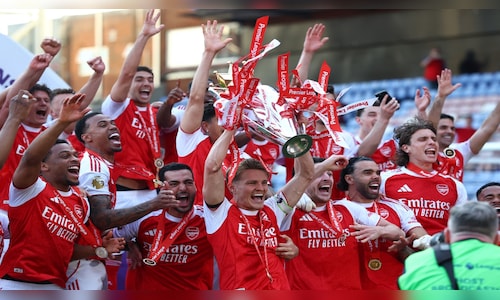
This is the formula that secured the Gunners their 14th league title, transforming ‘1-nil to the Arsenal’ from a catchphrase into the standard. The Champions of England scored from corners 19 times, surpassing their own record from the previous season, with 11 of those goals breaking the deadlock in matches.
Of the 71 goals scored by the now 14-time champions, only 42 came from open play, marking the lowest tally of goals from open play for any team lifting the sought-after Premier League trophy. Notably, 15 of Arsenal’s 26 victories were won by a single goal margin.
The beautiful game has been in decline for some time, and this version of Arsenal F.C. under Mikel Arteta resembles what Marcus Junius Brutus was to Julius Caesar—the final blow to a once-celebrated legacy.
Yet, this isn’t necessarily a negative outcome. As the saying goes, ‘The King is dead; long live the King!’ This transformation is precisely what the Gunners required, and it represents a new phase in football—just another evolution since the first leather ball was kicked into the net.
After collecting a hat trick of runner-up medals, the former Arsenal captain turned coach faced two choices: another second-place finish filled with poetry in motion or a League title built on structured, disciplined, ‘boring’ victories. His decision to implement the latter has resulted in a multi-million dollar success.
Claiming that Arsenal’s triumph was solely based on an impenetrable defense would be an understatement. Conceding just 27 goals and allowing 8.2 shots per game, it’s no surprise that Arsenal’s back line was considered unassailable.
Interceptions and tackles served as the key ingredients for this achievement. Over 160 crucial tackles and interceptions ensured that the defensive line faced fewer than 20 clear-cut chances throughout the season. For perspective, the second-best team—Brighton—allowed over 30 chances. Interestingly, despite Arsene Wenger’s reputation for “free-flowing football,” his first title win also utilized a similar approach.
During his tenure, the backline featuring Lee Dixon, Tony Adams, Martin Keown, Nigel Winterburn, and Steve Bould conceded only 17 goals— the second fewest in league history—drawing 12 games to achieve “only” 78 points. Even with a knack for “favoring the dark arts,” Arteta’s squad controlled 62.4% possession in the final third.
Man-management has also been a critical aspect of Arteta’s landmark success.Injuries during previous seasons led the manager to strengthen each position with solid replacements, guaranteeing both continuity and competition within the squad—essential elements for any silverware chase.
The prior season marked 36 injury incidents, with an average of 6-7 first-team players sidelined each week. Although this season’s challenges were mitigated, Arsenal’s influx of summer signings ensured that long-term injuries to players like Martin Ødegaard, Bukayo Saka, and Kai Havertz did not adversely affect their performances in Europe or England.
This constant rotation in personnel necessitated a formulaic approach to success, which corners and overt risk aversion provided. Thus, Arteta had to restrain the beautiful game to achieve this legendary feat. Indeed, it seems likely that this results-driven mindset will be increasingly rewarded as time goes on.
Having completed his much-discussed ‘process,’ Mikel Arteta now has the opportunity to revive the beautiful game once more. We witnessed glimpses of this in the season finale against Crystal Palace. Thus, while Arteta’s methods may continue to draw scrutiny, reaching this pinnacle of English football has granted the Arsenal veteran the space to redefine what beauty means in the sport.