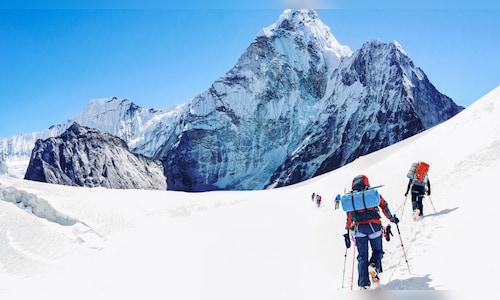
Currently, around 410 climbers, alongside an equal number of Nepali climbing guides, are stationed at the base camp, preparing for their ascent to the nearly 8,850-meter-high (approximately 29,000-foot-high) peak this month, during the eagerly awaited weather window.
Climbers started arriving at the base camp last month, which sits at an elevation of 5,300 meters (17,340 feet). However, for over two weeks, a large and unstable ice block, known as a serac, hindered their progress up the mountain.
“Icefall doctors,” expert guides assigned by the Sagarmatha Pollution Control Committee (SPCC), usually complete the yearly climbing route by mid-April, where they set ropes and secure aluminum ladders over crevasses.
This year, however, was different.
The team managed to open the Icefall route only on April 29, but they also issued a caution: “The serac has numerous cracks and could collapse at any moment. SPCC strongly advises all expedition operators and climbers to exercise extreme caution.”
It’s expected that the serac will remain, and the newly established trail lies beneath it.
This serac is part of the Khumbu Icefall, a glacier in constant motion with deep crevasses and massive overhanging ice blocks, some as large as ten-story buildings. It is regarded as one of the most challenging and perilous parts of the climb to the summit.
Climbers, their guides, and expedition organizers are both eager and wary of the conditions on the mountain.
Renowned mountaineer Lukas Furtenbach, who has 40 international climbers, 11 guides, and 90 Sherpas on Everest, expressed his concerns.
“Anyone who claims not to be worried is either inexperienced or ignoring the facts,” Furtenbach stated from base camp. “The serac poses a genuine, tangible threat.”
He noted that the route this year is more intricate and exposed than it was last year in certain sections.
“The Icefall is ever-changing, but currently, it’s not just more fractured — it’s also directed along a path that goes under unstable formations,” he explained.
This season, the team is taking precautions by reducing loads, limiting exposure time, timing crossings through the Icefall meticulously, and depending on highly skilled Sherpas and guides for risk evaluation.
Other expedition leaders are also warning their members about the dangers and keeping a close watch on developments.
“Going in the morning could be safer, as the ice is frozen; however, in the afternoon, it becomes hazardous due to rising temperatures, increasing the risk of melting ice falling,” noted Ang Tshering Sherpa from Asian Trekking in Kathmandu. “Caution is essential this year.”
A falling serac caused an avalanche in the Khumbu Icefall in 2014, resulting in the deaths of 16 Nepali guides and workers.
Concerns are mounting regarding the rapid melting of glaciers due to global warming and climate change. In 2023, U.N. Secretary-General António Guterres visited a mountain in Nepal to highlight the alarming rate of glacier melt in the Himalayas.
According to Ang Tshering Sherpa, a substantial number of climbers are present on Mount Everest this season, despite ongoing conflicts in Iran and rising travel costs. Although the number of climbers from Western countries like the U.S. and Europe has decreased, there’s been an increase of climbers from Asia.
Mount Everest, located along the Nepal-China border, has climbing routes on both sides. However, China has closed its route this year, compelling all climbers to attempt the ascent from Nepal’s southern side.
Since it was first summited on May 29, 1953, by New Zealander Edmund Hillary and Sherpa guide Tenzing Norgay, thousands of people have successfully climbed the peak.