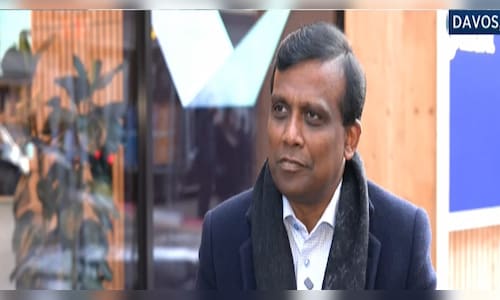
“If anyone had told me this is where we would find ourselves at the end of three years, I would gladly accept it,” Kumar stated in an interview with CNBC-TV18 during the World Economic Forum 2026 in Davos. “The initial three years focused on stabilization, while the next few will emphasize bold initiatives.”
No More Turnaround
Kumar, who became CEO in 2023, noted that Cognizant has significantly improved its performance and is now positioned in the upper quartile compared to peers, based on the most recent quarterly report.
With attrition at a record low, high customer satisfaction ratings, and organic growth returning at a competitive pace, Kumar believes these factors provide Cognizant with the confidence to think more ambitiously.
“Organic growth needs to be the foundation,” he explained. “Once that is established, we can layer substantial bets on top.”
AI as a Catalyst for Rebuilding
Central to these significant bets is a fundamental shift in Cognizant’s role within the enterprise technology landscape. Kumar contends that AI enables IT service companies to transcend beyond just systems integrators and rediscover their foundational identity as builders.
“With AI, we can create tailored, agentic capital,” he remarked. “Technology is now deeply integrated with enterprise operations, not merely IT. This greatly broadens the potential expenditure.”
He outlined two primary “swim lanes” for Cognizant’s AI strategy. The first involves modernizing decades of traditional software development by collaborating with machines. Cognizant recently orchestrated a company-wide “white coding” initiative, which saw 250,000 employees participate simultaneously, earning a Guinness World Record.
“That’s the culture we aim to foster — developing software for the future in tandem with machines,” Kumar added.
The second lane focuses on what he refers to as “Software 2.0” — leveraging machine-assisted development cycles, where software is increasingly produced by machines and validated by humans.
“This represents a much larger opportunity, but it also requires us to rethink and disrupt our historical approaches to software development,” he asserted.
Transformative Pricing Models
Kumar views AI as an opportunity for a fundamental shift in IT service pricing. For the first time, Cognizant envisions moving away from traditional linear, effort-based billing toward outcome-based pricing.
“As a builder, we aspire to own the entire value chain — from LLM access and computing to platforms and human capital — delivering it as a comprehensive package,” he stated. “We take on the risks and the results.”
Cognizant has established partnerships with Anthropic, Google, and Microsoft as part of this approach, positioning itself as a platforms-centric service provider rather than just a provider of labor.
Exploring a Secondary Listing in India
In addition to its AI initiatives, Cognizant is investigating a secondary listing or IPO in India — a step that would position it as one of the first American-listed IT services firms to pursue such a move.
Kumar mentioned that the company is currently in talks with Indian regulators, describing the discussions as constructive yet complex due to the lack of historical precedent.
“We’re collaborating with regulators in India. This is a unique initiative, and we bear the responsibility of guiding the process,” he noted.
While Kumar did not specify a timeline and acknowledged the difficulty in predicting if 2026 would be the year, he emphasized a strong strategic intent.
“There is a pool of investors in India eager to delve into tech services,” he mentioned. “IT services serve as a proxy for AI, and there is considerable interest from mutual funds and retail investors. Attracting a new category of shareholders would be beneficial.”
Also Read: WEF 2026 | AI will alter jobs as Indian IT embarks on a new growth phase: Cognizant CEO
Revisiting M&A Strategies
With revitalized confidence, Cognizant is open to pursuing significant acquisitions, especially in AI platforms, various industry sectors, or regions where it is currently underrepresented, such as Europe and the Asia-Pacific.
Kumar referenced the 2017 acquisition of TriZetto — which helped position Cognizant as a leader in healthcare services — as a testament to the company’s platform-building ethos. The more recent acquisition of Belcan has further solidified its commitment to strategic growth.
“M&A should complement organic growth,” he stated. “Now that we have regained our growth momentum, M&A can become a powerful tool.”
Here’s an excerpt from the interview.
Q: It has been three years since Ravi Kumar S took over as CEO of Cognizant and instituted a turnaround plan. Reflecting on this, can you provide your assessment after three years?
Kumar: If someone had said this is the outcome after three years, I would accept it. The initial three years were focused on stabilization, while the upcoming years will emphasize bold initiatives. During the first three years, we climbed the charts and, relative to our peers, we’re now in the upper quartile based on our public earnings announcement for Q3. I’m pleased with our current position, but the next three years will focus on bold initiatives.
Q: What do you mean by big and bold bets in terms of investment size and type?
Kumar: If we look back at our history, we were once known as builders who developed custom software. We transitioned to systems integrators over two generations of enterprise software development — one with SaaS and one with on-premises solutions. Now, with AI, we can return to being builders, developing tailor-made, agentic capital. This expands our role and our potential spend because technology is now inseparable from enterprise operations.
This presents a monumental opportunity. There are two pathways to realize this. The first is to take the classical software we’ve developed over the last few decades and modernize it — writing it in collaboration with machines. Our “white coding” initiative saw 250,000 employees simultaneously coding, setting a Guinness World Record. This reflects our commitment to evolving our software development practices in conjunction with machines.
The second path involves creating agentic capital distinct from traditional software development cycles — a concept I term “Software 2.0.” This approach opens up immense possibilities, allowing us to design software with the aid of machines that is then validated by humans, contrasting with previous methods specified entirely by human input. The potential here is vast, but we must also revolutionize our past practices.
Q: Regarding the potential secondary listing or IPO in India, what progress has been made? How close are we to a decision?
Kumar: We are actively engaging with Indian regulators. This is a groundbreaking endeavor, and we bear the responsibility of guiding the regulators as we navigate this process.
Q: How near are we to completion?
Kumar: Predicting this is challenging. Indian regulators are quite open to new opportunities. As an American-listed enterprise considering a secondary listing in India, we seek to tap into the interest from the Indian investor base — particularly given the potential demand from tech service investors. There’s an emerging pool of mutual fund investment, supported by India’s expanding middle class. Capturing this opportunity for Cognizant represents a significant venture.
Q: What inquiries are regulators making?
Kumar: Regulators have various questions since this is a fresh undertaking. However, our discussions are ongoing and constructive, and I’m pleased with the outreach we’ve had.
Q: Do you anticipate 2026 could be the target year?
Kumar: That’s difficult to ascertain. These matters are inherently unpredictable, but we will make an effort. Our goal is to undertake initiatives that maximize value for our shareholders. Attracting new shareholder categories would be beneficial, given the prominence of IT services as a sector in India.
Q: Returning to the discussion on bold initiatives, acquisitions have played a vital role in your strategy, with a notable one being Belcan. What’s the current appetite for significant M&A?
Kumar: I maintain that M&A should supplement organic growth. We’ve recovered our organic growth and are now performing at a higher rate than many industry competitors. This positions us to make substantial bets, particularly in areas like AI and platform development. Our history, such as the TriZetto acquisition that established us as the leading healthcare service provider, underscores this commitment.
Furthermore, our presence in Europe and Asia-Pacific lags behind that of our peers, offering potential avenues for growth, as well as opportunities in specific industry sectors. We can integrate M&A into our organic growth strategy. Organic growth must remain our foundation.
With present confidence — exemplified by record-low attrition rates and high customer satisfaction — we are keen to pursue substantial M&A opportunities. We are also enhancing our partnerships with organizations like Anthropic, Google, and Microsoft. As builders, we aim to own the entire value chain — from LLM access and computing to platforms and human resources — and deliver a comprehensive service package to clients. This approach enables clients to engage with us as builders, where we assume both risks and results. For the first time in technology services, we can transition from linear pricing to outcome-based models. That’s a significant, bold initiative for us.
Watch the accompanying video for the full conversation.