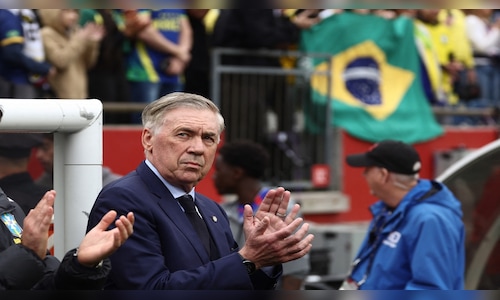
Carlo Ancelotti, one of the most accomplished coaches of his era, departed Real Madrid to steer Brazil’s national team last year, marking a unique instance of a foreign coach at the helm of the Seleção. While his results have been inconsistent — tallying five wins, three losses, and two draws — there’s a prevailing optimism that he can uplift a squad viewed as less glamorous compared to Brazil’s legendary teams of yesteryear, despite star players like Neymar and Vinicius Júnior being present.
Brazil boasts five World Cup victories — more than any other nation — but hasn’t claimed the trophy since 2002, an eternity for a country consumed by soccer, which has given rise to some of the greatest players ever, including Ronaldo, Ronaldinho, and Pelé.
Since 2002, Brazil has only advanced beyond the quarterfinals once — as the host nation in 2014 — and that campaign ended in dismay following a humiliating 7-1 semifinal defeat to Germany, the eventual champions.
Recent years have done little to bolster Brazil’s confidence, especially in light of archrival Argentina’s success, the reigning World Cup champions and two-time Copa America winners.
“It is allowed to believe,” Ancelotti says in a promotional campaign centered around the World Cup, acknowledging the self-doubt that has crept into Brazil’s soccer mindset.
The Brazilian team kicks off its World Cup journey at MetLife Stadium in New Jersey on June 13 against Morocco, semifinalists from the 2022 World Cup. Their other Group C opponents include Haiti and Scotland.
In Brazil, merely surviving the group stage is assumed — failing to do so would spell disaster in a World Cup that has expanded from 32 to 48 teams. The extent to which Brazil can advance against tougher rivals in the knockout stages remains uncertain.
“I have confidence in this team’s ability to compete with the best globally. Can we win the World Cup and make it to the final? Absolutely, we can reach the final. But whether that will be enough remains to be seen; ideally, we want to not only get there but win it,” Ancelotti stated on May 18.
A major dilemma for Ancelotti revolves around 34-year-old Neymar, who was once Brazil’s standout player but transitioned to a high-paying role in the Saudi league in 2023, where he struggled with a series of knee injuries. He returned to his hometown club Santos last year, only to face additional injuries.
Despite fitness concerns, Ancelotti named Neymar in his World Cup squad, labeling him an “important player” for the team. Barcelona winger Raphinha echoed this sentiment, describing Neymar as “the man of our sixth World Cup title.”
Should that transpire, it will come with a more structured game plan compared to the spontaneous style that previously distinguished Brazil in world soccer.
Known for his tactical prowess, Ancelotti has molded Brazil into a team that prefers to hold back and capitalize on counterattacks instead of monopolizing possession. He frequently employs a compact 4-4-2 formation that can swiftly transition into an attacking 4-2-4.
The Brazilian public generally views Ancelotti favorably, even if results thus far have been mixed. Under his leadership, Brazil secured two wins, one draw, and one loss in World Cup qualifiers, finishing fifth in the South American standings behind Argentina, Ecuador, Colombia, and Uruguay.
In more recent friendlies, Brazil triumphed over Croatia — who eliminated them from the 2022 World Cup in a quarterfinal shootout — yet fell short against France, the 2022 runner-up.
Filipe Luís, a former Brazil left-back now embarking on a coaching career, referred to Ancelotti in April as “the best thing that happened” to the national setup.
“There are no guarantees we will win anything,” he remarked. “But we needed someone of stature, someone competent enough to make critical decisions. A respected figure who understands Brazil’s long wait for another World Cup victory.”
Ancelotti stepped in after a chaotic period for Brazil.
The team faced challenges in qualifying for the 2026 World Cup, losing twice to Argentina, and was eliminated by Uruguay in the quarterfinals of the 2024 Copa America. Three coaches came and went — caretakers Ramon Menezes and Fernando Diniz in addition to full-time coach Dorival Júnior were all let go amid poor performances and fan backlash.
In the meantime, Brazil sought Ancelotti, whose second term at Real Madrid seemed to be winding down despite guiding the team to victories in both the Champions League and Spanish league in 2024.
So confident is the Brazilian soccer confederation in its choice that it has already extended Ancelotti’s contract until the 2030 World Cup.
“We have an incredible individual leading our national team, a man who commands respect from all quarters,” Luís stated. “This World Cup is an opportunity for us to build upon that.”