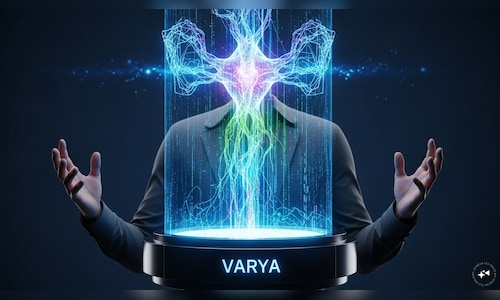
In an interview with CNBC Awaaz, co-founder Sravanth Aluru highlighted the significant real-world applications for Varya, particularly in education, commerce, and the creator economy.
He explained that in the educational sector, AI-generated videos can enhance student learning through engaging tutorials and visual explanations. For commerce, local shopkeepers and businesses can leverage video content to better promote their products and connect with a wider audience.
Aluru also addressed the expansion of the creator economy, pointing out that platforms like YouTube and TikTok have demonstrated the growing importance of video content. He anticipates that this trend will continue to escalate.
However, he noted that India’s video content market has yet to realize its full potential due to high production costs. Despite the availability of AI tools, video creation remains expensive, limiting accessibility for many users.
Varya aims to tackle this issue by significantly reducing the cost of video generation. Aluru compared it to Alibaba’s Wan 2.2 model, claiming Varya achieves comparable quality at nearly 27 times lower cost.
As reported by the company, generating video using Varya costs around ₹0.50 per second. In contrast, global AI video models like Google Veo, Kling, Luma, and Runway charge roughly $0.10 per second (equivalent to about ₹9.51 per second).
With Varya, users can create approximately 211 seconds of video content for every ₹100 spent, compared to just 3 seconds with Google Veo 3.1 and about 7 seconds with ByteDance’s Seedance 2.0.
Outlook notes, “India’s AI opportunity will not be determined solely by the largest models, but also by the most efficient ones. For a nation of 1.4 billion, affordability is not a nice-to-have; it is a necessity,” noted Aluru.
“We envision the next billion stories, lessons, ads, services, and experiences being generated through AI, and these capabilities should be accessible to all,” he further stated.
The company has also garnered support from the government as part of the India AI Mission. Last year, 12 startups, including Avataar.ai, were chosen to develop AI systems, gaining access to affordable computing resources (GPU resources), which are vital for training substantial AI models.
Earlier this year, IT Minister Ashwini Vaishnaw announced that India is gearing up for a significant expansion in the AI sector. The government aims to attract around $200 billion in investments by 2028 while also planning to more than double the country’s GPU computing capacity within the next six months.