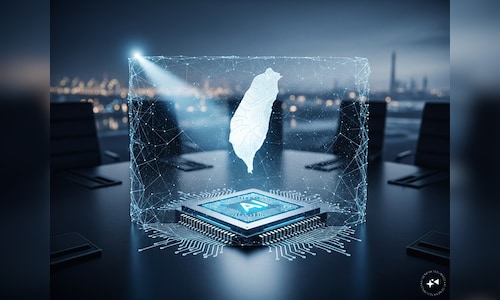
The objective is to equip authorities with more legal mechanisms to tackle the diversion of advanced technology, such as AI servers utilizing Nvidia Corp. chips, from Taiwan to China. Current U.S. regulations already prohibit such sales without government approval, as measures were first introduced in 2022 to stop Beijing from leveraging advanced Nvidia processors for military superiority.
However, Taiwan does not classify unauthorized exports of AI chips to China as criminal activity. While local authorities caution prospective sellers that they might violate U.S. regulations if they proceed, the only legal actions available through Taiwan’s courts involve charging suspected smugglers under other existing local laws.
This higher threshold poses challenges for the cases Taiwan can pursue. Last month, Taiwanese authorities made their first known arrests of alleged chip smugglers on charges of document forgery.
Currently, as part of ongoing trade discussions with the U.S., officials in Taipei are considering enforcing more robust AI chip regulations, which would prohibit sales to all clients in China, rather than just targeting specific entities on an export blacklist like Huawei Technologies Co. This would enable Taiwan to criminalize AI chip smuggling to China for the first time.
If enacted, these controls would represent one of the most extensive measures taken by President Lai Ching-te’s administration to protect Taiwan’s technological and national security interests, as Taipei navigates its levels of comfort with more assertive policies while managing U.S. pressure on various fronts.
Much remains undecided. Taiwan has signaled its intent to generally follow the U.S. model and may consider restricting sales of AI chips with processing capabilities above a certain limit, akin to U.S. practices. Nevertheless, Taipei has not fully resolved how extensively it will adopt American policies, and is still finalizing details before senior officials from both sides can evaluate and approve the potential agreement.
Requests for comments from representatives of the American Institute in Taiwan—the unofficial U.S. embassy—and the island’s International Trade Administration went unanswered. Nvidia also did not respond to inquiries outside regular business hours.
Any initiatives to limit AI chip sales are likely to elicit a response from President Xi Jinping’s government, which regards Taiwan as its territory—a claim the self-governing island democracy strongly opposes.
Last year, following Taiwan’s blacklisting of Huawei and semiconductor giant Semiconductor Manufacturing International Corp., a spokesperson from China’s Foreign Ministry remarked that “the DPP authorities’ submissive behavior towards the U.S. will only damage Taiwan’s interests,” referring to Lai’s ruling Democratic Progressive Party.
New restrictions aimed at China could also have repercussions for industry leaders in Taiwan, which accounts for a significant share of the world’s AI chip production and houses many companies that integrate Nvidia processors into servers used extensively in data centers for AI model training and operation. Taiwan authorities have not accused any companies of misconduct.
It is a challenging situation, and leaders in Taipei have previously expressed unease about imposing restrictions on a sector that has propelled Taiwan to become the world’s fifth-largest stock market.
Last year, Taiwan restricted AI chip exports to South Africa during a disagreement over its de facto embassy location, only to reverse that decision two days later. Foreign Minister Lin Chia-lung indicated afterward that Taiwan does not wish to weaponize semiconductors, while stating, “if our counterparts harm our interests, we must respond.” Beijing criticized Taiwan’s actions during that period.
In June, when Taiwan apprehended individuals connected to chip smuggling on document forgery charges, the associated press release did not mention the suspected transshipment location—Japan—or authorities’ belief that the defendants had already sent at least one batch of servers there before transferring them to Hong Kong.
Simultaneously, Lai committed last year to addressing unspecified U.S. concerns regarding export controls. Under his leadership, Taiwan has adopted a progressively hawkish stance on safeguarding the island’s technology sector.
In April, a Taiwanese court sentenced an engineer from Tokyo Electron Ltd. to ten years in prison for stealing proprietary information from Taiwan Semiconductor Manufacturing Co., which is crucial to Nvidia and the Taiwanese economy. In November, prosecutors conducted searches at the homes of a former TSMC executive suspected of leaking trade secrets to Intel Corp.
Last June, after years of U.S. urging that Chinese chip giant Huawei assists the mainland’s People’s Liberation Army, the Lai administration reached that conclusion independently. It blacklisted both Huawei and its manufacturing ally SMIC, prohibiting Taiwanese businesses from engaging with these Chinese entities without government authorization.
If Taiwan advances toward criminalizing AI chip smuggling, it would distinguish itself in a region historically pressured by the U.S. to prevent China from accessing restricted technologies, while simultaneously managing their own relations with the world’s second-largest economy.
For instance, Malaysia has been a point of concern for the U.S. regarding its potential role in facilitating the transfer of Nvidia chips to China. Last year, the Southeast Asian nation agreed to fully align its AI processor regulations with U.S. standards as part of a broader reciprocal trade agreement, marking a significant milestone following extensive negotiations.
However, it remains unclear if Malaysia has made any strides in implementing this initiative, especially following statements by its trade minister that cast doubt on the overall agreement’s status. The Ministry of Investment, Trade and Industry in Kuala Lumpur declined to provide comments.
On the other hand, Singapore has not shown an interest in enforcing controls on AI chips, opting instead to combat semiconductor diversion through existing local laws while reminding businesses of their obligations under U.S. semiconductor restrictions.
Singapore is currently prosecuting several individuals for misleading AI server suppliers regarding the final destination of hardware initially shipped to Malaysia, a case reminiscent of Taiwan’s prosecution focused on document forgery.