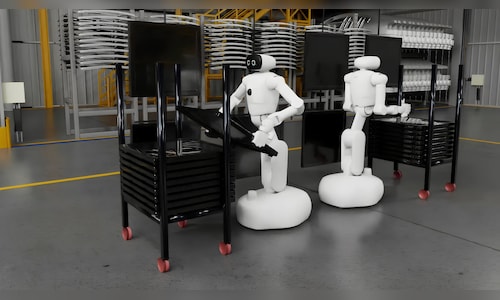
“We are collaborating on motor technologies as well as mechanical systems to advance humanoid robotics and the future of robotics,” Huang stated.
“We’re also assisting LG in designing future data centers,” he added. His comments highlight the deepening collaboration between Nvidia and LG Group in areas such as robotics, manufacturing, AI infrastructure, mobility, and sovereign AI technologies.
The two companies are establishing an AI factory to bolster LG Group’s AI-driven ventures, which include robotics, autonomous driving, data center technologies, and GPU cloud services.
This AI factory will deliver computing infrastructure to train, simulate, validate, and implement AI applications, merging Nvidia’s AI platform with LG Group’s strengths in consumer electronics, robotics, mobility, smart spaces, and data center technologies.
The objective is to integrate AI model development, robot simulation, training, physical AI data generation, edge deployment, and factory-scale digital twins into a cohesive workflow.
Robotics collaboration
LG Electronics intends to utilize Nvidia’s Isaac Sim and Isaac Lab robotics frameworks to simulate, train, and evaluate home robots before their deployment. The company is also investigating the application of Nvidia’s Isaac GR00T model for home and modular robots.
Nvidia and LG Electronics are set to collaboratively develop reference robots within the Isaac GR00T ecosystem.
To facilitate robotics development, LG Electronics is constructing a physical AI data factory that will employ Nvidia Cosmos world foundation models to produce and enhance training data.
LG Innotek plans to supply robotics components, including sensing solutions, specifically designed for Nvidia development environments and GPU architecture. Meanwhile, LG CNS will integrate Nvidia’s robotics technologies into its PhysicalWorks industrial robot platform aimed at manufacturing and logistics applications.
Data center initiative
The companies are also enhancing their collaboration on AI factory infrastructure. LG Electronics is partnering with Nvidia on cooling solutions, such as cooling distribution units and cold plates, along with prefabricated modular designs in line with Nvidia’s DSX AI factory platform.
LG Uplus, together with LG Electronics and LG Energy Solution, plans to construct AI factories based on Nvidia DSX. Additionally, LG CNS aims to create AI factories powered by Nvidia GPUs, while LG Uplus is focused on developing a large-scale AI data center capable of accommodating Nvidia’s latest GPUs.
LG Energy Solution is set to collaborate with Nvidia on 800-volt direct-current energy solutions for future data centers.
Mobility and AI
In terms of mobility, LG Electronics is aligning its advanced driver-assistance systems and in-vehicle AI technologies with Nvidia DRIVE platforms, including DRIVE Hyperion and DRIVE AGX, for autonomous driving and software-defined vehicles.
Separately, Nvidia and LG AI Research are working together on EXAONE, a series of Korean sovereign AI models. LG AI Research utilized Nvidia hardware, software, and datasets for model development, while LG Group is exploring broader applications of EXAONE and agentic AI technologies within its operations.