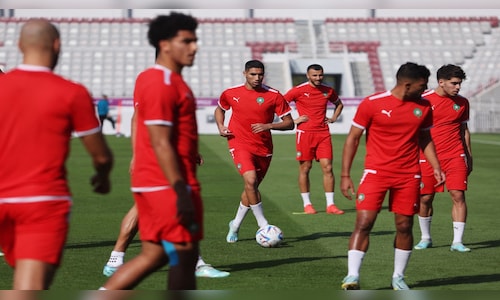
Morocco found itself at the center of controversy following its hosting of the latest Africa Cup of Nations — three years after the Atlas Lions made history as the first African squad to reach the World Cup semifinals.
Morocco’s incredible journey to the semifinals during the Qatar tournament — featuring knockout victories over Spain and Portugal, with whom it will co-host the 2030 World Cup — thrilled fans and rallied support throughout Africa.
However, the tumultuous Africa Cup final against Senegal in January remains fresh in the minds of many, with Morocco being named champion two months after losing the match 1-0 in extra time.
Initially, Senegal was crowned the Africa Cup champion after defeating Morocco in the final on January 18 in Rabat. However, the Confederation of African Football later rescinded the title on March 17, determining that Senegal should forfeit the match due to players walking off the field in protest over a late penalty call, only to return and complete the game. This decision transformed Senegal’s 1-0 win in extra time into a 3-0 default victory for Morocco.
Senegal has lodged an appeal with the Swiss-based Court of Arbitration for Sport. Subsequently, the Senegal squad paraded the trophy in Paris.
Moroccan celebrations have been subdued as they await the outcome of the ongoing appeal.
Morocco’s players are hopeful to move past the political drama and focus on their game following the repercussions of CAF’s unprecedented ruling.
The Atlas Lions are set to compete against five-time champions Brazil at New York New Jersey Stadium on June 13, followed by a match against Scotland at Boston Stadium six days later. They will conclude Group C with a game against Haiti at Atlanta Stadium on June 24.
Achieving success at the tournament co-hosted by Canada, Mexico, and the United States is crucial for a nation aiming to establish itself as a football powerhouse. Being a 2030 World Cup co-host is part of this ambition.
Moroccan coach Walid Regragui, who took the reins shortly before leading the team to the 2022 World Cup semifinals in Qatar, resigned after the Africa Cup in January — just months before the CAF awarded his team the title.
Despite the remarkable World Cup achievement, Regragui faced scrutiny over the team’s performance and received criticism following an unsatisfactory showing at the 2023 Africa Cup of Nations in Ivory Coast.
Mohamed Ouahbi, who guided Morocco’s under-20 team to the Youth World Cup victory in 2025, has succeeded Regragui and led the team to a draw against Ecuador and a win over Paraguay in March’s World Cup warm-up matches.
Key right back Achraf Hakimi has been sidelined due to a right thigh injury and is racing against time to be fit for the World Cup. He also faced an ankle injury during Morocco’s Africa Cup campaign but managed to return just in time for the knockout stage.
Brahim Díaz shone during the Africa Cup, scoring five goals — nearly one per match — aiding Morocco’s push to the final. The Real Madrid forward, who struggled for playing time at the Spanish club, thrived at the forefront of Morocco’s attack, driving the team forward with relentless energy.
Brahim appeared poised to clinch the title with a controversial penalty awarded to his team at the end of the final against Senegal, but the decision sparked uproar and altercations at the other end of the pitch. By the time Senegal’s players returned from their protest, about 16 minutes had passed.
Brahim’s feeble attempt at a Panenka penalty was comfortably saved by goalkeeper Édouard Mendy, leading Senegal to victory in extra time.
Brahim faced jeers from the Moroccan fans when he received his runner-up medal and did not start in either of the team’s recent matches under Ouahbi.