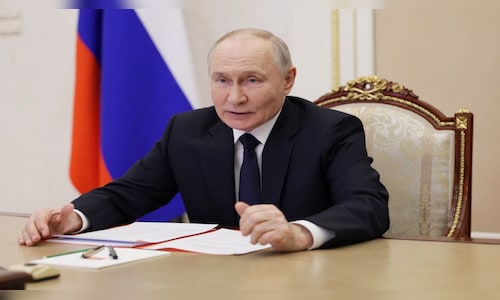
During his address at the Saint Petersburg International Economic Forum on June 5, Putin noted that India holds a substantial portion of the worldwide software market and has gained international acclaim for its highly skilled tech workforce.
“I wish to acknowledge yet another crucial partner of ours, India, recognized as one of the foremost participants in the IT sphere. It holds a noteworthy share of the global software market,” Putin remarked in the plenary session.
Applauding India’s capabilities, he added, “We recognize the exceptional talent of the Indian populace, their education, and their competence. They have garnered global recognition, particularly in coding.”
Putin on India and Russia ties
Characterizing India as an essential ally, Putin stated that the nation’s technological advancements reflect the strength of its human capital and skilled labor force. He underscored the enduring relationship between India and Russia, describing it as “very good, trust-based, brotherly relations in every sense of the term.”
BRICS economies
Putin shared these insights while addressing the increasing economic and technological clout of emerging markets, especially the BRICS group. Speaking at the forum, he remarked that BRICS nations are contributing a greater portion to global economic growth than the Group of Seven (G7) countries.
According to Putin, BRICS economies represented 49% of global GDP growth in the last five years, in contrast to approximately 18% from G7 nations. He also observed that BRICS countries now account for about 40% of global GDP assessed by purchasing power parity, while the G7 comprises less than 29%.
Putin stated that the bloc surpassed the G7 back in 2020, with expectations that this gap will continue to widen in the future. He predicted an annual growth rate exceeding 4% for BRICS economies, compared to approximately 1.1% for G7 countries.
“These figures are backed not only by us but also by the World Bank and the IMF. Naturally, it’s more appealing to invest in areas where development is most vigorous and where opportunities for production and sales exist. As a result, the center of global trade and the financial system is undergoing a shift, a trend that is likely to continue,” he concluded.