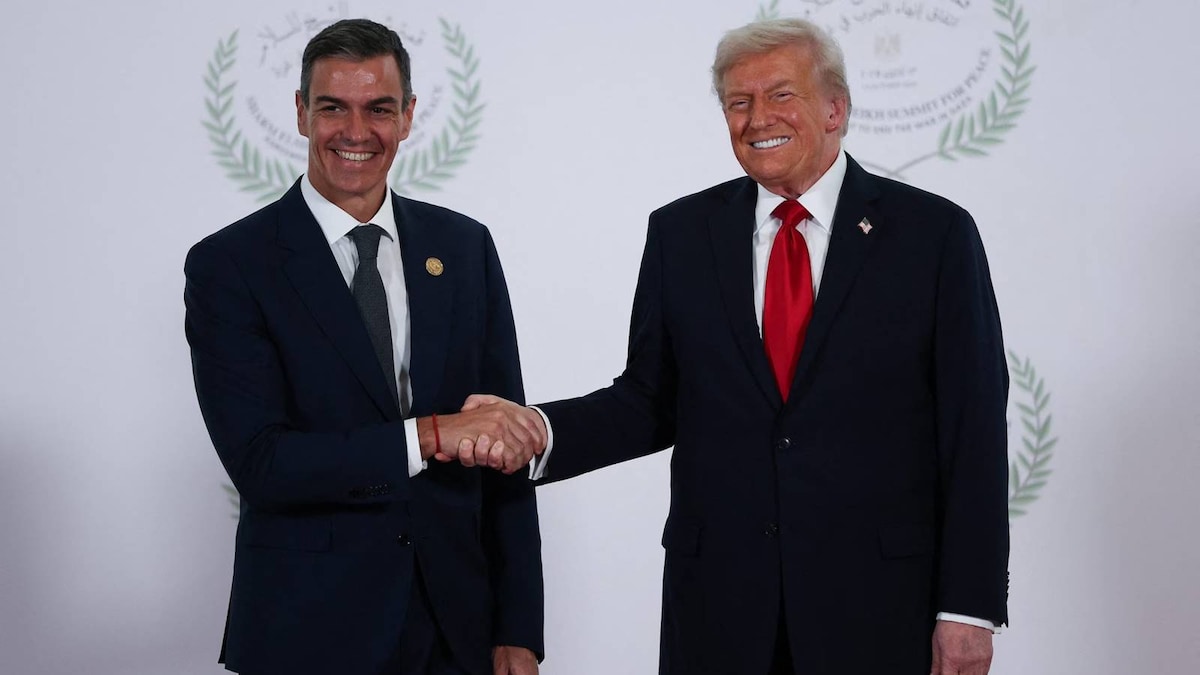
During a NATO summit in Ankara on Wednesday, Trump referred to Spain as a “terrible partner” and demanded an immediate end to all trade with the nation following disputes about defense spending and the Iran conflict.
While returning to the United States aboard Air Force One, he told reporters: “I had some issues, and I still have. However, Spain has fully come through today. They were quite generous.”
When asked about Spain’s actions, he stated: “They honored a request for substantial payments, and had they not done so, we wouldn’t have even discussed it.”
A spokesperson for Spanish Prime Minister Pedro Sanchez commented that this was understood to refer to Madrid meeting NATO’s previous defense spending target of 2% of GDP.
At the summit, Sanchez emphasized that Spain is on track to meet that goal this year, having significantly increased nominal defense spending from 0.98% of GDP in 2017 to nearly €33 billion ($37.7 billion). He downplayed the disagreement and noted having a “very cordial” discussion with Trump.
However, Trump has consistently criticized Spain for not agreeing to a new NATO target for member states to allocate 5% of GDP on defense by 2035. The left-leaning Spanish government argues for responding to genuine threats rather than simply increasing spending, as such an approach could require cuts to social benefits.
The implications of Trump’s softened rhetoric on his trade threat remain unclear.
When asked about the next steps after Trump’s statement, a U.S. official in Washington informed Reuters that relevant federal agencies would provide Trump with a “menu” of Spanish products that could be affected by an embargo.
Trade attorneys suggest that Trump might use the International Emergency Economic Powers Act to apply a complete or partial embargo on Spanish imports. The prior administration had imposed a 30% anti-dumping tariff on Spanish black olives in 2018.
OPPOSITION CRITICISM
According to the Spanish government’s agenda, Defence Minister Margarita Robles was scheduled to meet with U.S. Ambassador Benjamin Leon later on Thursday for a “working meeting,” with no further details provided.
Sources from the Spanish delegation in Ankara, cited by El Mundo, indicated that Madrid considered the dispute akin to a staged fight with no actual conflict, noting that Spanish officials had not observed any economic repercussions or drop in investment in Spain in recent years despite Trump’s critiques.
Some members of the main opposition People’s Party (PP) held Sanchez responsible for the disagreement but asserted their support for the nation.
A senior PP official pointed out the interdependence of Spanish and U.S. companies, suggesting that “economic reality outweighs the grandiose statements (Trump) makes to criticize Spain.”
In the PP-administered region of Aragon—where major U.S. tech firms like Amazon and Microsoft have invested billions in data centers—officials reported that it was business as usual.
Santiago Abascal, a Trump ally and leader of the far-right party Vox, described the tensions with Washington as “absolutely dramatic,” accusing Sanchez of “undermining Spain’s credibility on the world stage.”