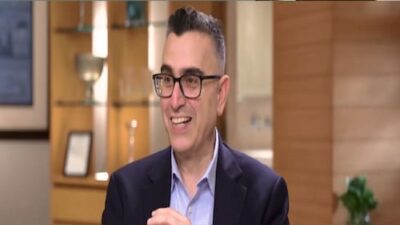
In an interview with CNBC-TV18, Afshar noted that the swift emergence of agentic AI — systems capable of reasoning, executing workflows, and learning autonomously — marks the fastest technological transition he has encountered in his 30 years within the tech sector.
“We spoke in the middle of 2024, and since then Salesforce has transformed into an agentic enterprise,” Afshar mentioned, revealing that the company now serves over 25,000 customers worldwide with its Agentforce AI solutions.
“I have never seen the speed, velocity, and trajectory that have contributed to the fastest-growing product in our company’s history,” he added.
Afshar compared the current AI surge to previous technology revolutions such as cloud computing, mobile internet, and social media, emphasizing that the breadth and speed of change driven by artificial intelligence far exceed those earlier shifts.
Also Read | Companies ignoring AI risk becoming irrelevant, warns Salesforce’s Vala Afshar
He stated that businesses are increasingly entering a phase he describes as “digital Darwinism,” where survival hinges on adaptability and AI integration.
“You’re either an agentic business or one that’s fading away,” Afshar asserted. “If you don’t leverage this technology, you’re headed toward irrelevance.”

These are edited excerpts from the interview.Q: What has surprised you about the pace and momentum of change in the world? We did talk about the fact that AI is going to accelerate tech adoption and change as we know it. But now, at this stage, people are talking about the possibility that, 18 months from now, people sitting in front of a computer could be redundant. Did you anticipate this?
Vala Afshar: We spoke in the middle of 2024, and since then Salesforce has transformed into an agentic enterprise. We have over 25,000 global customers, including remarkable innovations occurring in India, as companies become agentic and autonomous.
I’ve spent 30 years in tech, so I’ve had the privilege of witnessing the cloud revolution that Salesforce launched back in 1999. We’ve also seen and facilitated the mobile revolution, which many attribute to the iPhone’s debut in 2007, along with the social revolution, the Internet of Things, data, and advanced analytics.
I have never witnessed the speed, velocity, and direction that have led to the fastest-growing product in our company’s history, our Agentforce product and agentic AI solutions, alongside the tremendous potential to provide agents with reliable data.
When I evaluate our data and agentic business, it ranks among the most successful product lines ever in the company, with tens of thousands of users.
So yes, I believe you and I effectively anticipated this agentic future. We discussed its potential to be the electricity of the 21st century.
Some argue that the impact of AI — both agentic and physical — could be 10 times greater than that of the Industrial Revolution in merely one-tenth of the time. Such a statement carries significant implications for the future, and I truly believe we are only at the beginning.
I am particularly excited to engage with 2,000 exceptional individuals who are transforming not just India, but the world, through innovative adoption, pioneering business models, and strategies to remain relevant and thrive amid the uncertainty that surrounds us.
Despite my enthusiasm for technology, I recognize that we face converged uncertainties — tariffs, global conflicts, climate change, revolutionary technologies, and inquiries about the future of work — underscoring the necessity of being anchored in core values, learning from fundamental principles, and adapting swiftly.
Q: You have previously said — and we talked about this as well — that if you’re not at the forefront of adopting AI, then you face an existential question at this point in time, given where we find ourselves. Do you believe more companies are now at risk not just of being left behind, but of facing existential uncertainty, than they were two years ago?
Vala Afshar: Absolutely. Following our conversation, I felt motivated to work on my next book.
The book’s subtitle reads, “The Fittest Companies.” It reminds me of Darwin and the concept of “survival of the fittest.” Darwin didn’t imply strength alone; those with certain adaptations were better suited to survive. Thus, adaptability is key.
The subtitle highlights “The Fittest Companies” because we’re discussing digital Darwinism. The companies that thrive are those that adopt an AI-first strategy and digital labor.
Without digital labor, you cannot consider yourself an autonomous business or agentic enterprise.
Today, discussions around hybrid work have evolved. In the past, hybrid work referred to physical locations — home or office. Today, it signifies the collaboration of humans and AI to create value swiftly.
Your anticipatory capabilities, scalability, and the level of intelligence driven by AI are crucial. I’m intentional in using the term “systems,” as this conversation encompasses more than just language models. A language model serves as a component in a broader system that agents utilize for reasoning, creation, executing complex workflows, adapting, and learning from iterations. That necessitates a system.
At Salesforce, our system comprises four subsystems, indicating that multiple components are essential for this capability to flourish.
Returning to your question, you’re either an agentic business or one that’s dying. If you don’t leverage this technology, you’re headed for irrelevance. That’s a belief grounded in experience.
In my three decades of technological advancement, I have never seen anything as transformative or impactful as the advancements we are witnessing in AI — predictive machine learning, generative AI, and now agentic and physical AI.
By physical AI, I refer to intelligent drones, autonomous vehicles, robots, humanoid robots, and even smart wearables. Everything I can accomplish with my Salesforce platform, I can also execute through smart glasses. I can simply speak to them and review my customer service cases, marketing opportunities, and sales leads.
Now, interactions are conversational and multimodal, to the extent that you can wear your agent, a possibility I wouldn’t have imagined just a few years ago.
Q: There are numerous significant statements emerging from you there, and I want to delve into them individually as they each carry complexities. Let’s start with digital Darwinism and your assertion that if you’re not agentic, you’re a dying business. What does this imply for the workforce when discussing a hybrid workforce where digital labor and human labor coexist? What are the potential implications numbers-wise? We are hearing mixed messages, for instance from Salesforce. Mark Benioff mentions the company is bringing on 1,000 graduates and interns, yet simultaneously, Salesforce has restructured and let go of thousands of employees over the last two years. We’re observing similar restructuring and slow hiring trends among global tech firms. What does this mean for the human workforce before we even address digital labor?
Vala Afshar: This is an excellent question, and it weighs heavily on everyone’s mind. You and I spoke two years ago, and since then, Salesforce has added over 20,000 employees. From 2024 to 2026, I anticipate we will number around 85,000 employees globally. I joined a decade ago when we had just over 15,000 employees.
The organization remains committed to investing in human capital, labor, and talent.
However, I believe businesses will confront several realities over the next decade regarding this transformational change. Becoming an agentic enterprise proves far more complex than merely modernizing outdated processes; it’s a significant transformation.
The initial step involves redesigning systems. You’ll onboard agents that coexist with humans to accomplish specific tasks, necessitating a redesign of processes.
Not every business task necessitates automation, but if it involves reasoning, complexity, or repetitive actions, it is inefficient to engage humans in low-value tasks.
We will witness extensive redesigns across entire organizations.
Upon successfully redesigning and deploying an agent, businesses can experience a liberating realization — human talent is freed to engage in higher-value activities.
Often, these higher-value tasks may lie outside their existing roles. At Salesforce, we redesigned help.salesforce.com, the website that provides global support to customers, and integrated agents that resolved cases more effectively than anything we have encountered in our 27-year history.
We’ve addressed beyond 3.5 million cases in the past 16 months with Agentforce.
This innovation allowed us to free up employees who previously handled those functions, resulting in the internal hiring of approximately 3,000 individuals. These employees transitioned into roles such as forward deployment engineers, solutions engineers, architects, sales professionals, programmers, professional services experts, and technology training leaders.
Some made immediate transitions due to their existing skills, while most required reskilling.
The second “R” involves reskilling. Once individuals acquire the necessary skills, they can be redeployed into new positions.
Often, these roles are more creative, complex, and better-compensated, demanding strategic thinking rather than monotonous tasks.
Redeploying talent carries financial implications, necessitating budget and organizational structure adjustments. Budgets may shift from customer service to engineering, sales, or marketing, potentially requiring less middle management as work dynamics evolve to consist of humans collaborating with digital labor.
When discussing redesigning, reskilling, redeploying, and restructuring, a major realization surfaces: reclaiming hidden value.
By reallocating human talent, we realized we lacked support in six to eight languages across vital growth markets.
Tomorrow at Agentforce Mumbai, we plan to announce Agentforce Voice will support Hindi — the language spoken by 53% of the population. Although we’ve operated in India since 2001, we had not previously supported the majority’s language.
Transforming into an agentic enterprise permitted us to identify signals we previously overlooked — buying signals, marketing signals, and capability gaps — while addressing high-value opportunities that had previously gone unrecognized.
The journey thus encompasses redesigning, reskilling, redeploying, restructuring, and reclaiming hidden value.
In summary, since our last conversation, I’ve recognized this change extends beyond technological transformation. It encompasses relational transformation — the dynamics of how we cultivate relationships among people, between humans and agents, and even among agents themselves.
Believe it or not, we now have super-agents operating as managers overseeing subordinate agents in our business structure.
The world is evolving rapidly, but one truth remains: success has always been predicated on the quality of our relationships. After all, the “R” in CRM signifies relationships.
This presents a tremendous opportunity for businesses to not only rethink technological transformation but to also ensure that people remain central.
We must not lose human agency. Salesforce aims to create products that enhance human capabilities rather than replace them. We envision humans and AI agents collaborating to produce value in a personalized, intelligent, and rapid manner.
This is our pathway to maintaining relevance.
Fortunately, I can affirm that the number of employees at Salesforce continues to rise. We will consistently engage in restructuring and reskilling, as that is essential to ensure we have the right talent on the field performing optimally for us.
Since our last chat, we’ve reported record performance, and we are grateful that companies worldwide recognize the value in the solutions we’re developing. That recognition fuels our motivation.
Q: You’re reiterating Mark Benioff’s viewpoint — that you aim to enhance people, not replace them with digital labor. But how do you address the concerns of recent graduates tuning into podcasts and interviews where tech executives discuss an impending white-collar crisis? For a graduate today, it may seem like they could be made redundant in 18 months. How should they prepare for the job market?
Vala Afshar: That’s an insightful question. As companies navigate this transition, there’s often a notable lack of vision among leaders regarding where human talent can be effectively redeployed after implementing agentic capabilities.
My research indicates six distinct categories of latent value companies can identify, which fundamentally relate to inefficiencies in business operations.
There’s significant inefficiency present in many businesses.
We conduct Slack Future of Work research annually to evaluate where businesses can enhance operations and where employees can find greater satisfaction.
Our most recent findings suggest that businesses experience about 40% inefficiency in total.
Sales leaders reportedly spend only 28% of their time actively selling — that is, educating, inspiring, and driving action. The remaining 72% is consumed by planning, administrative tasks, meetings, and preparations.
In marketing, once a lead becomes marketing-qualified, it indicates that the marketer perceives sufficient intent for potential conversion into a sale. Yet, a mere 17% of marketing-qualified leads transition into sales-qualified leads, effectively losing over 80%.
So, where does this inefficiency arise?
In my research, inefficiency manifests when resources are improperly assigned to tasks, either through over-utilization or under-utilization.
As companies adopt agents, they’re realizing they often misallocate resources to specific tasks.
For instance, having a graduate from a prestigious university handling tedious, repetitive work is wasteful and does not fully leverage their skill set.
Conversely, you might be burdening an employee with excessive work on low-value tasks that machine learning systems can perform far more effectively.
Organizations will need to become more insightful in terms of resource management.
If leaders can harness a sense of creativity, they’ll discover that most businesses overlook valuable inputs from employees, customers, partners, and communities.
AI provides the means to cultivate remarkable experiences, generate long-term value, and derive meaningful insights. This position allows us to uncover impactful tasks not only for individuals but also for our hybrid work environments.