The updated timeline aligns Microsoft’s goals with those of competitor IBM, which recently announced plans to invest $10 billion in quantum technology. IBM has also launched a spin-off company focused on developing quantum chips for external clients, supported by the Trump administration.
Previously, Microsoft had not specified a target year for its new chip, indicating only that the timeline would span years rather than decades.
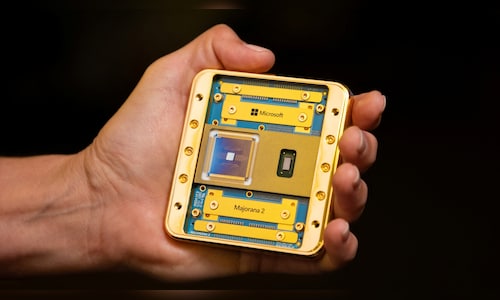
The competition in quantum computing is fierce, with Microsoft and IBM vying against Alphabet’s Google, Amazon, and various initiatives in China to create quantum systems capable of solving complex issues in fields such as medicine, chemistry, and cybersecurity—tasks that would take traditional computers an impractical amount of time. On Tuesday, Microsoft introduced the Majorana 2 chip, a successor to its initial Majorana chip released last year.
AI TOOLS ENABLE MATERIALS INNOVATION
One significant advancement in Microsoft’s new chip compared to its predecessor is its construction from a completely new set of materials. While competitors like Google and IBM typically use superconducting wires made from aluminum for their quantum chips, Microsoft’s approach utilizes lead, a larger atomic element.
This shift was facilitated by AI tools that Microsoft developed for materials science, resulting in a remarkable 1,000-fold enhancement in certain performance metrics of Majorana 2, according to Jason Zander, an executive vice president overseeing the company’s quantum initiatives. Zander explained that the breakthrough involved discovering how to incorporate lead, which is water-soluble, into a chip without losing it during manufacturing.
“The reason why people tend not to use it for chip production is that it necessitates an exceptionally specialized process. We’ve managed to achieve that,” Zander remarked.
Microsoft’s quantum computing strategy is based on quasiparticles called Majoranas, whose existence had not been verified until Microsoft’s claims.
SCIENCE CRITICISM SURROUNDING CLAIMS
This has sparked a wave of skepticism among physicists, who assert that Microsoft has not provided sufficient data to corroborate its claims. Last year, the publication Science informed its readers that it was examining the data from an earlier Microsoft study from 2020, and some critics argue that the issues with data and protocols identified in Microsoft’s past work persist in the latest release.
“Microsoft can utilize as much lead as they wish; however, it will not exempt them from the fundamental scientific principle that results must be reproducible,” stated Henry Legg, a lecturer in quantum physics at the University of St. Andrews in Scotland.
In response to criticism, Microsoft executives noted that proprietary information limits their ability to disclose all data, but they have shared it extensively in private discussions with the US Defence Advanced Research Projects Agency, which is reviewing various quantum system feasibility studies.
“We’ve conducted enough physics to have solid data,” said Zander regarding concerns over Microsoft’s methodology. “Trust me, I wouldn’t invest in engineering if I felt we were still off on the physics.”
Also Read: Trump appeals US trade court order for broad IEEPA tariff refunds