The elections saw a voter turnout exceeding 78%, indicating strong public engagement. In the final count, Congress emerged as the largest party with 63 seats, followed by the Communist Party of India (Marxist) (CPI-M), which obtained 26 seats.
Key allies, including the Indian Union Muslim League (IUML) and the Kerala Congress, played a vital role in contributing to the UDF’s majority. The Bharatiya Janata Party (BJP) managed to win three seats, while smaller parties and independent candidates filled the remaining positions.
Prior to the elections, the UDF unveiled a detailed manifesto centered around five major promises introduced by Congress leader Rahul Gandhi, known as the “Indira guarantees.”
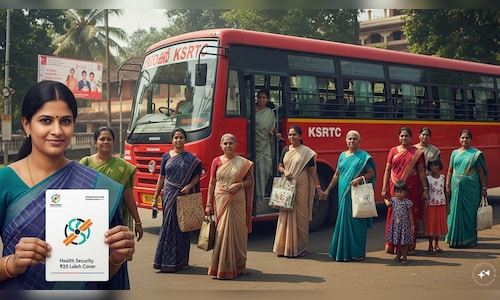
These commitments included free KSRTC bus travel for women, a monthly allowance of ₹1,000 for female college students, a health insurance scheme providing coverage up to ₹25 lakh per family, interest-free loans up to ₹5 lakh for youth entrepreneurs, and an increase in welfare pensions to ₹3,000.
Emphasis on social welfare and healthcare
The manifesto also highlighted initiatives to enhance livelihoods and social security. It assured better wages for ASHA workers, updated pay for Anganwadi staff and school cooks, as well as free dialysis for families below the poverty line.
ALSO READ | West Bengal results: A look back at BJP’s promises on jobs, healthcare and UCC
Plans such as SHE hospitals for women and children, specialized health centers in tribal and coastal regions, and “no-bill hospitals” were designed to lessen healthcare costs. Other initiatives included a K R Narayanan scholarship for outstanding students, resolving pending welfare arrears, and constructing affordable wedding auditoriums for economically disadvantaged groups.
Housing, agriculture, and livelihood support
The UDF committed to building five lakh houses within five years and proposed a separate agriculture budget. It also aimed to tackle man-animal conflicts and introduced plans for a fisheries sub-plan, along with fuel subsidies for fishing boats, Kerala Roadways buses, autorickshaws, and owner-operated taxis.
ALSO READ | Tamil Nadu elections: Gold for brides to free LPG cylinders, what Vijay’s TVK promised in election manifestoJobs and infrastructure
Regarding development, the manifesto presented Mission Samudra, which aims to transform Kerala’s 600-km coastline and 44 rivers into a global maritime hub. Additionally, high-speed rail corridors in collaboration with the central government were proposed. To bolster employment, the UDF vowed to establish 10,000 MSMEs and create a Global Job Watch Square to monitor employment trends.
Education and institutional reforms
In the realm of higher education, the alliance proposed initiatives such as the ‘Semester in Kerala’ program to attract international students and the Siddharthan Anti-Ragging Act to enhance campus safety. Plans for establishing a tribal university were also part of this vision.
Election Timeline
Kerala held its elections in a single phase, with voting taking place on April 9 and counting scheduled for May 4 for all 140 Assembly seats.