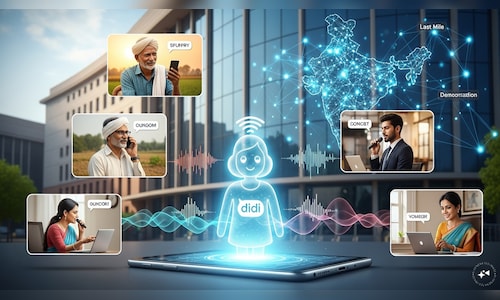
During the unveiling of the chatbot named ‘Samadhan Didi’, Union Minister of State for Personnel Jitendra Singh referred to it as a “democratisation of the public grievance mechanism,” emphasizing the government’s steadfast commitment to improving access to public services for citizens.
The chatbot represents a pivotal advancement in simplifying public grievance redressal, making it more user-friendly, accessible, and genuinely multilingual, he remarked.
Citizens can now submit grievances by simply speaking in their own language, articulating their concerns in straightforward terms, without having to determine the relevant ministry or department, Singh highlighted.
The chatbot comprehends the issue, poses a few pertinent clarifying questions, automatically recognizes the suitable ministry, department, category, and sub-category, and then submits the grievance to the appropriate authority, he explained.
Created by the Department of Administrative Reforms and Public Grievances (DARPG) in partnership with Bhashini (an AI-powered tool), the chatbot was developed within secure government infrastructure to ensure data privacy.
At the launch event, the chatbot was showcased live and tested in various Indian languages.
Singh emphasized that a citizen-focused approach has been central to governance reforms under Prime Minister Narendra Modi’s leadership.
Highlighting the transformative impact of technology in public administration, the minister remarked that Artificial Intelligence facilitates the democratization of grievance redressal—making it more accessible, responsive, and efficient—and that AI-enabled tools are enhancing citizen engagement while improving the quality and speed of grievance resolution.
Stressing that these initiatives exemplify the government’s ‘whole of the nation’ approach, Singh encouraged states and other stakeholders to adopt AI-driven, voice-assisted tools like “Samadhan Didi” within their own state grievance portals to effectively reach all citizens.
He highlighted the significant changes in the public grievance mechanism in the past 12 years under the Modi government, noting that when the administration took office in 2014, public participation in the grievance redressal system was minimal, with roughly 2 lakh grievances registered annually through the CPGRAMS portal.
Now, the annual number of grievances submitted through the system has surged to over 25 lakh, Singh stated.
The Centralized Public Grievance Redress and Monitoring System (CPGRAMS) enables citizens to submit grievances against government departments online.
Singh stated that this transition signifies increasing public trust in the government’s responsive and citizen-centric approach, as the grievance disposal rate has now surpassed 95 percent.
The minister remarked that the chatbot demonstrates the commitment to governance that reaches every citizen.
He asserted that India’s linguistic diversity should facilitate access rather than hinder it, reflecting the essence of a self-reliant, technologically sovereign India where each citizen’s voice is acknowledged in their own words and language.
Singh mentioned that efforts are in progress to enhance linguistic accessibility on the CPGRAMS platform.
In addition to supporting the 22 languages recognized in the Eighth Schedule of the Constitution, regional and indigenous languages like Bhojpuri, Garo, Khasi, Mijo, and Bodhi are being gradually included to ensure better inclusivity for citizens from various linguistic backgrounds.
Singh noted that CPGRAMS has become a global benchmark for citizen-centric governance, illustrating how technology-enabled governance can bolster transparency, accountability, and responsiveness while fostering trust between citizens and the government.
The system combines the language capabilities of Bhashini with grievance-classification models developed based on CPGRAMS data, delivering a smooth experience across Indian languages, according to a Personnel Ministry statement.