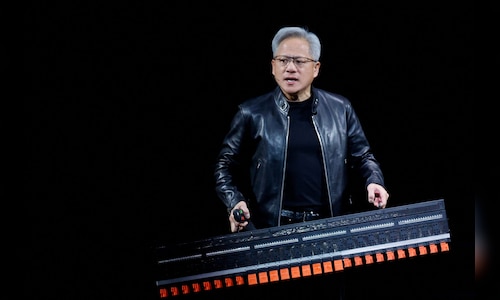
At the Computex trade event in Taipei, Jensen Huang announced that Nvidia’s new RTX Spark Superchip will debut in laptops and desktops from major PC manufacturers, including Dell Technologies and Lenovo Group Ltd., starting this autumn. With assistance from Taiwan’s MediaTek Inc., this product integrates a microprocessor and graphics chip to support Microsoft’s Windows operating system for ARM.
After an unsuccessful initiative over a decade ago, Nvidia, now a key player in data centers, is making another foray into the personal computer processor market.
This effort also bolsters Nvidia’s goal to sustain its critical role at the forefront of AI research and applications.
Also Read: May Auto Sales: Escorts Kubota shares decline despite 19% growth; Here are the near-term headwinds
The initial laptops featuring RTX Spark, as stated by the Santa Clara, California-based company, will focus on the luxury segment and aim to overcome competitors’ limitations. Thanks to the chip’s efficiency, PC manufacturers will be able to create incredibly powerful yet lightweight and compact devices.
Currently, the revenue from its data center chip lineup surpasses the total sales of its closest rivals. In its latest quarter, Nvidia’s revenues were comparable to those of Advanced Micro Devices Inc. and Intel last year.
Despite this, investors who have increased their stakes in Nvidia’s stock due to the rapid advancement of AI may be pleased to see Nvidia broadening its range of devices that deliver cutting-edge technology to consumers. This year, Nvidia’s stock performance has lagged behind the benchmark Philadelphia Stock Exchange Semiconductor Index, even while it reports growth outpacing other chipmakers.
The RTX Superchip will feature a Blackwell-generation graphics processor with 6,144 cores and a CPU with up to 20 computational cores. These components will facilitate handling large AI models and demanding games as they will share integrated memory. They will communicate via Nvidia’s NVLink interface, incorporating elements of data center technology into personal computers. TSMC will be responsible for producing the chip design.
Nvidia has stated that it has worked with Microsoft over the years to develop these new devices and ensure software support that will help Arm Holdings Plc technology gain traction in the Windows PC market. For over a year, Qualcomm and Microsoft have been promoting similar PCs with limited success.
Most PCs, with the exception of Apple Inc.’s Mac series, are powered by AMD or Intel processors. While Arm excels in power efficiency, it falls short in software compatibility.
The new Nvidia-based hardware will better support AI models and features in popular applications. For instance, Adobe Inc.’s Photoshop is being revamped to enhance image and video generation based on AI inputs. According to Nvidia, these new devices will also elevate gaming experiences, enabling laptops to handle high-end games.
Typically, large AI models can be effectively managed on Nvidia-powered PCs, offering users easily implementable controls over software and data access.
This type of security will accelerate the evolution of PCs into personal assistants that perform beyond mere reactions to human input. Nvidia notes that routine tasks, such as searching emails, alongside more complex functions like identifying and fixing website issues, will be much simpler.
The company declined to provide performance comparisons between upcoming and existing technologies based on competitive analysis. Nvidia stated that such information would be available once the new devices are ready for market. The organization does not foresee current semiconductor industry supply limitations affecting availability.