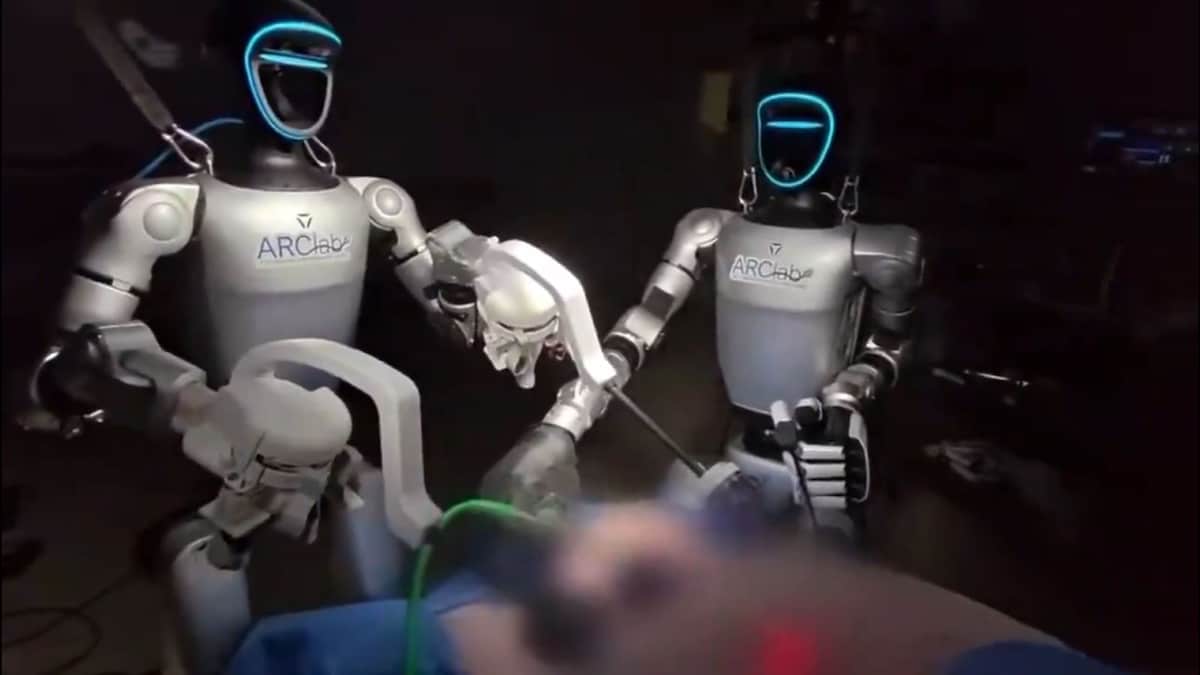
The results of this study were published on July 8 in the journal Nature under the title “In vivo feasibility study of humanoid robots in surgery.” The research was conducted by a team of engineers and surgeons from the University of California San Diego.
Successful completion of two surgeries
The research team executed two gallbladder removal surgeries on pigs. In the initial operation, a humanoid robot was assisted by a surgeon, while the second surgery was carried out solely by two humanoid robots working collaboratively.
These successful surgeries are a pivotal moment in assessing the technology prior to human trials. In an interview with ABC News, Dr. Ryan Broderick, the interim director of the Centre for the Future of Surgery at UC San Diego, remarked, “As a proof of concept, it absolutely worked.”
‘Surgie’ designed for compact surgical spaces
The humanoid
robots, named ‘Surgie’, are designed with a head and arms, occupying significantly less space than traditional robotic surgical systems used in hospitals.
Broderick explained that these robots act as bedside assistants, “fitting into the space that we’re traditionally used to being in for laparoscopic surgery.”
Addressing staffing challenges
The research team indicated that humanoid robots might help alleviate the strain on hospitals by assisting surgical teams and allowing for an increase in the number of procedures performed.
According to Michael Yip, a professor at UC San Diego, the successful surgeries showcased that humanoid robots can safely conduct real operations in an operating room, ultimately saving lives.
Expanding possibilities beyond hospitals
Researchers envision that humanoid robots could eventually be utilized outside conventional hospital settings. Dr. Shanglei Liu, a colorectal surgeon at UC San Diego, noted that this technology could improve access to surgical care in remote or smaller facilities.
“You can envision this device being utilized on a ship, in a rural village, or in a compact operating environment outside major cities. It opens up many opportunities for access,” Liu added.