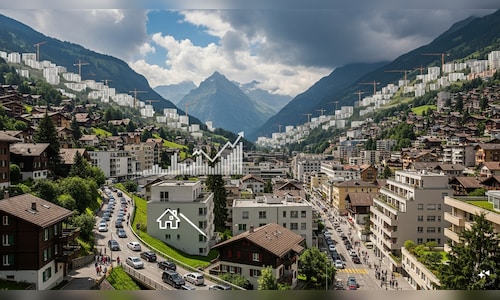
Residents have raised concerns that the increasing demand for housing and public infrastructure is overwhelming the area, which is central to the forthcoming referendum on whether Switzerland should implement a population cap.
The proposal put forward by the right-wing Swiss People’s Party (SVP) states that Switzerland’s permanent resident population should not surpass 10 million by 2050, with potential repercussions for the country’s freedom of movement agreement with the EU.
Also read: US H-1B visa registrations fall 38% as government tightens rules and favours high-wage applicants
”10 million would be catastrophic,” remarked 63-year-old Erika Hermann, a former sales worker in the village who supports the initiative. ”It’s too many people for Switzerland.”
Businesses oppose a population cap
Currently, the population exceeds 9 million and, given current trends, is projected to reach the proposed cap well in advance of 2050.
Should the initiative pass on June 14, it may disrupt trade relations with the EU, Switzerland’s most significant trading partner.
Some critics have compared the referendum to the Brexit vote in the UK, emphasizing that freedom of movement is crucial for Swiss access to the European single market.
The ruling Federal Council stands against the population cap. Last month, it introduced measures to make it more difficult for foreigners to buy real estate, referencing the referendum.
Business groups warn that this could limit labor access for Switzerland, where over one in four residents are foreign nationals, with more than 82% hailing from Europe, especially Italy, Germany, Portugal, and France.
While Swiss voters generally consider the economic implications of such proposals, polls suggest this initiative might succeed.
Residents in Knonau who spoke to Reuters about the referendum highlighted how construction and population growth have transformed the village, with those firmly expressing their views generally supporting the initiative, though some claim it could be detrimental to Switzerland.
Population ‘keeps spiralling upwards’
Switzerland’s prosperity, although not an EU member, relies significantly on open market access globally.
Its wealth and competitive wages have made it an appealing destination for top talent from other nations.
Knonau has seen its population surge nearly 150% to 2,514 since 1990, compared to a 36% increase for Switzerland and an 8% rise for the EU.
”It just keeps spiraling upwards; at some point, there must be a stop,” expressed Peter Zuercher, 77, a retired technician in Knonau who supports the initiative. ”We require some immigration, but the current pace is excessive.”
The attractiveness of Knonau is partly due to its proximity to Zug, which has significantly lower corporate tax rates than Britain, France, Italy, and Germany, and is over 2.7 percentage points lower than the Swiss average. Income tax is also considerably lower.
Real estate in Zug outstrips major cities
Many Knonau residents commute to work in Zug but choose to live in the village to save on housing costs, according to Martin Iten, a 54-year-old solar panel installer.
He observed that affluent newcomers are driving up property prices and noted that his family home is set to be demolished for apartment development with underground parking. He is contemplating relocating abroad to profit from the sale.
In the past generation, Zug’s economy has expanded faster than any canton except the pharma hub of Basel, contributing to rising property prices.
According to Wüest Partner, homes in Zug now exceed prices in Geneva, once known for having prime real estate worth more than in cities like Singapore, London, New York, Tokyo, and Paris, according to Knight Frank’s 2026 wealth report.
”If you managed to buy a house 20 years ago, you hit the jackpot. For everyone else, it’s a disaster,” said Luzian Franzini, head of the Green Party in Zug, which he referred to as ”the Switzerland of Switzerland.”
The Greens oppose the population initiative.
Zug’s SVP finance director, Heinz Taennler, noted that the canton is somewhat a “victim of its own success,” leading to what he characterized as “exorbitant” housing demand. However, he asserted that housing prices are influenced more by location and accessibility than by tax rates, referencing a 2017 study.
”We must exercise caution; that’s the issue—residents of Zug may no longer afford homes in their own canton,” he stated.