CEO Sundar Pichai stated that the company plans to allocate between $175 billion and $185 billion for capital expenditures this year, a stark increase from $31 billion in 2022. This funding aims to bolster infrastructure for what he described as the “agentic era” of artificial intelligence.
“As we enter the agentic era, we are elevating our efforts,” Pichai remarked. “We are making substantial investments now and for the future.”
This initiative reflects competition with Microsoft, Amazon, and OpenAI, as companies transition from traditional chatbots to autonomous AI agents capable of completing tasks with minimal human intervention.
Internal Utilization of Agentic AI
Pichai noted that Google is already implementing AI agents within its operations.
“Currently, almost 75% of all new code at Google is AI-generated and approved by engineers, up from 50% last autumn,” he commented. “We are moving towards genuinely agentic workflows.”
He emphasized that human engineers still oversee AI-generated code. Google is also leveraging AI in its cybersecurity strategies to handle massive amounts of threat data and enhance response times.
“Each month, our teams receive unstructured threat reports at a scale that would require thousands of hours to review—a nearly unfeasible task,” he explained. “Today, our security operation center agents automatically triage tens of thousands of unstructured threat reports monthly by accelerating the extraction of crucial intelligence and filtering out irrelevant information. This has reduced threat mitigation time by over 90%; we are more proactive than ever.”
Launch of the Agentic Platform and Ecosystem Support
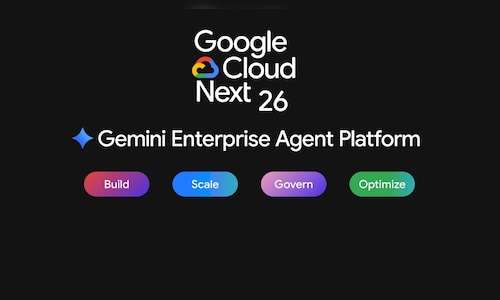
Google introduced the Gemini Enterprise Agent Platform, designed to assist organizations in building, deploying, and managing AI agents at scale.
Additionally, the company announced a $750 million fund to bolster its 120,000-member Google Cloud partner ecosystem. This program provides engineering support, early access to Gemini models, and incentives for companies such as Accenture, Deloitte, and McKinsey & Company.
During the event, Citigroup unveiled “Citi Sky,” an AI-driven wealth management assistant for U.S. clients. Thinking Machines Lab revealed its expanded utilization of Google Cloud’s AI Hypercomputer to accelerate research and model training.
“One thing is abundantly clear: We are firmly in the agentic Gemini era,” Pichai stated. “The discussion has shifted from ‘Can we create an agent?’ to ‘How do we manage thousands of them?’”
Infrastructure and NVIDIA Partnership
Google highlighted that its long-standing partnership with NVIDIA is foundational to the platform. The companies collaboratively develop AI systems spanning hardware, software, and cloud services to support both agentic and physical AI.
The new infrastructure features A5X instances powered by NVIDIA Vera Rubin systems, NVIDIA Blackwell and Blackwell Ultra GPUs, along with confidential computing capabilities. Google claimed these systems enhance performance and facilitate large-scale AI workloads, including training, inference, and simulations.
The platform accommodates both proprietary and open models, such as Gemini, Gemma, and NVIDIA Nemotron. It also comprises managed training tools built with NVIDIA NeMo for reinforcement learning and model customization.
Adoption and Use Cases
Google reported that companies like OpenAI are utilizing its infrastructure for extensive inference workloads. CrowdStrike employs related tools for cybersecurity applications.
The platform also supports industrial and physical AI, encompassing robotics and digital twins. Software providers such as Cadence and Siemens Digital Industries Software offer applications on this infrastructure.
Google revealed that enterprises and startups, including Snap Inc., Schrödinger, and Salesforce, are leveraging the platform to bring AI systems into production.
Furthermore, the company noted that over 90,000 developers have joined its joint developer community with NVIDIA in just over a year.