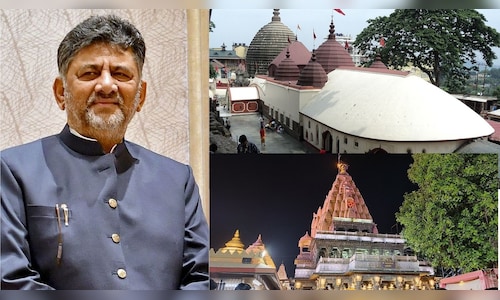
Although D K Shivakumar has consistently portrayed these visits as personal expressions of faith, political analysts and supporters tend to view them through a broader political context. His astrologer, Rajguru Dwarakanath, has publicly commented on auspicious dates and potential leadership opportunities, further adding to the speculation.
This article provides a closer examination of some key temples and religious sites he visited during this politically charged period.
Also read: Who is Nagendra Nath Tripathi, named BJP national organiser
Kabbalamma Temple, Kabbalu, Bengaluru Rural
Among the temples associated with Shivakumar, Kabbalamma Temple holds the utmost personal significance. Situated in Kabbalu near Kanakapura, he and his family revere this female deity.
The temple gained political symbolism in October 2019 when Shivakumar visited immediately after his release from Tihar Jail during the money laundering trial. The visit was widely interpreted as a thanksgiving prayer and a symbolic political reset.
Through the years, he has made many return trips to the temple before elections, significant political events, and personal milestones. Recently, during discussions over Karnataka’s leadership, supporters gathered for special prayers at the temple, hoping for a larger role for him in the state government.
Kenkeramma Temple, Kanakapura
Kenkeramma Temple is another shrine intimately associated with Shivakumar’s political and personal roots in the Kanakapura area. It is considered the family’s presiding deity. DKS’ residence in Sadashivanagar, Bengaluru, is also named after this deity—Kenkeri.
His visits gained notice during times of political uncertainty and internal Congress discussions. The temple holds strong local significance within various communities, making it a vital spiritual stop whenever Shivakumar returns to his constituency at crucial junctures of his political career.
Observers noted that visits to local deities like Kenkeramma often intensified whenever leadership speculation arose.
Jagadishwari Temple, Andle, Ankola, Uttara Kannada
A notably discussed visit was to the Jagadishwari Temple in Andle village near Ankola in Uttara Kannada district. He reportedly visited the temple in December 2025, as advised by his astrologer, and regular ‘sankalpa’ ceremonies have been held in his name since then.
This consistent puja was intended to remove any obstacles he may face. He is also said to have received ‘hingara’ or arecanut flower as prasada, which fell from the deity’s head, symbolizing success in his prayers.
The visit drew attention as it coincided with heightened political discussions about possible leadership changes in Karnataka. Analysts noted that Shivakumar’s uptick in temple visits across coastal and northern Karnataka aligned with renewed debates about succession and future power-sharing arrangements within Congress.
Though framed as a spiritual visit, it quickly became intertwined with Karnataka’s broader political narrative.
Ajjayya Mutt, Nonavinakere, Tumakuru District
D K Shivakumar’s visit to the historic Sri Kadasiddeshwara Mutt, commonly known as Ajjayya Mutt at Nonavinakere in Tumakuru district, was another significant stop in his spiritual outreach.
The mutt wields considerable influence across various communities in central Karnataka. Political figures from multiple parties have historically maintained close ties with the institution and its leaders.
His visit occurred at a time when religious outreach and community interactions were increasingly visible components of Karnataka’s political landscape. When discussions about his future role in Karnataka politics heated up, DKS was seen attending Ajjayya’s branch mutt in Bengaluru seeking blessings.
Madhyaranganatha Temple, Shivanasamudra, Chamarajanagar
The Madhyaranganatha Temple at Shivanasamudra is one of three notable Ranganatha temples situated along the banks of the river Kaveri.
Shivakumar’s visit to this temple attracted attention as part of a larger series of religious pilgrimages made during a politically pivotal period. The temple is venerated across southern Karnataka and draws thousands of devotees annually.
Political observers interpreted the visit as an effort to reinforce connections with significant religious centers while solidifying his image as a leader rooted in Karnataka’s traditional institutions.
Kamakhya Temple, Assam
The Kamakhya Temple in Guwahati stands as one of the most vital spiritual destinations linked to Shivakumar’s recent temple visits.
Dedicated to Goddess Kamakhya, the temple is recognized as one of India’s prominent Shakti Peethas and is often associated with powerful Tantric traditions and spiritual practices.
Reports over the years have indicated that Shivakumar visited Kamakhya upon the counsel of astrologers and spiritual advisors. The visit garnered substantial interest as it occurred during a time of intense speculation about his political future.
Within political circles, Kamakhya has a reputation as a destination frequented by leaders seeking blessings during periods of uncertainty or transformation in their careers.
Mahakaleshwar Jyotirlinga, Ujjain
One of the most widely reported visits was Shivakumar’s trip to the Mahakaleshwar Temple in Ujjain, Madhya Pradesh.
He prayed at both the Mahakaleshwar Jyotirlinga and the nearby Kalabhairava Temple, actively participating in special rituals alongside family. This visit, along with the one to Kamakhya temple in Guwahati, was reportedly in accordance with instructions from Rajguru Dwarakanath Guruji, whom DKS respects greatly.
The visit took place during a time when speculation regarding Karnataka’s political future was again prominent in the media. Given that Mahakaleshwar is one of the most well-known Jyotirlingas in India and has historically attracted political figures before major electoral or political decisions, the visit quickly became a topic of discussion in both political and media spheres.
Why these visits became political talking points
Temple visits by politicians are typically routine. What distinguished Shivakumar’s visits was their frequency, timing, and the geographic spread of the temples involved. Along with the temples mentioned, DKS has also visited the Mahabaleshwara temple in Gokarna, Uttara Kannada, the Bhoovarahanatha Swamy Temple in Mandya, Dharmasthala Sri Manjunatheshwara, and several other temples across the state.
Many of these pilgrimages coincided with periods rife with rumors about changes in leadership, rotational chief minister arrangements, and future power dynamics within the Karnataka Congress. Over the past three years, DKS has made trips to hundreds of temples throughout India.
From the Vaishnodevi shrine in Kashmir to the Rajarajeshwari temple in Kerala, known for its protective qualities against black magic, he has visited all and performed multiple pujas and offerings at each.
Adding to the speculation was the repeated public commentary from astrologer Rajguru Bellur Dwarakanath, who spoke about favorable timings and significant dates related to Shivakumar’s political aspirations.
Supporters viewed these temple visits as spiritual preparations for a larger political role, while critics interpreted them as strategic political messaging meant to sustain leadership discussions. Despite this, Shivakumar has remained firm in stating that these visits are personal expressions of faith. Nevertheless, in Karnataka’s highly symbolic political culture, each temple visit, special puja, and engagement with influential religious entities inevitably acquires political significance far beyond the prayers themselves.