Household names like ChatGPT, Gemini, and Claude have emerged, as companies and investors diligently pursue the development of increasingly sophisticated models.
However, the forthcoming phase of the AI competition may focus less on the models themselves and more on the essential physical infrastructure required to construct and operate them.
This infrastructure encompasses data centers, GPUs, computational capability, power, cooling systems, and the investment necessary to scale them effectively.
The importance of this is clear: countries with access to extensive computing capacity will be better positioned to train, host, and deploy AI systems.
India is currently entering what industry experts refer to as an AI infrastructure supercycle.
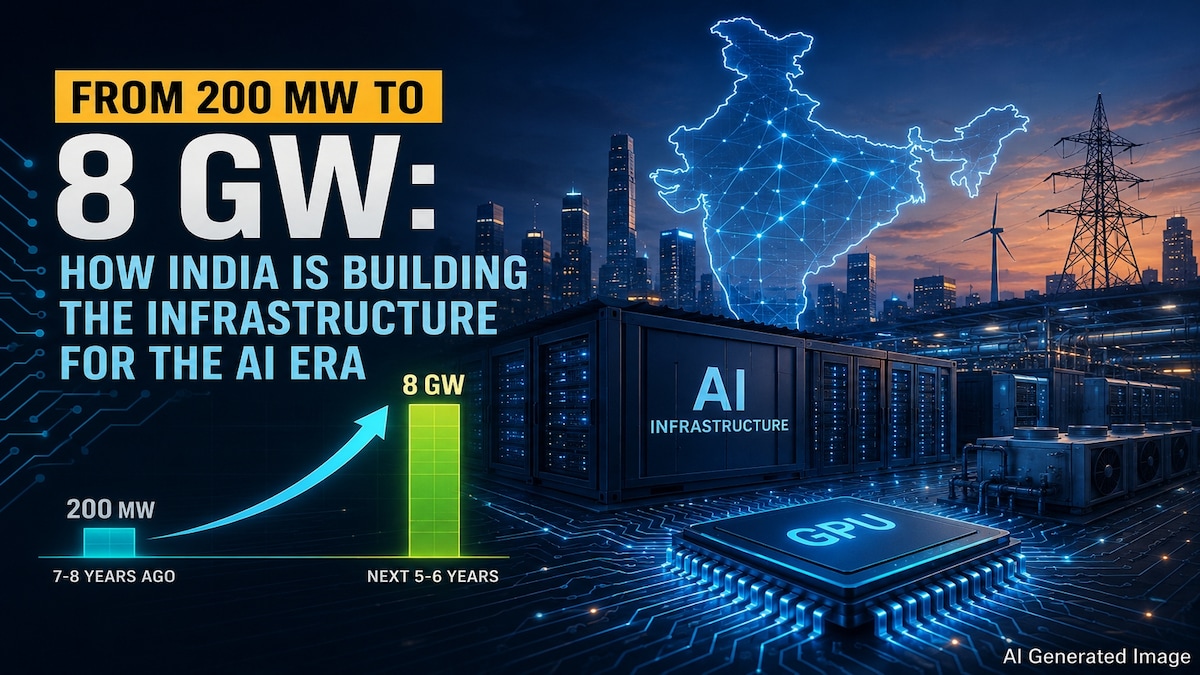
The nation’s data center capacity has surged from around 200 megawatts seven or eight years ago to roughly 1.6 gigawatts today. Predictions suggest this could escalate to about 8 gigawatts in the next five to six years, as noted by Sunil Gupta, Managing Director of Yotta Data Services.
This would indicate a significant growth in India’s digital infrastructure within a short timeframe, necessitating substantial investments in data center construction, GPUs, power connections, cooling systems, and supplementary infrastructure.
What is propelling this swift expansion? What elements comprise AI infrastructure? What could hinder India’s growth, and why is it crucial for the nation’s technology aspirations?
What exactly is AI infrastructure?
At the core of the AI infrastructure opportunity is a fundamental truth: artificial intelligence demands vast computing power.
The AI ecosystem is generally conceptualized as a layered stack.
At the base is the physical infrastructure, including data centers, power supplies, cooling systems, and the computational equipment contained within them.
Traditionally, data centers primarily utilized CPU-based servers for enterprise applications, internet services, and cloud computing. The advent of AI has transformed that demand.
To train and operate extensive AI models, GPU-based computing systems are essential. GPUs excel in performing numerous parallel calculations crucial for various AI tasks, but they also require substantial power and generate significant heat.
This heightened demand necessitates the construction of high-density data centers, specialized cooling systems, and dependable power infrastructure.
Above the physical layer, we find the data and model layer.
A large volume of data is processed and utilized to train AI models, which subsequently serve as the foundation for applications available to consumers, businesses, and governments.
The top layer is the application layer, where users engage with AI via chatbots, enterprise software, copilots, and other applications.
Historically, India has excelled in the upper tiers of this stack, particularly in software development, technology services, and business applications.
The current opportunity lies in developing more of the foundational infrastructure as well.
Why is the AI infrastructure boom happening now?
Data centers have existed for decades, with Yotta operating for roughly three decades and Sify for about 25 years.
What has shifted is the pace at which demand for computing is escalating.
Sharad Agarwal, CEO of Sify Data Center, notes that the data center industry has progressed through several technological cycles.
In the early 2000s, data centers helped businesses expand internet and enterprise networks. Subsequently, they facilitated enterprise resource planning systems, data analytics, digital transformation, and cloud computing.
Now, the emergence of AI has sparked a new wave of demand.
“The time to scale has continually evolved. The time to double has consistently changed, and because it’s accelerating so quickly, it’s now doubling rapidly,” Agarwal explains.
The pivotal change is AI’s need for computing capacity at a significantly greater scale and velocity than many previous technology cycles.
Businesses require infrastructure not only to train AI models but also to operate them once developed. This latter process, known as inference, occurs each time an AI system produces an answer, recommendation, prediction, or another output.
As AI applications gain traction, the need for inference capacity can increase swiftly.
This generates concurrent demand for GPUs, data centers, and power and cooling infrastructure.
From 200 MW to a projected 8 GW: How big is the opportunity?
India’s data center sector has already experienced rapid growth.
According to Gupta, the nation’s data center capacity was approximately 200 MW seven or eight years ago; today, it stands at around 1.6 GW.
The upcoming phase could be even more transformative.
Considering the investments being proposed by major firms and emerging market demand signals, Gupta anticipates India’s data center capacity could reach around 8 GW over the next five to six years.
The significance of this projection extends beyond mere numbers. It indicates a rapid enhancement of the infrastructure essential for bolstering India’s digital economy and AI aspirations.
Constructing that capacity will necessitate substantial investments in servers, GPUs, land, power connections, cooling systems, and networking infrastructure.
It will also demand that companies commit sizable capital to a swiftly evolving technology landscape.
The driving forces behind this expansion include cloud computing, digital services, and, increasingly, AI workloads.
This magnitude of opportunity is also transforming India’s standing in the global technology ecosystem.
For decades, India has primarily been a consumer of technology developed elsewhere. However, as Gupta observes, the country’s data center infrastructure is now serving clients beyond its borders.
“For the first time, I am witnessing that despite being in India, my compute and GPU resources are not limited to Indian use cases. US and European clients are consuming the compute resources hosted here,” he remarks.
This signifies a considerable shift.
India is not merely constructing infrastructure to meet its own AI demands; it could also evolve into a global supplier of computing capacity.
Why data centers alone will not make India an AI power
While building data centers constitutes one aspect of the AI opportunity, the infrastructure ultimately needs to be utilized to develop models, software, and applications.
Gupta asserts that India’s software and technology industry holds a definite edge at the application level.
Indian IT firms have spent decades creating software and technology solutions for global companies. This experience can now be leveraged for AI.
The impending challenge will be to evolve.
Rather than concentrating exclusively on traditional software development and coding, companies will increasingly need to create AI-driven products and applications.
India has a growing roster of firms focusing on AI models, enterprise applications, and sector-specific use cases.
Ankush Sabharwal, CEO and CTO of CoRover.ai, contended that the nation already possesses much of the technology and infrastructure needed to construct solutions addressing business and societal issues.
Consequently, the next phase is not solely about augmenting computing capacity; India must also translate that capacity into scalable products and applications.
What does sovereign AI actually mean?
The discussion surrounding AI infrastructure is closely tied to national sovereignty.
AI systems rely on several components: data, models, computing hardware, software, and the infrastructure utilized for training and operating the systems.
These elements do not necessarily have to be managed by the same nation.
For instance, possessing a data center in India does not inherently render an AI system sovereign. Sovereignty is also conditioned by who governs the data, the models, the chips, the software stack, and the infrastructure utilized for training and execution.
The importance of this debate arises because AI models can be trained on vast volumes of information related to individuals, businesses, industries, and communities.
Gupta posits that India cannot afford to remain solely a consumer of technology while its own data is exploited to develop valuable intellectual property.
“As AI increasingly intertwines with our personal and professional lives across sectors, the fundamental infrastructure required to build, host, train, and apply AI models becomes crucial,” he explained.
Therefore, advocating for the development of AI infrastructure in India goes beyond constructing additional data centers.
It involves establishing the capacity to train models using Indian data, develop AI systems tailored to Indian needs, and create capabilities that reduce reliance on foreign infrastructure and models.
This would encompass AI models and agents that comprehend India’s languages, cultures, industries, and public sector demands.
The overarching goal is to guarantee India has greater authority over the infrastructure and technology necessary for its AI future.
Is capital the biggest bottleneck?
AI infrastructure is notably capital-intensive.
GPU servers, high-density data centers, specialized cooling systems, and reliable power infrastructure require significant upfront expenditures.
Gupta revealed that Yotta has already invested around $4 billion and intends to invest an additional $4 billion within this financial year.
The magnitude of investment required gives rise to a financing challenge.
The swift evolution of technology necessitates that investors and lenders evaluate not only the demand for computing capacity but also the risk that current hardware may become obsolete within a brief timeframe.
This creates challenges around:
- the financing costs;
- the lifespan of GPU hardware;
- the capacity to maintain high utilization rates;
- the stability of customer contracts; and
- the returns from substantial capital investments.
Gupta contends that the sector needs more risk capital, including private equity and other investors with a higher tolerance for technology-related risks.
The question, therefore, is not solely whether India can attract sufficient capital to develop its infrastructure but also whether the financing structure can keep pace with the rapid advancements in AI technology.
As the AI infrastructure supercycle gains traction, capital accessibility could dictate how swiftly India can augment its capacity.
What does an 8 GW data-center industry mean for India’s power system?
The accelerated growth of AI infrastructure has sparked concerns regarding electricity consumption.
Large data centers demand significant power, and AI workloads are particularly energy-intensive.
However, evaluating this issue is more intricate than simply comparing India’s total power generation capacity with projected data center demands.
For data centers, the critical factors are dependable, consistent, and high-quality power at the site where the facility is established.
This indicates that transmission capacity, grid connectivity, and the capacity to secure power at appropriate locations are just as vital as the nation’s overall power generation capabilities.
Agarwal does not perceive power generation itself as a significant obstacle for the growth of India’s data centers.
India’s installed power generation capacity exceeds 550 GW, while peak demand hit approximately 270 GW in May.
Even if data center capacity reaches 8 GW, Agarwal asserts that the sector will constitute a relatively minor fraction of India’s overall energy landscape.
Additionally, India is ramping up its renewable energy capabilities, with solar and wind energy contributing a large percentage of new generation capacity.
The government’s increasing emphasis on nuclear power could further diversify the country’s long-term energy strategy.
This suggests that the data center industry is confident in India’s capacity to support a significant expansion of AI infrastructure.
A more immediate challenge may be ensuring that adequate reliable power is accessible at the specific sites where extensive data centers are being deployed.
Why water consumption could be different in India
Water usage is another pressing global issue.
Many Western data centers utilize evaporative cooling systems, which can consume vast amounts of water.
Agarwal indicates that the Indian data center sector has predominantly opted for closed-loop water chiller systems instead.
He points out that nearly 70% of global data center capacity employs evaporative cooling; however, in India, almost 100% of the sector utilizes closed-loop water chiller systems.
This distinction in water consumption can be substantial, although actual requirements depend on the cooling technology, climate, facility design, and measurement methods.
Agarwal states that evaporative cooling can necessitate around 3 million gallons of water per megawatt annually, while closed-loop systems use less than 1,000 liters per megawatt each year.
These estimates reflect comparisons made by industry executives concerning the two cooling techniques and should be understood in the specific context of systems compared.
The overarching point is that India’s choice of cooling technology may affect how quickly water may become a limitation as data center capacity scales.
The industry is optimistic that widespread adoption of closed-loop systems could mitigate water consumption compared to some evaporative cooling models used in other regions.
Why speed could determine who wins
The opportunity at hand is substantial, but so is the competition.
AI infrastructure is being developed worldwide, and countries are vying for investment, computing capability, and technology firms.
In India, the speed of execution could emerge as a crucial factor.
Agarwal emphasizes the necessity for rapid infrastructure development as one of the nation’s foremost challenges.
“The capability to execute and construct infrastructure as swiftly as possible is paramount. So, I would emphasize speed,” he expressed.
The urgency of rapid execution is underscored by the fast-evolving demand for AI.
As large infrastructure projects complete, the technological landscape and computing requirements may have already shifted.
Consequently, India must enhance its capacity while ensuring its infrastructure remains adaptable enough to accommodate new chip generations and AI systems.
This creates a challenging balancing act.
Companies must move quickly enough to leverage demand, but also avoid committing to infrastructure that may become outdated.
The bigger opportunity for India
The AI infrastructure supercycle ultimately transcends mere data centers.
It signals a potential transformation in India’s role within the global technology economy.
The nation has already established considerable expertise in software, IT services, and digital applications. The subsequent step involves laying the physical groundwork that supports AI at scale.
This necessitates data centers equipped with high-density GPU capacity, reliable and increasingly renewable power, specialized cooling systems, and sufficient capital.
It also entails constructing models and applications that leverage Indian data and address Indian challenges.
The transition from around 200 MW of data center capacity seven or eight years ago to about 1.6 GW today, with an outlook of reaching 8 GW in the next five to six years, illustrates the magnitude and speed of this opportunity.
The next chapter of the AI race may not solely hinge on which company forges the most advanced model.
It could very well be influenced by which nations cultivate sufficient computing capacity to train, host, and execute those models while nurturing the talent, applications, and sovereign capabilities required to convert that infrastructure into economic value.
For India, the AI infrastructure supercycle is already underway.
The pressing question now is whether the nation can build swiftly enough, secure adequate capital, access reliable power and cooling, and develop sufficient sovereign AI capabilities to turn its infrastructure growth into a lasting competitive advantage.
Watch accompanying video for complete discussion