
The company is currently awaiting regulatory clearance for its joint venture with Vivo, which Gupta indicated is “nearly there.” Upon approval, the JV could add 12-15 million units this year, substantially enhancing Dixon’s overall manufacturing scale and competitive edge.
Rising memory prices, which have increased by 12-15% over the past six months, are impacting demand for low-end smartphones. Gupta noted that the issue is not availability — it’s pricing. He believes this trend will be short-lived, with volumes expected to rebound next year.
“Overall, 65–70% of revenue will derive from mobiles, telecom should account for about 12–13%, and IT hardware around 10%,” Gupta mentioned while outlining the revenue composition by the end of FY27.
Dixon Technologies is broadening its focus beyond mobile manufacturing into higher-margin sectors such as telecom, lighting, and specialized electronics manufacturing for industries like aerospace, defense, and medical devices.
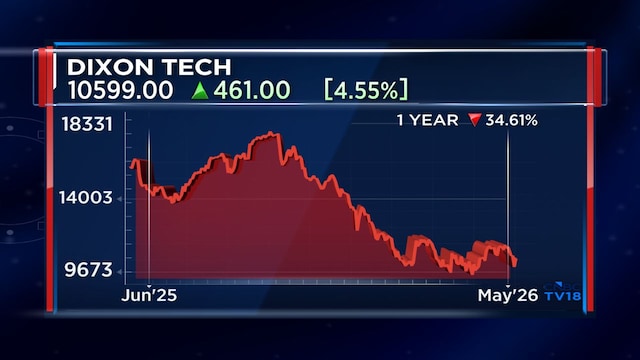
The stock was priced at ₹10,686 at 10:09 am on the NSE and has decreased by over 34% in the last year.
In the January-March quarter (Q4FY26), Dixon Technologies recorded a revenue of ₹10,510 crore, an adjusted profit after tax of ₹181 crore, and margins at 3.90%.
This is an edited transcript of the interview.Q: Everyone is looking for an update on the Vivo joint venture and the regulatory approval. Have you received any updates from the authorities, and what timeline are you targeting internally?
A: We stated in our earnings call yesterday that we are entirely confident that the approval for the Vivo JV should be imminent and will arrive soon. We are actively engaged with the government on this matter, and we expect to receive positive news shortly.
Q: Are you suggesting it will happen in the next month or three? We’ve been waiting for a while.
A: I prefer not to specify a timeline, as we’ve previously misjudged timelines. However, we feel it is very close.
Q: You indicated flat mobile volumes for FY27. I understand the memory price rises are affecting demand. Could you elaborate on the extent of memory price increases and the market situation? When do you anticipate some recovery? Additionally, discuss export volumes, as you are optimistic about their growth.
A: We expect stable volumes this year. We finished with around 33 million smartphone volumes last year and foresee similar figures this year. Following the announcement of PLI-2, and as a result of our ongoing discussions with several anchor customers, we believe we can add another four to five million export volumes, bringing the total to potentially 37–38 million.
Memory prices have surged significantly over the last six months. There was a decrease in demand, but recently we’ve observed a better balance in supply and demand.
Major brands we manufacture for have secured memory through long-term contracts and strong global relationships. Therefore, availability is not the current concern; price hikes are. This particularly affects low-end smartphones, which is one reason we anticipate flat or minimal growth this year. Prices are likely to remain elevated by at least 12–15%, but we view this as a temporary situation and expect next year to show much improved volume figures.
Q: Assuming the Vivo JV gets approved in the first half of the year, what volume contribution could you expect from this JV, both annually and towards the end of this year? What will the average selling price of this volume be?
A: Vivo is currently the largest player in the Indian market, selling about 35 million smartphones in a 150 million smartphone market in India. Our agreement specifies that 67% of the volumes will be produced through this JV, a 51:49 partnership with Vivo. Annually, we anticipate it could reach around 20–22 million units. If approval occurs within the first six months or for around eight months of this financial year, we could potentially manufacture about 12–15 million units.
We believe Vivo has a relatively premium portfolio, so the pricing is expected to be better than our current offerings.
Q: What do you estimate the realization per unit will be?
A: It should be at least 20–30% higher than our current portfolio across five brands.
Q: A brief update on export volumes this year. You’re forecasting relatively flat volumes; last year’s exports were around—
A: Last year, exports reached approximately 3.7 million units. We are aiming for an additional three to four million units this year. These base volumes should remain stable, with the potential for further increases of another three to four million units. It’s important to recognize that the government is working on PLI-2, which may have been delayed due to other issues, but we expect it to be introduced within the next few months.
Our understanding is that PLI-2 will focus heavily on exports and localization, which positions us well to leverage that opportunity.
Q: Regarding your other business segments like lighting and telecom, you expect close to doubling of revenue in FY27. What will drive that growth, and will it affect margins?
A: Telecom is a relatively high-margin sector for us. We’ve grown from around ₹700 crore a couple of years back and are now targeting nearly ₹7,500–8,000 crore this year. We see considerable opportunities ahead. Bharti is our JV partner, and we’re expanding beyond customer premise equipment (CPE) products.
We recently secured a large order for micro radios from a US client, which will serve both the domestic and export markets. That segment should continue to achieve robust double-digit growth in the coming years.
In the lighting segment, following the JV with Signify, we’ve broadened our category offerings and are moving toward premiumization.
Furthermore, we are discovering increasing export opportunities, having secured orders from a prominent US retail chain and a significant European retail chain. Over time, we believe this segment can scale to ₹2,500–3,000 crore for us.
Q: Given your multiple avenues for growth, can you provide a detailed breakdown of segment contributions by the end of FY27? How much will come from domestic mobile phones, telecom, IT hardware, consumer appliances, and exports?
A: In general, 65–70% of revenue will come from mobiles, telecom should contribute roughly 12–13%, and IT hardware should be around 10%. These will remain the core of our business. However, we are also significantly expanding in lighting, washing machines, and refrigerators while innovating in new product categories. Yet, these three sectors will continue to be our primary growth engines.
Q: What about the India Semiconductor Mission (ISM) 2.0? Are you involved in that?
A: We will not be participating in ISM 2.0.
Q: You previously mentioned being in advanced negotiations to onboard a new ODM in the smartphone sector. Can you provide clarity on that situation? When might we expect some positive news?
A: It will take time, but we’re actively working on it. At this point, I cannot disclose a timeline. We are pursuing multiple objectives, including mobile PLI 2.0, which could act as a catalyst for export growth. Additionally, we aim to increase wallet share with our existing customers and pursue potential customer acquisitions. All these factors could significantly spur mobile growth for us.
Q: You’re also looking into an inorganic opportunity that could add ₹3,000–4,000 crore in revenue, something notable from your conference call. Can you elaborate on this?
A: We have made the decision to enter the high-end specialty EMS sector, focusing on aerospace, defense, medical, and industrial markets. We’re currently evaluating several opportunities. We expect this initiative to contribute ₹3,000–4,000 crore in revenue over time, yielding double-digit margins, with potential margins in the high teens.
Q: What kind of funds have you set aside for an acquisition like this? You need to be prepared.
A: We currently enjoy a negative net debt position of around ₹700 crore. With earnings visibility for next year, we anticipate that most of our capital expenditure has already been accounted for, so we do not foresee a steep increase in capital intensity, aside from backward integration projects like displays and camera modules. We believe we can fund the complete capex needs and a large portion of any acquisitions through internal resources. If necessary, we can also consider borrowing, with our balance sheet offering sufficient buffer.
Q: So, this business is expected to yield higher margins?
A: Yes, it should generate margins exceeding 20%.
Q: When might we receive more information about this? Since you are expressing confidence in such an opportunity, should we expect developments within the next quarter or two?
A: I prefer not to set a timeline, but we are actively working on it.
Q: To clarify the financial outlook, if Vivo proceeds, strong growth is likely. However, even without Vivo, you’ve projected 15–17% revenue growth during the last call. What about margins?
A: This year’s margins will rely on the timing of the PLI rollout; we could see a 20–30 basis point decline in margins compared to FY26. Nevertheless, as our backward integration initiatives start yielding results, primarily from FY27–28 onward, we anticipate margins could expand by another 40–50 basis points from FY26 levels.
Q: Can you provide insights on Q Tech and Ismartu? What were their contributions in Q4, and how do you envision the scaling of both businesses?
A: Q Tech generated approximately ₹1,700 crore last year. This year, our target is around ₹2,500 crore, and we foresee this segment scaling to ₹6,000–7,000 crore in the next couple of years, driven by robust smartphone demand and our intent to manufacture camera modules for our own smartphone needs.
In terms of Ismartu, it is likely to produce ₹10,000–11,000 crore in revenue this year. We are increasingly capturing export opportunities in African markets, where we are a market leader in both feature phones and smartphones. We expect export contributions to grow this year.
Q: What were the Q4 contributions from both businesses?
A: Ismartu contributed about ₹1,500 crore, while Q Tech accounted for around ₹400–450 crore in quarter four.
Q: What is the capex outlook for FY27 and FY28?
A: For FY27, we anticipate capex to be around ₹2,500 crore. In FY28, Q Tech should contribute ₹4,500–5,000 crore, and Ismartu could generate approximately ₹10,000–11,000 crore this year while continuing to grow as significant export shifts occur from neighboring countries to India.
Dixon Technologies’ current market capitalization stands at ₹64,626.33 crore.
Watch the accompanying video

Follow our live blog for more updates on Q4 results