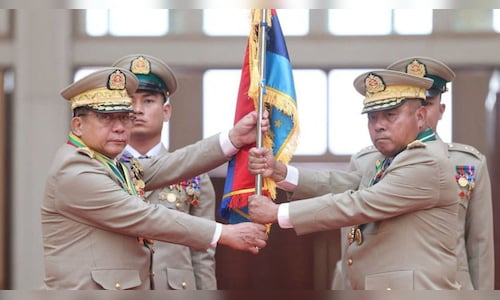
Myanmar President U Min Aung Hlaing is scheduled to visit India officially from May 30 to June 3, accompanied by a high-level delegation that includes several Cabinet ministers, senior officials, and business leaders. According to India’s Ministry of External Affairs (MEA), Hlaing will meet Prime Minister Narendra Modi on June 1 to discuss ways to enhance the historical and civilisational ties, in addition to participating in a business forum.
Hlaing will make a trip to Bodh Gaya on May 30 and visit Mumbai on June 2 for engagements related to business and industry, along with site visits.
The MEA noted that Myanmar occupies a strategic position within India’s Neighbourhood First, Act East, and MAHASAGAR policies, and Hlaing’s visit is anticipated to strengthen and deepen the multifaceted relationship between the two nations. Myanmar is part of the 10-member ASEAN group, which includes Brunei, Cambodia, Indonesia, Laos, Malaysia, the Philippines, Singapore, Thailand, and Vietnam.
This trading bloc is a key target for India as it seeks to enhance exports amidst global trade uncertainties. ASEAN represents approximately 11% of India’s global trade, with bilateral trade reaching $123 billion in FY25.
On May 6, the MEA announced India’s aim to achieve comprehensive tariff liberalisation across 80% of tariff lines in its review of the ASEAN-India Trade in Goods Agreement (AITIGA), with a target of at least 70% liberalisation for every individual country.
During a press briefing in New Delhi earlier this month, MEA Secretary (East) P Kumaran indicated that the AITIGA review was a significant topic of discussion among state leaders, focusing on completing the review promptly to help both parties meet their trade objectives.
Regarding India’s demands, Kumaran mentioned: “India has generally indicated a desire for overall tariff liberalisation of 80%, with at least 70% for each individual country,” highlighting the varying levels of economic development among ASEAN members, where “some economies” are “very open, like Singapore,” while others are less so. He added that the offer to India “shouldn’t simply reflect a weighted average of tariff liberalisation but should consider the economy’s size” for comparison purposes.
Talking about the negotiations, Kumaran remarked: “We seem to have reached a sort of understanding; details are still being discussed. We expect to gain more clarity in the coming months regarding the completion of the review.”
Regarding the AITIGA review, government sources mentioned last year that India is open to pursuing separate free trade agreements (FTAs) with individual ASEAN countries, noting that it has existing FTAs with Singapore and Malaysia.
Previously, sources suggested that India sought a country-specific review of the AITIGA to address its growing trade deficit with the ASEAN bloc. While India’s exports to ASEAN countries rose by 65.23% from $26,628 million in FY11 to $44,000 million in FY23, imports surged by 186% from $30,608 million in FY11 to $87,577 million in FY23.
In FY24, India’s imports from ASEAN countries were $66,551 million while exports stood at $32,713 million. For FY25, India’s exports to ASEAN were approximately $39 billion, compared to imports close to $84 billion.
Sources previously indicated that, in the AITIGA review, India had opened 71% of its tariff lines, contrasting with Indonesia’s 41%, Vietnam’s 66.5%, and Thailand’s 67%, despite India having a lower per capita income.
The sources clarified that the government has echoed the concerns of Indian industry while renegotiating and reviewing the ASEAN FTA, questioning why tariffs on Chinese imports were lowered during the UPA government. They noted that subsidised goods from third countries were entering India until anti-dumping measures were enacted. Additionally, India has implemented safeguard duties to combat steel dumping, as the “melt-and-pour” clause was omitted from the ASEAN FTA.
In October 2024, Indian government sources informed CNBC-TV18 that several ASEAN countries’ positions have evolved since the agreement was established in 2010, with some no longer holding the same views. They stated that ASEAN does not function as a unified customs union but rather as a coalition of countries at various development stages, emphasizing that India is aiming to adopt a flexible approach in its negotiations while collaborating with individual member nations. Indian industry has persistently raised concerns regarding the impact of inexpensive imports from ASEAN countries on domestic sectors like steel and electronics.