In a statement, UNESCO emphasized the urgent need to protect cultural heritage in “all its forms,” reminding both countries of their responsibilities under the 1954 Hague Convention and the 1972 World Heritage Convention. “UNESCO will keep monitoring the cultural heritage situation in the region to ensure its protection,” it stated, also mentioning its readiness to provide technical assistance and emergency safeguarding measures “as soon as conditions permit.”
Tensions erupted on December 10, with reports of artillery and rocket fire along the border, each nation accusing the other of targeting civilians. This escalation follows earlier incidents in May when a landmine explosion resulted in the death of a Cambodian soldier and injuries to Thai troops, leading to several months of cross-border violence that claimed at least nine civilian lives by July 2025. Despite a truce brokered on the sidelines of the ASEAN summit in Kuala Lumpur by US President Donald Trump and Malaysian Prime Minister Anwar Ibrahim, the recent clashes indicate the ceasefire has deteriorated.
Also read | Thailand and Cambodia continue fighting across contested border ahead of expected Trump calls
On December 10, Cambodia’s Defence Ministry accused Thai F-16 aircraft of deploying munitions across five provinces, labeling the strikes a serious violation of international humanitarian law. Officials claimed that Cambodian forces remained on the defensive while repelling Thai advances. The Ministry of the Interior reported extensive damage to homes, schools, roads, pagodas, and historic sites due to “Thailand’s intensified shelling and F-16 air strikes targeting villages and civilian population centres up to 30km inside Cambodian territory”.
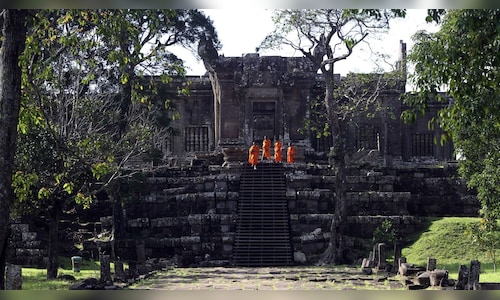
It stated: “It should be noted that … these brutal acts of aggression by the Thai military indiscriminately fired upon civilian areas, particularly schools, and caused further destruction to Ta Krabey and Preah Vihear temples, which are highly sacred cultural sites of Cambodia and part of global cultural heritage.”
According to the Bangkok Post, Thailand’s Ministry of Defence reported that nine soldiers had been killed and 120 injured after five consecutive days of violence. Cambodian officials claimed 10 civilian fatalities and around 60 serious injuries, while military casualties remain unspecified; unconfirmed reports indicate that at least eight Cambodian soldiers may have died.
President Trump stated that he anticipated speaking with the leaders of both nations to urge an immediate halt to the fighting. “They’ve been fighting for a very long time, many, many decades,” he remarked. “But I got along great with both. I found them to be two great leaders, two great people, and I settled it once. I believe I can do it pretty quickly. I think, I think I can get them to stop fighting. Who else can do that? Think of it.”
Also read | How do Cambodia and Thailand’s militaries compare?
Malaysia’s Prime Minister Anwar Ibrahim mentioned in a Facebook post that he had conversed with both prime ministers but cautioned that “no complete resolution has yet been reached.” He emphasized that Malaysia would continue to support peaceful dialogue grounded in international law and regional cooperation.
Preah Vihear, constructed in the 11th and 12th centuries during the Khmer Empire, alongside the nearby Prasat Ta Muen Thom temple, has long been a source of territorial disputes. The conflict arises from a 1907 map drawn by colonial-era France, which places the temple on Cambodian land, a stance upheld by the International Court of Justice in 1962 and reaffirmed in 2013.
Despite these legal decisions, the border over the 800-kilometre frontier remains contested, with the latest violence underscoring the volatility surrounding the ancient Hindu sites.