Despite maintaining a standard pre-earnings silent period, market analysts suggest that the rally indicates “renewed interest in a clean structural play on Indian air travel and travel-retail consumption.”
Divergence From Mainstreet QSR Performance
Market players believe TFS is increasingly recognized as a structural investment in travel-induced consumption rather than a typical restaurant stock.
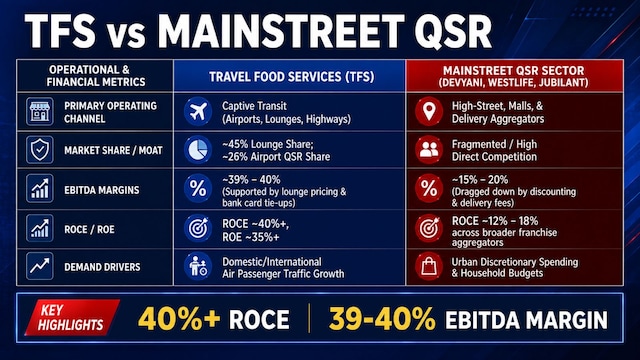
In contrast to listed QSR operators like Jubilant FoodWorks, Devyani International, Sapphire Foods, and Westlife Foodworld — which are facing weak same-store sales growth, aggressive discounting, and margin pressures from food delivery services — TFS predominantly operates from captive transit locations such as airports.
The company holds an estimated 45% of India’s airport lounge market and around 26% of QSR outlets at airports, managing over 127 international, regional, and proprietary brands, including ARAYA Lounges, Gordon Ramsay’s Street Burger, KFC, and Krispy Kreme.
This business model has translated into superior financial metrics compared to the broader QSR sector. TFS achieves EBITDA margins of approximately 39-40%, bolstered by premium lounge pricing and banking partnerships, in contrast to the 15-20% margins for most listed QSR competitors.
Created using ChatGPT
Financial Trajectory and Brokerage Consensus
For FY26, the company posted a 25% year-on-year increase in consolidated revenues, while net profit climbed 21% over the same timeframe, driven by robust operating cash flows and zero net debt.
Also Read: Shipping Corporation had a blockbuster quarter. Here’s what drove it
The market consensus on the stock remains overwhelmingly positive, with all four analysts covering it holding “Buy” ratings. Brokerage firm HSBC recently reaffirmed a “Buy” rating on TFS, setting a target price of ₹1,540, emphasizing its pricing power and long-term positioning in the travel-retail market, despite some seasonal air traffic trends causing temporary weakness in Q1. Since its listing in July 2025 at an issue price of ₹1,100, the stock has appreciated over 33%, fueled by a 16% rally in the past month.
Growth continues to be supported by increasing passenger volumes at major Indian airports, coupled with infrastructural advancements. The company is actively expanding its footprint in newly developed terminals, such as Delhi T1, and is competing for upcoming greenfield airport concessions, including Noida International Airport (Jewar) and Navi Mumbai International Airport.
Analyst Perspective on Valuations and Risk Factors
“Travel Food Services’ move signifies a revived interest in a clean structural investment in Indian air travel and travel-retail consumption,” stated Vaqar Javed Khan, Senior Fundamental Analyst at Angel One. “The company is the leading operator of airport QSRs and lounges—a near-oligopoly characterized by high entry barriers, long airport concession agreements, and strong pricing power in captive areas.”
Khan pointed out that the main long-term drivers for the stock remain compelling, including rising passenger volumes, greenfield airport projects, terminal expansions, and the ongoing premiumization of the travel-dining experience. However, he advised caution against pursuing short-term price momentum given the stock’s current valuation framework.
“With earnings at 40x and over 11x book value, much of the growth is already incorporated into the pricing, and it remains a stock with high promoter holding and driven by OFS,” Khan added. “Investors are acquiring a high-quality franchise but should pay attention to traffic trends, concession renewals, and margins instead of chasing momentum.”
Beyond basic passenger volumes, institutional investors are keeping an eye on potential operational risks, including changes to credit card lounge access rules from domestic banks, minimum guaranteed rent (MGR) increases at major airport terminals, and renewal terms for key airport concessions in upcoming fiscal periods.
Also Read: Weight-loss drugs have officially entered the corporate boardroom