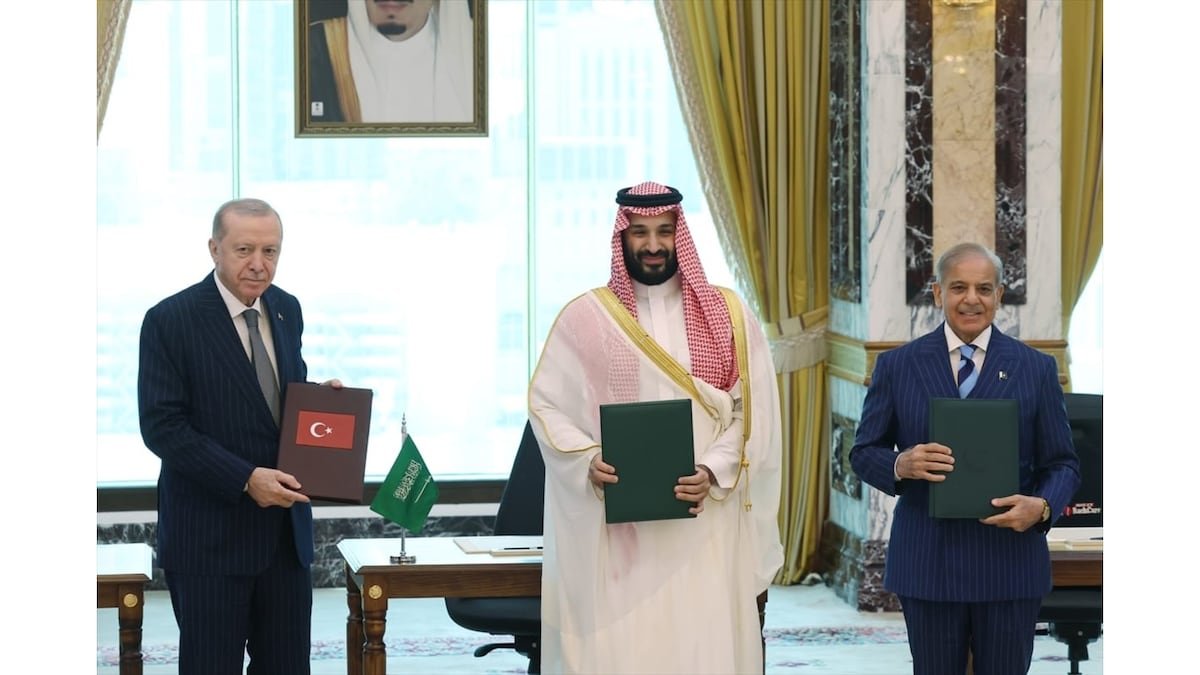
On Friday, Saudi Arabia, Turkiye, and Pakistan signed the “Makkah Joint Defence Agreement,” establishing that an armed attack on any one of the countries will be viewed as an attack on all three.
The agreement was formalized in Mecca on August 7 by Saudi Crown Prince Mohammed bin Salman, Turkish President Recep Tayyip Erdogan, and Pakistan Prime Minister Shehbaz Sharif. Pakistan’s army chief, Field Marshal Asim Munir, was also present at the signing.
According to a joint statement, this agreement builds upon the historical connections, shared strategic objectives, and long-standing defense cooperation among the three nations. It aims to enhance collective security and deterrence while fostering regional peace and stability.
“The agreement is designed to bolster collective deterrence against any acts of aggression, stipulating that any armed attack on one of the three states shall be viewed as an affront to all,” the statement noted. “It also enhances all aspects of defense cooperation among the three nations.”
The language of the agreement gives it a mutual-defense characteristic, drawing parallels with NATO’s Article 5. However, with limited public information on the details of the agreement, the exact military or operational obligations remain unclear.
Saudi Arabia has made efforts to clarify that the pact does not imply the establishment of a new military bloc or any nuclear aspects.
Saudi Arabia’s Deputy Minister for Public Diplomacy, Ambassador Dr. Rayed Krimly, emphasized that the agreement does not signify an orientation toward forming a military axis or a sectarian bloc, nor is it connected to “nuclear ambitions or an arms race.”
Instead, Krimly framed it as a framework for defense cooperation and the development of sustainable, self-reliant capabilities.
“The Makkah Joint Defence Agreement permits the three signatory countries to create joint defense capabilities, enhance strategic deterrence, improve readiness, and integrate their defense capabilities to collectively address any security threats,” he stated on social media platform X.
Krimly added that the pact does not supersede any of Saudi Arabia’s existing bilateral or multilateral agreements.
Importance amid regional unrest
Speculation about a trilateral framework involving the three nations had been ongoing since Saudi Arabia and Pakistan finalized their Strategic Mutual Defence Agreement in September 2025. This previous agreement, established shortly after an Israeli strike on Qatar, similarly indicated that aggression directed at one would be viewed as aggression towards both.
Pakistan’s Minister for Defence Production informed Reuters in January that discussions were ongoing for a separate trilateral arrangement involving Turkiye. Friday’s agreement officially delineates the framework with Ankara following nearly a year of negotiations.
The signing occurs during a particularly delicate period for Saudi Arabia, which is facing the repercussions of the broader US-Israel-Iran conflict, as well as renewed confrontations involving Yemen’s Houthi group.
On July 20, the Houthis declared a naval blockade targeting Saudi Arabia, preventing Saudi and Saudi-linked vessels from traversing the Red Sea. The group has since reported missile and drone assaults on Saudi energy infrastructure, including Aramco facilities in Jizan and Yanbu. They have also announced attacks on eight Saudi-linked ships and claimed that 29 Saudi oil tankers were compelled to change course. Saudi Arabia has yet to respond to these claims.
Internal conflict in Yemen has also escalated, with reports of clashes between the Houthis and the Saudi-supported internationally recognized government. Recent confrontations have resulted in the deaths of at least 30 government forces.
In a separate incident, the spokesperson for the Saudi-led coalition reported that 11 individuals, including a four-year-old child, were injured in a Houthi attack on Saudi Arabia’s southern Najran region.
In light of these developments, the agreement brings together three nations, each with unique strengths within a volatile region. Saudi Arabia offers significant financial resources, energy influence, and a strategic location in the Gulf and Red Sea.
Turkiye maintains NATO’s second-largest military and a rapidly growing defense industry, while Pakistan contributes a large military and nuclear capability, though Saudi officials have clearly stated that the new pact does not have a nuclear focus.
(Edited by : Ajay Vaishnav)