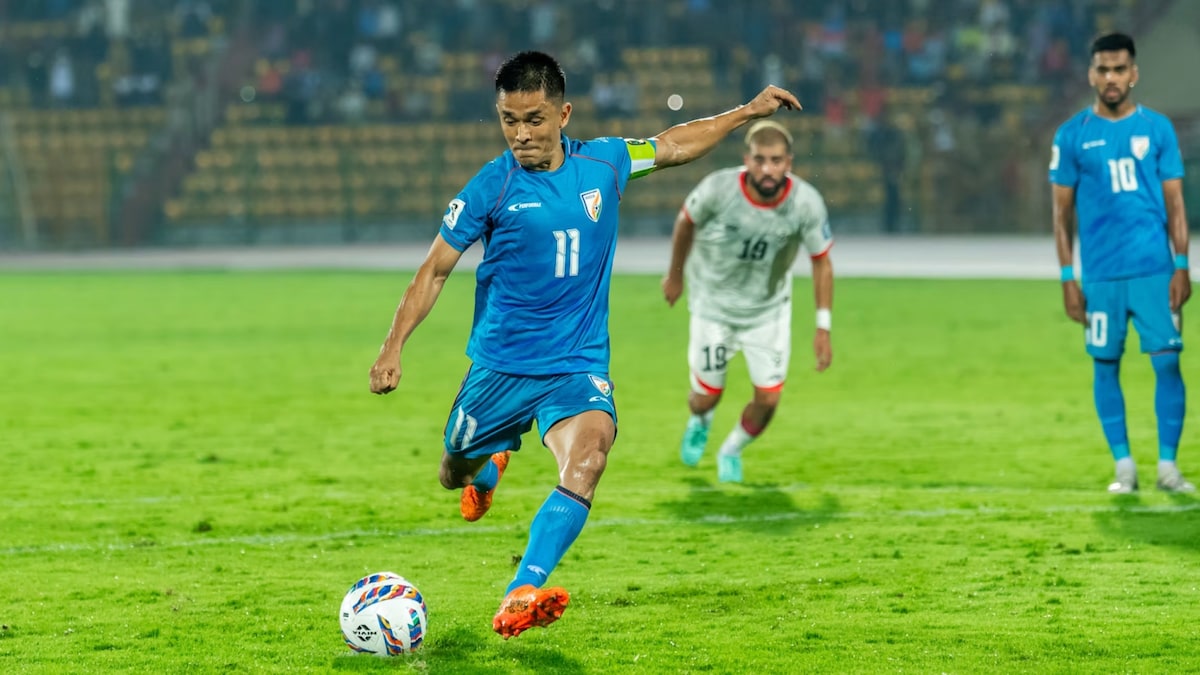
India’s omission from the tournament is particularly notable in light of its football history. The country qualified for the 1950 World Cup after several opponents withdrew, but ultimately the All India Football Federation (AIFF) decided against sending the team. Following this, India saw a ‘golden era’ under Syed Abdul Rahim, securing gold at the Asian Games in 1951 and 1962, achieving a fourth-place finish at the 1956 Melbourne Olympics, and coming second at the 1964 AFC Asian Cup.
However, these accomplishments were never transformed into lasting success. Currently, India holds the 138th position in the FIFA men’s rankings, has yet to play a match in the World Cup finals, and was eliminated in the second round of Asian qualifying for the expanded 2026 FIFA World Cup. A 1-2 loss to Singapore in October 2025 also dashed India’s hopes of qualifying for the 2027 AFC Asian Cup.
Inspirations aplenty
The contrast is intensified by the advancements of countries with a fraction of India’s population. Cabo Verde, with around half a million people, and Curaçao, which has about 150,000, both qualified for their first World Cups in 2026. Curaçao made history as the smallest nation by population ever to qualify, while India, with over 1.4 billion citizens and significantly more resources, failed to qualify for either tournament (the FIFA World Cup or AFC Asia Cup).
In light of India’s limitations, former NITI Aayog CEO Amitabh Kant (@amitabhk87 on X) has urged the nation to treat qualification for the 2034 FIFA World Cup as a national priority rather than a distant goal. In a series of posts on X, Kant emphasized that India “should not be satisfied with just being one of the world’s largest football audiences” but should strive to “become a football nation,” stressing that qualification by 2034 must be grounded in “systems, talent, and execution.”
While he recognized that FIFA’s expanded 48-team World Cup offers Asia better chances for qualification, he warned that “no country qualifies due to an expanded format. Countries qualify because they build,” advocating for a grassroots revolution focused on improved coaching, increased playing opportunities, and enhanced state-level investments in football.
Collaborative efforts required
Kant contended that India’s challenge lies not in a lack of talent but in the absence of a structured pathway for its development. “The essential question is not whether India possesses talent—it certainly does. The real question is whether we have established the infrastructure to discover, train, test, and nurture that talent,” he noted. He expressed that India would need thousands of qualified coaches, stronger youth leagues, advancements in sports science, data-driven scouting, and consistent high-quality competition, suggesting that top Indian players should compete in 35 to 40 meaningful matches annually. He also highlighted the success of Odisha’s investment in hockey as a model for states to follow in football.
Rather than placing the onus solely on the AIFF, Kant described World Cup qualification as a collaborative effort among multiple stakeholders. He asserted that the AIFF should “anchor the technical vision,” while clubs ought to function as “talent factories,” states should bolster district and school-level competitions, corporations should invest in player advancement, and universities should enhance opportunities for competitive football. He stressed the importance of supporters in making the sport commercially viable.
Kant insisted that India’s football aspirations must be supported by tangible reforms rather than mere aspirational goals. He advocated for elite academies in every football-playing state, a well-defined development pathway from Under-13 to Under-23, a strengthened domestic league structure, increased investment in women’s football, and transparent performance metrics. “The next decade should not focus on whether India can qualify for the World Cup,” he remarked. “It should center on executing the rigorous tasks that make qualification inevitable: improved coaching, enhanced leagues, superior facilities, effective governance, better match exposure, and an unwavering focus on Indian player development.”
(Edited by : Tarkesh Jha)