Deloitte anticipates that future investments will predominantly focus on AI-optimized graphics processing unit (GPU) infrastructure, with funding increasingly leaning towards an infrastructure-style debt model. Gupta noted that debt financing in the industry could increase from the current 55-60% to nearly 75% as the sector evolves.
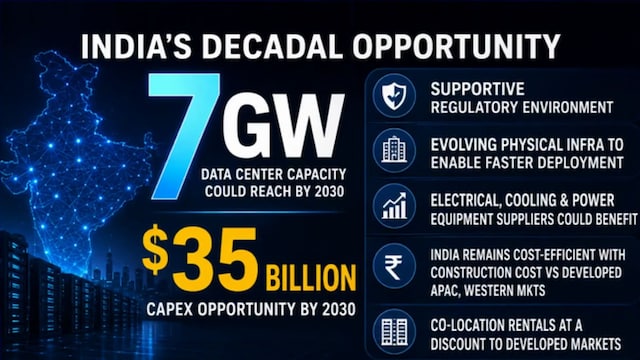
Gupta stated, “I would expect this $100 billion to be funded,” pointing to robust interest from both local and international investors.
Kumar mentioned that the adoption of AI will transform the structure of data centers, with GPU-based frameworks gradually replacing traditional CPU-centric workloads over time.
“Currently, 30% of the market is allocated to GPU cloud, while 70% is still focused on CPU cloud. We predict this will flip in the next five years as nearly all the workloads transition to AI-centric tasks,” he explained.
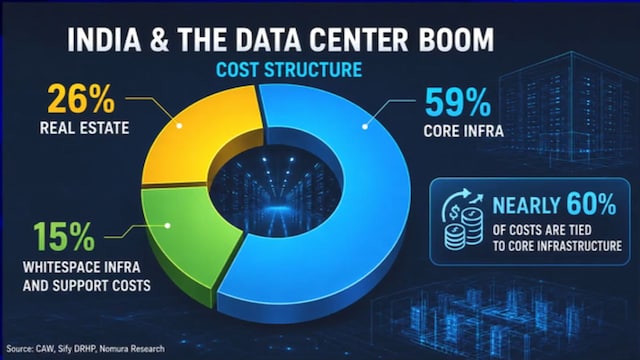
He elaborated that GPU data centers are considerably more costly to establish, with GPU cloud infrastructure investments ranging from $30-35 million per megawatt, compared to about $12 million per megawatt for CPU cloud infrastructure, not counting civil construction and mechanical, electrical, and plumbing (MEP) expenses.
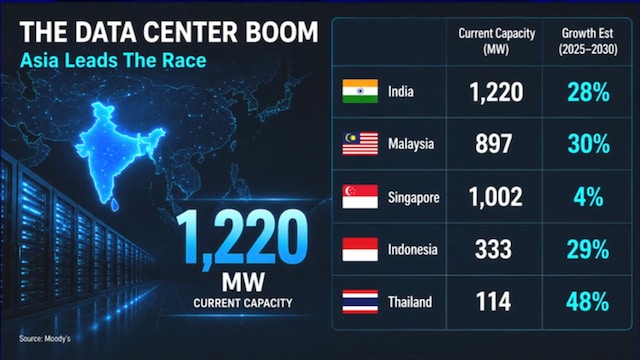
Gupta highlighted that India’s competitive construction costs, lower energy rates, recognition of data centers as infrastructure, and supportive governmental policies make the nation an appealing investment location. Factors like land availability, power supply, water resources, fibre connections, and state-level policy support are pivotal in determining where new facilities are established.
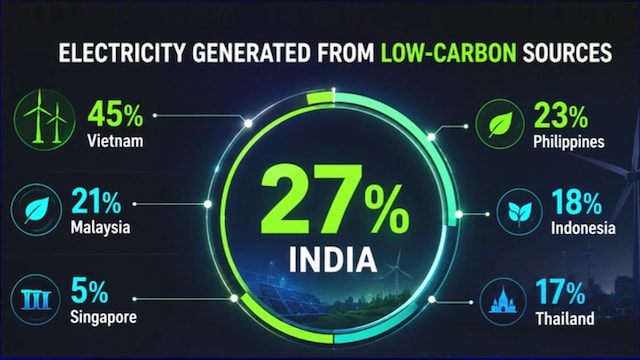
Kumar pointed out that the upcoming development of data centers will increasingly incorporate renewable energy infrastructure, with developers aiming for sites that unify data centers, power generation, and connectivity via undersea cable networks.
He also noted that storage memory, rather than GPUs, is emerging as the supply-chain bottleneck and remarked that advancements in liquid and immersion cooling technologies could help lessen water consumption over time, although water availability continues to pose a significant challenge for the industry.
For the full interview, watch the accompanying video