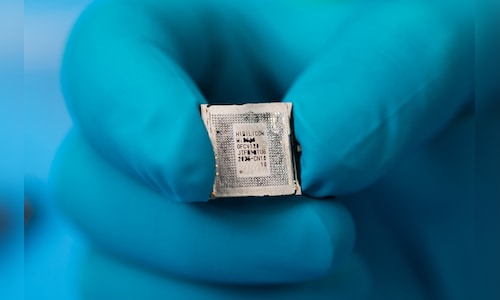
Strong demand for memory data storage cards and advanced chips has strained global supplies, leading to higher prices in recent quarters. Manufacturers are ramping up investments and production capacities to fulfill worldwide market needs. The increased costs of memory chips have, in turn, raised production expenses for various electronic products, including smartphones and laptops.
“Certainly, there’s a significant increase in investment directed towards memory manufacturing facilities. This is largely because, for the first time, the semiconductor industry is experiencing rapid growth accompanied by a severe shortage of certain components essential for AI data centres and high bandwidth memory chips,” Vaishnaw stated.
Investments in data centres in India are projected to exceed USD 200 billion imminently, which will require billions of gigabytes in storage capacity.
The minister noted a global supply-demand imbalance phenomenon, which is currently being addressed by establishing additional production units.
“For instance, Micron produces high bandwidth memory chips and became the first plant to commence commercial production on February 28th this year, with a second plant following on March 31st. These initiatives are already showing positive outcomes. There exists a significant supply-demand discrepancy in the memory sector,” he explained.
When questioned about the potential for new investments in the memory chip sector or if only existing companies intend to boost production, Vaishnaw remarked, “It seems that both scenarios may unfold.”
He mentioned that the India Semicon Mission 1.0 could spawn about 48 startups focused on technology products.
“In ISM 2.0, the foremost priority will be design, followed by the machines utilized in semiconductor manufacturing. We will earnestly seek to attract equipment manufacturers to India for both design and production of these tools,” Vaishnaw said.
The minister emphasized that after decades of efforts, the current regime under Prime Minister Narendra Modi has successfully drawn chip manufacturers to India, establishing a solid foundation for the domestic semiconductor industry through the India Semicon Mission 1.0 programme.
He added that ISM 2.0 is progressing, with chip design being a primary focus.
The government will also consider fostering the local production of complex chemicals and gases essential for chip manufacturing.
“We will be adding numerous fabs (chip manufacturing plants) and ATMP (chip packaging) units. The advancements we made in talent development during the first version of the semiconductor mission will be continued,” Vaishnaw noted.
Discussing the increasing investments in India’s data centre sector, the minister stated that the vast talent pool available in India is a fundamental reason attracting global companies to establish their operations here.
“Additionally, our grid is nearly new, with over 200,000 kilometres of transmission lines built in the last decade. There has been a remarkable upgrade in transmission, creating a very robust grid. Furthermore, the substantial availability of renewable energy in our country is noteworthy, as nearly 50% of our power generation capacity comes from renewable sources,” Vaishnaw said.
He asserted that these three significant factors are enticing hyper-scalers to India.
“Many nations, including some affluent ones, have grids that are 30-50 years old, resulting in imbalances when power requirements at data centres increase significantly. This contrasts sharply with the robustness of our grid, developed over recent decades,” the minister commented.
When asked about environmental issues associated with data centres, Vaishnaw responded, “We are adhering to very strict norms. Numerous innovations are emerging, including advancements in power and water requirements, such as certain water cooling methods that can reduce water needs by around 70%. Innovations of this nature are indeed occurring.” Growing concerns regarding power and water consumption by data centres worldwide have been noted.
A study by Mordon Intelligence estimates that water use by data centres in India will reach 150.30 billion litres by 2025 and is projected to climb to 358.66 billion litres by 2030.