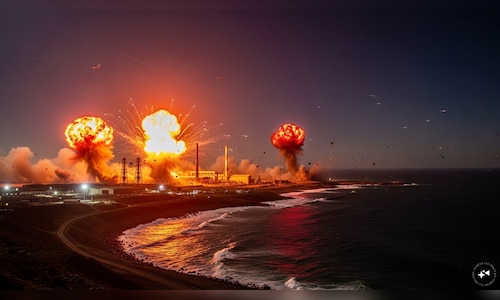
A US official informed Reuters that the four Iranian drones were aimed at regional maritime operations. U.S. Central Command announced on X that the US subsequently targeted Iran’s surveillance facilities in Goruk and Qeshm Island, both located on the Strait of Hormuz.
The US and Iran have been involved in mainly indirect discussions aimed at securing a temporary agreement to cease the three-month-old war, leaving contentious issues like Iran’s nuclear program for further dialogue.
As part of any accord, Tehran seeks access to billions in oil revenue, waivers on sanctions regarding crude exports, the lifting of a US blockade on its ports, and influence over the Strait. Iran has essentially blocked this critical waterway, through which roughly a fifth of the world’s oil passed before the conflict.
US President Donald Trump is under growing domestic political pressure to end the unpopular war, particularly due to rising gasoline prices. He stated in an NBC interview that, although most of Iran’s drone and missile production facilities have been dismantled, the Iranians still possess around twenty percent of their missile stock.
”They have some missiles, they have some drones. I would estimate that percentage wise, maybe 21%-22% of their missiles remain. It’s a significant quantity, but far less than before we initiated our attacks,” Trump said in an excerpt from NBC News’ ”Meet the Press” program released on Friday (June 5).
When questioned about why Iran’s leaders, if they are as desperate as he describes, aren’t more willing to negotiate, Trump responded:
”Because they are strong. They’re proud. There are actions they never imagined they’d resort to that they will have to take, they’ve got no choice, and it requires some time.”
The war was initiated by Israel and the US with strikes on Iran in late February.
FIGHTING FLARES ACROSS REGION DESPITE CEASEFIRES
In a concurrent conflict in Lebanon, the Iran-aligned militant group Hezbollah announced on Friday that it conducted two assaults on Israeli soldiers in southern Lebanon, including near the recently secured Beaufort Castle, while Lebanese security officials reported Israeli airstrikes targeting towns in the southern region.
Iran has reiterated its support for Hezbollah, demanding Israel pull out from southern Lebanon. Tehran has set a ceasefire between Israel and Hezbollah as a prerequisite for any peace agreement with Washington to resolve the regional conflict, now entering its fourth month, and to restart shipping through the Strait of Hormuz.
The latest clashes between Hezbollah and Israel began in early March, just two days after the US and Israel conducted strikes against Iran. Hezbollah claimed its actions were in solidarity with Tehran.
Hezbollah leader Naim Qassem this week dismissed a US-mediated agreement between Israel and the Lebanese government aimed at ceasing hostilities in Lebanon, as the deal did not stipulate an Israeli withdrawal, and Hezbollah had not participated in the discussions.
Israel has continued its airstrikes in southern Lebanon and asserted that its forces would neither withdraw nor cease operations in the area amid escalating tensions with the US.
Lebanon’s parliamentary speaker and Hezbollah ally Nabih Berri stated on Friday that he would consent to the group’s withdrawal from southern Lebanon if Israeli forces simultaneously exited the territories they occupy in the nation.
In addition to Lebanon, residents of Gaza, northern Israel, and Kuwait have faced attacks this week, despite US-brokered ceasefires that Trump characterized as involving “shooting in a more moderated manner,” rather than a complete cessation of hostilities.