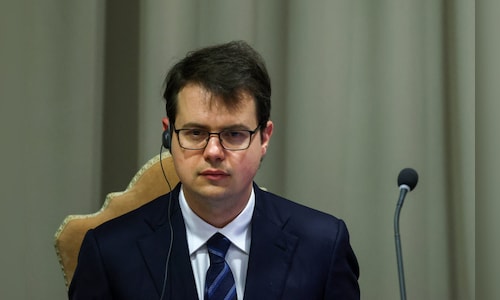
On Monday, the co-founder of AI firm Anthropic emphasized that the advancement of artificial intelligence should not rest solely on tech companies, calling for increased oversight from religious figures, governments, and civil society.
During the introduction of Pope Leo’s inaugural encyclical, which addresses the issues raised by AI, Chris Olah mentioned there is “a real possibility” that AI could lead to significant job displacement for humans.
“If that occurs, supporting those affected will be a moral obligation of historic proportions,” stated the Canadian, who was present with the pope.
He pointed out that companies like his operate under considerable commercial, geopolitical, and personal pressures that may not align with societal interests.
“Every leading AI lab functions within a framework of incentives and constraints that can occasionally clash with ethical practices,” he noted, adding that even researchers with good intentions can be swayed by these influences.
Olah emphasized the necessity for external oversight.
This event represented an unusual alliance between the tech industry and the Catholic Church, which has been striving to establish itself as a moral authority on the implications of swift advancements in AI.
SOLE BIG TECH REPRESENTATIVE AT THE VATICAN
Anthropic, established in 2021, is a US-based firm known for its Claude AI tools. It was founded by Olah and former staff members of OpenAI, the AI organization launched by Sam Altman and Elon Musk, among others, which is behind ChatGPT.
The Anthropic founders departed from their current rival out of concerns that OpenAI was progressing too quickly without adequate testing.
Anthropic has had disagreements with the Trump administration, particularly advocating for safeguards that limit how its models can be utilized in military contexts, such as autonomous weapon targeting or domestic surveillance.
When asked by Reuters why he was the sole Big Tech representative invited to the Vatican gathering, Olah referenced his long-standing commitment to AI safety and collaboration with religious groups.
“In the end, it’s up to the Vatican to decide who they invite,” he remarked, adding that his career has been dedicated to making AI systems safer and that he has interacted with over 15 religions regarding the technology’s implications.
‘A SCARY MOMENT’
In his speech, Olah praised the Church’s involvement with rapidly evolving technology, asserting that the ethical dilemmas posed by AI go well beyond technical considerations.
He noted that the public’s apprehension about AI, especially among the youth, is justified given the rate of its development.
“This is a frightening moment. Things are accelerating quickly. It’s a profoundly powerful technology,” he shared with Reuters.
“There is a risk that outcomes could turn negative, and it is our collective responsibility to steer this in a positive direction.”
Olah underlined three critical issues that demand immediate focus—the potential for widespread job losses, the importance of ensuring that AI benefits are globally accessible, and the ongoing challenge of understanding increasingly intricate and sometimes unclear system behaviors.
“The development of AI is concentrated in a small number of affluent countries. How can we guarantee that the advantages of AI are distributed worldwide?” Olah posed to the audience at the Vatican.