
Velamakanni noted that Fractal aims to boost its research and development (R&D) investments to 10% of revenue, up from the current 6.5%. This focus will be on foundation models, agentic artificial intelligence (AI) platforms, and enterprise AI transformation tools. He also mentioned an expectation of margin improvement as the company transitions more operations from input-centric models to output- and outcome-based ones, with revenue per employee expected to increase further as AI adoption expands.
Watch the full conversation here or scroll for edited excerpts.

In the January-March quarter of 2026 (Q4FY26), Fractal Analytics reported a sequential revenue increase of 3.7%, reaching ₹886 crore compared to ₹854 crore in the previous quarter. Earnings before interest, taxes, depreciation, and amortisation (EBITDA) surged 40% quarter-on-quarter (QoQ) to ₹180 crore from ₹128 crore, with EBITDA margin significantly expanding to 20.3% from 15.04%. Net profit rose by 14.8% sequentially to ₹117.8 crore, up from ₹102.6 crore.
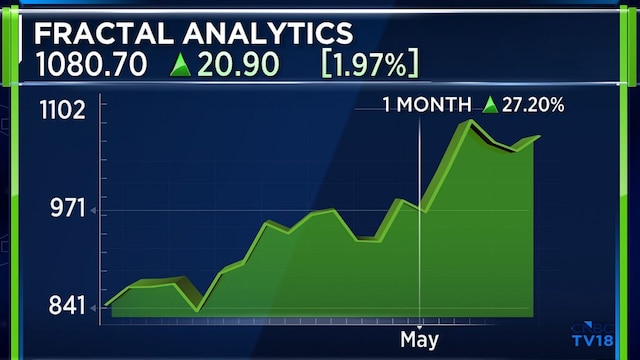
The Mumbai-based AI firm boasts a market capitalisation of approximately ₹18,512.04 crore, with its shares having increased almost 25% in the last month. Fractal Analytics was one of India’s first dedicated artificial intelligence companies to list on stock exchanges, debuting on February 16.
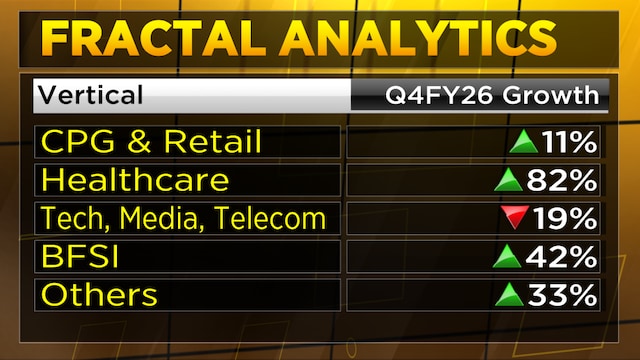
 This is an edited transcript of the interview.Q: It’s been a good quarter and a good year. For the full year, you have ended with 19% top-line growth, slightly lower than the 20%-plus run rate you were enjoying earlier. You flagged pressure in TMT clients, which led to a 19% drop in revenues for that vertical. Is that the only reason growth was lower, and what can you guide on those TMT clients?
A: We reported strong overall numbers — 19% growth for the year along with significant gross margin and profitability expansion. One recurring concern before and during our public market journey was about our ability to maintain long-term profitability. We’ve shown that sustainable profitability is indeed achievable.
Regarding TMT, we did face client-specific challenges that resulted in a decline within that vertical. If we exclude TMT, our annual growth would have been 27%, a commendable figure overall.
In TMT, one client formed a joint venture and significantly decreased their engagement with us, while another client undertook reorganisation efforts. Even with these challenges, we believe a 19% growth is still a strong outcome considering Fractal’s trajectory.
Q: Do those issues with the two TMT clients persist into FY27, and will there be a quantifiable revenue loss because of that?
A: Those issues have now cleared from the P&L. We don’t anticipate any further complications from those clients, so we expect to return to normalcy. This should positively influence our overall growth for this fiscal year.
Q: So, FY27 revenue growth should be better than FY26?
A: Yes, it should surpass FY26.
Q: You were investing around 6.5% of revenue into R&D, which is 100 basis points higher than before. Where will this number settle, and what exactly does R&D spending mean for a company like yours?
A: We plan to keep boosting our R&D investments beyond current levels, aiming for R&D expenditures to reach 10% of revenue. This would place us between service and product companies, as the latter typically allocate about 14% of revenue to R&D.
We intend to increase these investments while also enhancing gross margins. Part of the extra margin will be dedicated to R&D, while overall profitability continues to rise.
Also Read | AI-led pricing pressure to keep IT growth weak; worst yet to come: Fractal Analytics’ Velamakanni
Our R&D funds are earmarked for foundation models, agentic models, and our platform Cogentiq, which forms the basis for every transformation solution we offer. It serves as a multi-agent technology platform where AI agents work in collaboration to address complex business challenges with tools like machine learning algorithms and enterprise data.
Additionally, we’re developing foundation models such as our Vaidya medical model and the Asper platform, which facilitates revenue growth for consumer-packaged goods (CPG) companies. These represent the primary focus of our R&D spending.
Q: So, the increase from 6.5% to 10% in R&D spend is largely people-related expenses?
A: It’s partly people-related, but a significant portion also goes to computing expenses, data acquisition, data labeling, and platform development. Overall, it encompasses human resources, computing, data procurement, and the R&D team as well.
 Q: We are speaking on a day when OpenAI’s deployment company announcement is creating some flutter in IT services stocks. What are your thoughts?
A: Anthropic has announced its enterprise initiatives, and OpenAI has concurrently revealed its deployment plans. This illustrates the significant effort required for enterprises to extract value from AI.
The message from OpenAI and Anthropic is clear: models alone are insufficient. Enterprises must develop AI service capabilities to deploy these systems effectively at scale. This investment confirms the trajectory and growth potential for our sector, affirming that Fractal stands to benefit significantly from this evolution.
Q: Coming back to the numbers, if you want to increase R&D spend to 10%, you will need higher gross margins. What will gross margins need to look like to support that? Also, how much of the recent gross margin expansion came from pricing, outcome-based models, or productivity improvements?
A: Most margin growth has resulted from transitioning from input-based models to output- and outcome-oriented frameworks, which yield margins five to seven percentage points higher.
Licensed revenues generate even higher margins, sometimes 25-30 percentage points more. As we shift our mix from input-driven to output-driven models, that’s where we’re seeing gross margin leverage. Very little of this is due to pricing strategies or other factors.
We expect to maintain this shift, which will help us accelerate growth, enhance margins, and reinvest some of those gains into R&D.
Q: What percentage of revenues are currently input-based? That determines the headroom for this transition.
A: Currently, approximately 60% of our revenues stem from input-based models, while 40% are derived from output-, outcome-, and license-driven models.
We anticipate that the input-based portion will decline to 40% or even lower over time. This reflects the ongoing transformation.
Q: By when do you expect this transition?
A: We are aiming for a transition period of about three years. The exact timing will depend on our clients, as we prioritize a client-centric approach. However, we are starting with outcome- or output-driven models across the board.
Also Watch | Fractal Analytics sees 20% revenue growth as enterprise AI demand rises
Q: What kind of gross margin improvement can come from this shift?
A: An additional 20% shift in mix could lead to roughly a seven-percentage-point increase in margin on that segment, translating to around two to three percentage points of overall gross margin improvement.
Thus, a 48% gross margin could potentially rise to 51%.
Q: Revenue per billable employee has also been inching up by about 5%. With AI becoming much smarter, do you think this can rise to 10% year-on-year?
A: This is one of the most critical metrics for firms today—whether revenue per employee is on the rise. It indicates whether companies are leveraging AI effectively rather than being overtaken by it.
At Fractal, we foresee a continued increase in revenue per employee. Currently, it’s growing at 5%, but we believe this growth rate will accelerate in the coming years.
Catch all the latest updates from the stock market here