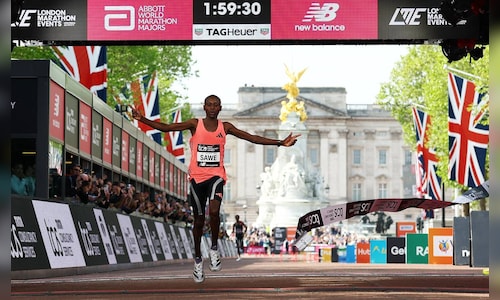
“What comes today is not for me alone,” Sawe remarked on his remarkable achievement, “but for all of us today in London.”
In an astonishing twist, the second-place finisher, Yomif Kejelcha from Ethiopia, also finished under 2 hours, clocking in at 1:59:41 during his first marathon. Jacob Kiplimo of Uganda also made headlines by breaking the previous world record set by Kenya’s Kelvin Kiptum in Chicago in 2023, finishing in 2:00:28, a seven-second improvement.
The 29-year-old Sawe, who defended his title in London, described it as a “day to remember for me” and expressed gratitude to the immense crowds that lined the streets of the British capital to support him.
“I think they help a lot,” he shared, “because if it was not for them you don’t feel like you are so loved … with them calling, you feel so happy and strong.”
In an exhilarating display, Sawe accelerated as the race progressed, completing the second half of the marathon in just 59 minutes and 1 second. He pulled ahead of Kejelcha after the 30-kilometer mark, making his decisive move in the final two kilometers, sprinting down The Mall to roaring cheers.
The quest to break the 2-hour mark in a marathon has been a long journey — though it has been achieved before.
When Eliud Kipchoge, the legendary Kenyan long-distance runner, accomplished this feat in Vienna in 2019, it took place during a specially organized event known as the 1.59 Challenge, created by British billionaire Jim Ratcliffe. This event featured optimal conditions on a 6-mile (9.6-kilometer) circuit, with rotating pacemakers assisting.
As such, Kipchoge’s time of 1:59:40 was not recorded as an official marathon record.
Nonetheless, Sawe surpassed this time by 10 seconds on a predominantly flat course in London under dry, sunny conditions.
“The goalposts have literally just moved for marathon running,” noted Paula Radcliffe, a former London Marathon champion, while commenting for the BBC.
At the start of the century, the record for the men’s marathon stood at 2:05:42, established by Khalid Khannouchi in Chicago in 1999.
Khannouchi improved his own record by four seconds in 2002 — the last occasion when the fastest men’s marathon was recorded in London. The record has been progressively lowered over the past 24 years by numerous Kenyan and Ethiopian athletes, including Haile Gebrselassie, Wilson Kipsang, Kipchoge, and most recently, Kiptum.
A new record was also set in the women’s race, with Tigst Assefa of Ethiopia breaking away with about 500 meters to go, winning in 2:15:41 and defending her title in the fastest-ever women’s-only marathon.
However, this time was 16 seconds slower than the course record of 2:15:25 set by Paula Radcliffe in 2003 during a mixed race.
In wheelchair races, Switzerland saw a double victory, with Marcel Hug earning his sixth consecutive men’s title — and eighth overall — while Catherine Debrunner edged out Tatyana McFadden in a close finish to retain her title.
(With AP inputs)