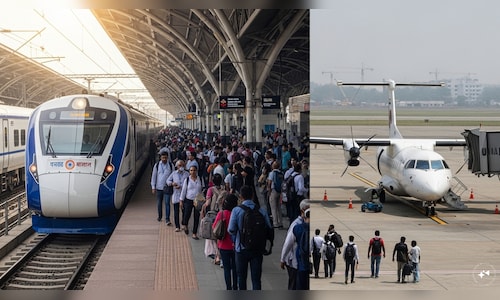
Vande Bharat experienced a remarkable year-on-year passenger increase of approximately 34%, with total passengers rising from 2.97 crore in FY25 to 3.98 crore in FY26.
The newly launched Vande Bharat Sleeper service, which started in January 2026, accommodated 1.21 lakh passengers over 119 trips within its initial three months, showcasing strong early interest in this new offering.
In a statement, the Ministry of Railways reported that since its inception in February 2019, the Vande Bharat Express has transported more than 9.1 crore passengers through one lakh trips.
In contrast, domestic aviation growth during the same timeframe remained modest. For the first 11 months of FY26, air passenger traffic saw a mere 1.6% year-on-year increase, reflecting a deceleration.
Crisil’s recent report indicates that air traffic in FY26 is anticipated to grow by 0–3% year-on-year, reaching between 165 and 170 million passengers.
The Government of India unveiled UDAN 2.0 on March 25, 2026, with a financial commitment of ₹28,840 crore aimed at developing 100 new airports and 200 helipads from FY27 to FY36, building on the foundations laid by UDAN 1.0, which had a budget of ₹8,523 crore implemented over FY17–26.
This analytics firm emphasized that UDAN 2.0 signifies a transition toward a more extensive regional aviation framework, encompassing airport development, operations and maintenance, helipad expansion, and support for airline sustainability.
Despite the expansion of infrastructure, UDAN routes currently represent only 2–3% of total domestic passenger traffic, indicating a limited effect on overall passenger volumes.
Among the airports supported by UDAN, only Hindon and Kannur surpassed one million annual passengers in FY26, driven by the enhancement of airline capacity deployment.
Data further shows that smaller regional airports experienced robust growth post-COVID from a low baseline, with some airports witnessing growth rates three to ten times higher between FY20 and FY25, in contrast to the overall passenger traffic growth of 1.2 times.