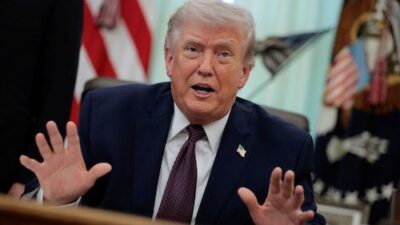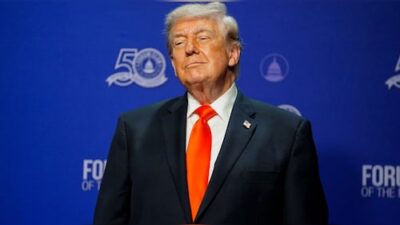
This week, Trump threatened to pull troops from the NATO ally after Chancellor Friedrich Merz stated that the US was being “humiliated” by Iranian leaders and criticized Washington’s strategy in the conflict.
Pentagon spokesman Sean Parnell remarked, “The decision follows a comprehensive review of the Department’s force posture in Europe and acknowledges the requirements and conditions in the theater.”
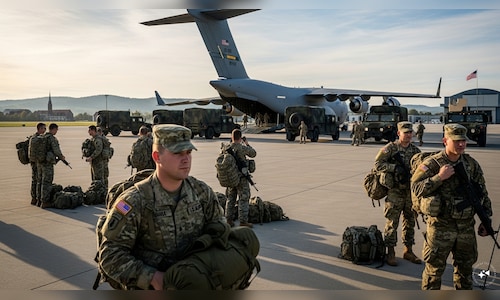
Germany hosts multiple US military installations, including the headquarters for European and Africa commands, Ramstein Air Base, and a medical facility in Landstuhl, where casualties from the conflicts in Afghanistan and Iraq have been treated. Additionally, U.S. nuclear missiles are stationed in the country.
The troop reduction would represent 14% of the 36,000 American service members currently based in Germany.
The announcement of the troop withdrawal faced immediate backlash from congressional Democrats and a hawkish think tank in Washington, who argued that it would benefit Russian President Vladimir Putin and undermine US security interests.
Sen. Jack Reed of Rhode Island, the top Democrat on the Senate Armed Services Committee, stated the withdrawal “implies that American commitments to our allies depend on the whims of the president.”
“The president must halt this reckless action immediately to prevent irreparable damage to our alliances and long-term national security,” Reed emphasized.
Bradley Bowman, a scholar at the Foundation for Defense of Democracies, noted that the U.S. military presence in Germany and elsewhere in Europe “not only enhances deterrence against further aggression from the Kremlin but also aids in projecting American military power into the Mediterranean, Middle East, and Africa.”
On Friday, as he boarded Air Force One in Ocala, Florida, following a rally promoting his economic agenda, Trump sidestepped questions from reporters regarding the troop withdrawal.
During his first term, Trump had made a similar threat, suggesting he would withdraw around 9,500 of the roughly 34,500 troops stationed in Germany at the time, but he did not initiate the process, and Democratic President Joe Biden formally halted the planned withdrawal shortly after taking office in 2021.
Trump has long contemplated reducing the American military footprint in Germany and has criticized NATO for not supporting Washington in the war, which commenced on February 28 with US-Israeli strikes on Iran.
On Wednesday, Trump stated on social media that the US was reviewing potential troop reductions in Germany, with a decision expected soon. The following day, he still focused on Merz, suggesting the German leader devote more attention to “ending the war with Russia/Ukraine” and “fixing his broken Country” rather than worrying about Iran.
Since Trump’s inauguration, NATO allies have anticipated a U.S. troop withdrawal, with Washington indicating that Europe will need to manage its own security, including that of Ukraine, moving forward.
Typically, around 80,000-100,000 U.S. personnel are stationed in Europe depending on operations, exercises, and troop rotations. NATO allies have been preparing for over a year for the eventual departure of U.S. troops deployed following Russia’s all-out war on Ukraine that began in February 2022.
Ed Arnold, a European security expert at the Royal United Services Institute (RUSI) in London, expressed that Europe is increasingly concerned about matters such as a potential U.S. redeployment of Patriot missile systems and ammunition from Germany to West Asia.
In October, the U.S. confirmed plans to decrease its troop presence along NATO’s borders with Ukraine. The decision to cut 1,500-3,000 troops was revealed with little notice, leading to unease in NATO ally Romania, where the military organization operates an airbase.