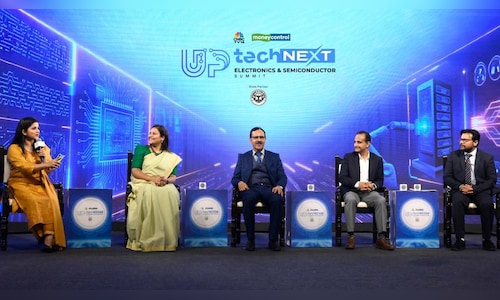
Building upon this rapid growth backdrop, Sunil Kumar Sharma, Minister for Information Technology & Electronics, Uttar Pradesh, shared tangible progress: land allocations for semiconductor facilities, secured central funding, and an expanding investor community. The state anticipates its first semiconductor unit to commence operations by 2027–28, representing a crucial shift towards decreasing reliance on foreign chips and facilitating large-scale employment.
Transitioning from sector initiatives to the broader economic vision, Awanish Kumar Awasthy, Chief Advisor to Chief Minister Yogi Adityanath, expanded the discussion around UP’s $1 trillion economic goal aligned with the Viksit Bharat vision. He highlighted growth in tourism, increasing revenues, AI and electronics initiatives, and enhanced inter-departmental collaboration as critical factors, emphasizing that the main challenge ahead is execution rather than funding.
With this strategic context in place, industry leaders from SEMI India, Micron, Kaynes, and Analog Devices combined realism with optimism. They acknowledged concerns regarding timelines but reiterated that semiconductors are a long-term industry. They illustrated how India is becoming a reliable manufacturing partner while emphasizing the necessity of bolstering R&D, university infrastructure, and developing a skilled workforce.
Adding a policy dimension to these industry insights, Dr. Sushil Pal, IAS, Joint Secretary, MeitY, outlined the focus of Semicon 2.0 on execution and value-chain development; other panels examined how chips are poised to revolutionize agriculture, cooperatives, transport, and digital services.
Rotating around the theme of future preparedness, the innovation-centered panel with Saankhya Labs, IndieSemiC, PwC, and UP Electronics Corporation acknowledged India’s talent but pointed out the need for a more robust risk-taking culture, IP generation, and a product innovation ecosystem. Their suggestions included fostering semiconductor startups, focusing on high-demand chip sectors like automotive, and enhancing digital capabilities in rural areas.
Throughout the discussions, the underlying message was clear: Uttar Pradesh is not only preparing to engage in India’s semiconductor journey but is also aiming to lead it. Fueled by policy initiatives, industry collaboration, and a growing innovation ecosystem, the state is carving out its role as a key player in the future of India’s semiconductor landscape.
Discover every insight, policy detail, and industry perspective by watching the complete summit here.