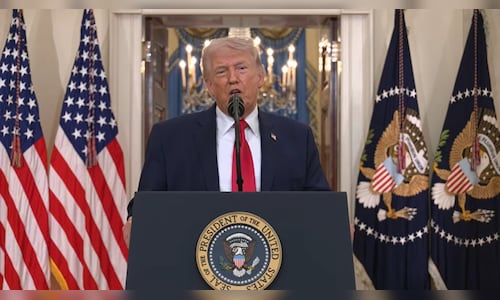
Earlier, President Trump stated on Friday, April 17, that the naval blockade against Iran will remain effective until a comprehensive agreement with Tehran is finalized.
The extension of the ceasefire occurs as the US and Iran are considering a second round of peace talks, following the unsuccessful first round of negotiations held in Islamabad.
Also Read: US-Iran fail to reach agreement in Islamabad peace talks, says JD Vance
In a post on Truth Social on Monday, April 20, Donald Trump remarked that the nuclear deal currently under negotiation with Iran would be “far better” than the 2015 Joint Comprehensive Plan of Action (JCPOA), which aimed at limiting Tehran’s nuclear program.
Announcement of the April 8 ceasefire
Trump announced on Wednesday, April 8 Indian Time, that he would suspend military actions against Iran for a duration of two weeks. He made the announcement on Truth Social, shortly after US market futures started trading on Wall Street.
Since the ceasefire began on April 8, he has consistently indicated that his administration is in discussions with Iranian officials interested in a deal.
Iran criticizes ceasefire tactic
An advisor to Iran’s parliament speaker and chief negotiator MB Ghalibaf accused Donald Trump of extending the ceasefire as a “ploy to buy time” for a potential surprise attack on Iran, as reported by Reuters.
In a post on X, the advisor stated that the ongoing US blockade on Iranian ports is “equivalent to bombardment” and should be met with a military response, indicating a significant escalation in rhetoric.
In a separate development, Iran’s Foreign Minister Abbas Araqchi declared that the US blockade of Iranian ports constitutes an “act of war” and a breach of the ceasefire, increasing tensions between both parties.
In a post on X on Tuesday, he asserted that Iran possesses the capability to counteract restrictions, safeguard its national interests, and resist what he characterized as coercive pressure.
Blockading Iranian ports is an act of war and thus a violation of the ceasefire.
Striking a commercial vessel and taking its crew hostage is an even greater violation.Iran knows how to neutralize restrictions, how to defend its interests, and how to resist bullying.
— Seyed Abbas Araghchi (@araghchi) April 21, 2026