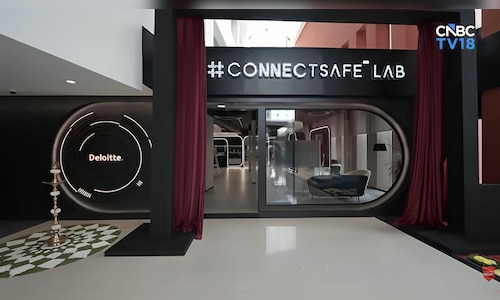
It is this transformation that Deloitte India’s ConnectSafe™ lab in Bengaluru aims to tackle, not as a theoretical model, but through an immersive environment where organizations can confront cyber risk before it manifests.
At its essence, the lab signifies a broader change occurring within Deloitte itself. The firm is actively redefining its role within a shifting business landscape. Romal Shetty, CEO of Deloitte South Asia, elaborates on this evolution, stating, “At Deloitte, we once operated under a framework called Imagine, Deliver, Run. Initially, we focused heavily on Imagine. Then, we transitioned to Deliver, which involves implementing solutions for clients. Now, however, clients expect us not only to implement but also to manage ongoing operations for them.”
In light of this shift from advisory roles to ownership, ConnectSafe™ stands as a cybersecurity initiative that exemplifies Deloitte’s movement towards outcome-driven, platform-centric solutions.
A New Risk Equation
What makes ConnectSafe™ particularly pertinent is the type of risk it confronts. As systems grow interlinked, vulnerabilities are no longer isolated; they ripple through entire ecosystems. Shetty encapsulates this stark reality by stating, “Cybersecurity used to focus solely on data. Nowadays, it can incapacitate a factory, disrupt power grids, or even affect medical outcomes.”
Within the ConnectSafe™ lab, these risks are simulated in real-world contexts—altered medical reports that could lead to incorrect treatments, compromised smart home systems that undermine consumer trust, and manipulated industrial controls capable of halting production lines.
These scenarios highlight a fundamental shift in cybersecurity, transitioning from an IT issue to a top-level priority that resides at the intersection of business continuity, customer trust, and enterprise value.
From Awareness to Experience
Although awareness of cyber risks has improved, a significant gap persists, particularly in how organizations comprehend and prepare for them. “Most companies may not even realize they’ve already fallen victim to a cyberattack,” Shetty observes.
ConnectSafe™ addresses this gap by advancing beyond audits and reports to experiential learning. Organizations can simulate tailored attacks, observe how vulnerabilities spread, and test responses in a controlled environment.
This method is crucial in industries where legacy systems exist alongside modern digital infrastructures. Manufacturing plants, for example, frequently operate with a combination of outdated operational technology and new IT frameworks, creating complex surfaces for potential attacks. The lab enables companies to visualize these interdependencies and redesign their security architectures accordingly.
Cyber as a Business Enabler
While ConnectSafe™ emphasizes experience, its foundational philosophy revolves around changing mindsets. Gaurav Shukla, Partner & Leader – Cyber, Deloitte South Asia, asserts, “The most significant misconception organizations have is that cybersecurity is merely an IT issue. That misconception is where trouble begins.” He suggests that, when approached effectively, cybersecurity can enhance business performance and foster growth. “Yet many organizations still haven’t fully embraced this shift,” he states.
Shukla’s viewpoint resonates with a growing consensus among business leaders. In an interconnected world, the ability to remain resilient and recover from disruptions serves as a competitive advantage.
When Digital Meets Physical
One of the most compelling features of ConnectSafe™ is its capacity to illustrate how digital vulnerabilities lead to physical consequences.
For instance, in the automotive sector, simulated attacks demonstrate how a connected vehicle might lose control, turning a cyber breach into a safety concern. In healthcare, altered diagnostic data underscores the risks of erroneous clinical decisions. In power systems, simulated breaches illustrate how cyberattacks can trigger widespread outages.
These examples highlight an essential point, as emphasized by Shukla: “Cybersecurity is no longer just about data theft or financial risks. It can directly affect safety and human lives.”
This convergence of cyber and physical risks renders traditional approaches inadequate and calls for a new framework that integrates security into every phase of the product or service lifecycle.
Build, Test, Transform
At the core of ConnectSafe™ lies the straightforward yet impactful methodology of ‘build, test, fix, transform’. Organizations can replicate their environments, analyze vulnerabilities, apply fixes, and subsequently translate those insights into real-world systems. This iterative approach ensures that cybersecurity is not merely a one-off effort but a continual capability.
Equally crucial is the principle of secure by design. As Shukla notes, “If you address an issue at the design phase, the cost is minimal. By the time it reaches production, it becomes exponentially more expensive.” For CEOs and CTOs, this technical perspective serves as a strategic directive.
The Future of Cybersecurity
ConnectSafe™ epitomizes a response to the changing nature of business itself. As industries become increasingly interconnected, resilience will emerge as the key metric of success. For Shetty, the lesson is evident: “I don’t view cybersecurity as a cost; it’s a critical business necessity.”
In a realm where disruptions can stem from various sources—from cyberattacks to geopolitical events—the capacity to anticipate, respond to, and adapt is what distinguishes resilient organizations from the rest. ConnectSafe™ aims to render risk visible, tangible, and manageable, transforming cybersecurity from a defensive necessity into a strategic asset.