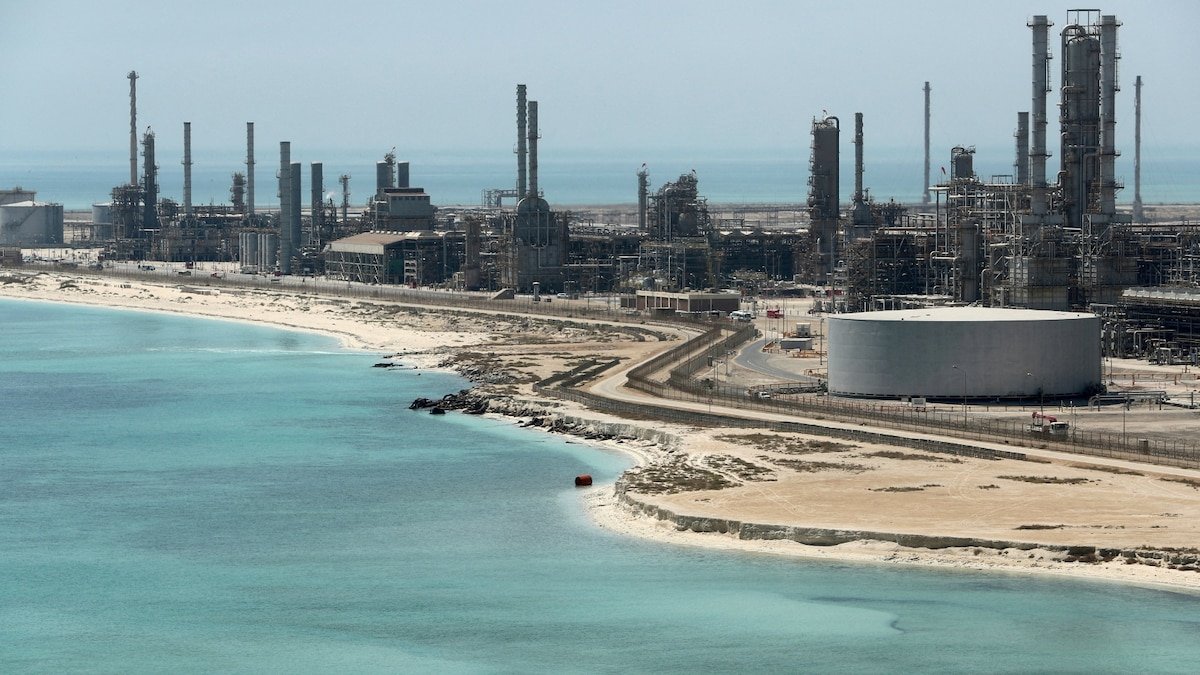
On Saturday, satellite imagery indicated that five very large crude carriers were docked at Yanbu’s oil-loading terminals, potentially marking it as the most active day since the Iran-backed Houthi rebels established a blockade on Saudi ports two weeks prior. These images were captured by the European Union’s Sentinel 2 satellite, which surveys the region only every few days.
Yanbu has become essential to Saudi Arabia’s strategy for maintaining large volumes of crude shipping after conflicts affected traffic through the Strait of Hormuz. The kingdom has circumvented the waterway by transferring millions of barrels daily to the Red Sea for global export. A VLCC has the capacity to hold roughly 2 million barrels.
In a separate development, the Greek-operated Suezmax Lesvos and the India-flagged VLCC Desh Vaibhav passed through Bab el-Mandeb over the weekend, transporting Saudi crude loaded at Yanbu with their transponders turned off, as reported by analytics firms Vortexa and Kpler. The ships have since reappeared in waters off Oman after previously transmitting their locations near the Red Sea port, according to ship-tracking data.
Read Also: Explained – What triggered the first US-Japan joint intervention in 15 years to save the Yen
Some tankers continue to openly transit through Bab el-Mandeb, including those carrying Russian crude. However, the Houthi threat has compelled certain Saudi vessels to opt for longer routes around Africa, leading the kingdom to reroute some oil shipments destined for Asia from the Red Sea to Egypt’s Sidi Kerir along the Mediterranean coast.
Late last week, a liquefied natural gas tanker carrying a shipment from Qatar was hit by a projectile while navigating the Strait of Hormuz, highlighting the safety concerns for shipowners in the area. On Monday, visible traffic through the chokepoint was minimal.
Nevertheless, crude is still leaving the Persian Gulf, predominantly on tankers that have deactivated their transponders. On Friday, over 8.4 million barrels exited the gulf, representing one of the highest daily flows since the Iran conflict began at the end of February, based on ship-tracking data.