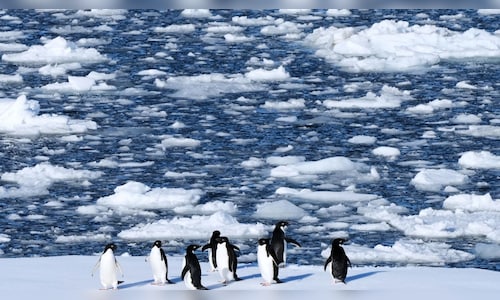
Although the current number of visitors remains modest—largely due to steep costs and lengthy travel times—they are increasing rapidly, prompting alarm among scientists and environmentalists.
A serious outbreak of the rare hantavirus on a Dutch vessel during an extended polar cruise has highlighted the burgeoning trend in tourism.
Most journeys are directed toward the Antarctic Peninsula, recognized as one of the fastest-warming regions globally. From 2002 to 2020, approximately 149 billion metric tons (164 billion tons) of Antarctic ice melted annually, according to the National Aeronautics and Space Administration.
A typical route involves traveling from Argentina southward before proceeding north along the African coast, similar to the path taken by the cruise ship MV Hondius.
“The sites you will witness in Antarctica are incredibly unique and cannot be found anywhere else on Earth—the whales, the seals, the penguins, the icebergs—it’s all breathtaking and leaves a lasting impression,” stated Claire Christian, executive director of the environmental organization Antarctic and Southern Ocean Coalition.
In 2024, over 80,000 tourists landed on the expansive ice-covered continent and 36,000 viewed it safely from their ships, according to the International Association of Antarctica Tour Operators.
The International Union of Concerned Scientists estimates that Antarctic tourism has increased tenfold over the past 30 years.
This figure may continue to grow in the forthcoming decade as prices decline with the introduction of more ice-capable vessels and advancements in technology, according to Hanne Nielsen, a senior lecturer in Antarctic law at the University of Tasmania. Her colleagues estimate the annual number could triple or quadruple, surpassing 400,000 visits in that period.
Some travelers pursue “last chance tourism,” realizing the rapidly changing landscape is melting away, Nielsen noted.
Thus far, officials have indicated no evidence of contamination linked to the MV Hondius.
However, flocks of migrating birds have carried avian flu from South America to Antarctica in recent years, as noted by the U.S. Centers for Disease Control and Prevention.
This outbreak has prompted the International Association of Antarctica Tour Operators and others to tighten regulations regarding tourist behavior and hygiene to safeguard visitors from potential contamination. To shield the delicate ecosystem from invasive species, whether large or microscopic, tourists are advised to maintain distance from wildlife and to avoid making contact with the ground beyond what their feet require.
“There are rules that travelers must adhere to when heading south,” Nielsen remarked, reflecting on her experiences as a former guide. Crew members and passengers utilize vacuums, disinfectants, and brushes to clean their shoes and gear of insects, feathers, seeds, and dirt that carry microbes.
“A lot can be found between the tongues and laces of boots,” she pointed out.
Cruise ships have faced outbreaks of diseases such as norovirus, which can quickly spread in close quarters. In 2020, a COVID-19 outbreak aboard the Diamond Princess turned the vessel into an incubator for the then-unknown virus.
Hantavirus typically spreads through inhaling contaminated rodent droppings.
The World Health Organization announced Tuesday that the MV Hondius departed from Ushuaia, Argentina, on April 1, visiting Antarctica and several remote islands.
WHO is investigating potential human-to-human transmission aboard the cruise ship, said Dr. Maria Van Kerkhove, WHO’s director of epidemic and pandemic preparedness. Officials suspect the initial infected individual likely contracted the virus prior to boarding, and they have been informed that no rats are present on the ship.
Antarctica is governed by the Antarctic Treaty, which established the region as a scientific reserve for peaceful purposes in 1959. A series of subsequent rules aim to ensure that all visits, irrespective of location, do not adversely affect the Antarctic environment or its scientific and aesthetic values, according to the treaty’s secretariat.
Companies and scientific projects voluntarily adhere to biosecurity protocols and submit environmental impact assessments for operations in Antarctica.
The treaty was formulated when tourism numbers were significantly lower, Christian noted.
“Activities need to be appropriately regulated, similar to any of the world’s sensitive and invaluable ecological areas,” Christian stated from Hiroshima, Japan, where she was preparing for an Antarctic Treaty Consultative Meeting. There, she will advocate for stronger protections for Antarctica’s penguins, whales, seabirds, seals, and krill—tiny organisms at the foundation of the food web.
Meanwhile, the appeal of this frozen frontier continues to attract visitors.
“You can leave a footprint in Antarctica, and it remains for 50 years,” Christian remarked.
Also Read: India’s ‘situational traveller’ is forcing a hospitality reset